
This article was written by AI.
Or maybe it wasn’t.
Maybe I wrote every sentence and asked AI to critique the structure, tighten the prose, and suggest a better title? Maybe AI wrote the first draft and I rewrote most of it. Maybe it only fixed a few commas.
Can you tell?
Increasingly, the answer is no. And more importantly—does it matter?
The internet has entered its processed food era. For the past few years we’ve argued about whether AI-generated writing is authentic, whether it lacks soul, and whether it will destroy journalism, marketing, blogging, or literature. But those debates miss the more interesting question.
The question isn’t who wrote it? It’s whether it accomplished what it needed to accomplish.
Even if you proudly proclaim that every word on your website was handcrafted, there’s a good chance AI was involved somewhere.
Was AI used to research the market, identify your audience, organize your outline, edit your draft, or brainstorm your title? You may not have asked it to write, but you almost certainly asked it to think alongside you.
And your audience? They’re probably seeing your words through an AI lens.
Your article may first appear as an AI-generated search summary, an email preview, a chatbot response, or a three-bullet synopsis before anyone ever clicks the link. The first version of your idea that reaches the reader is likely a remix.
Maybe writing has always been remixing?
Which author invents language? Every sentence is assembled from books we’ve read, conversations we’ve had, teachers we’ve learned from, and ideas we’ve forgotten we borrowed. Human creativity has always been recombination. AI simply recombines faster.
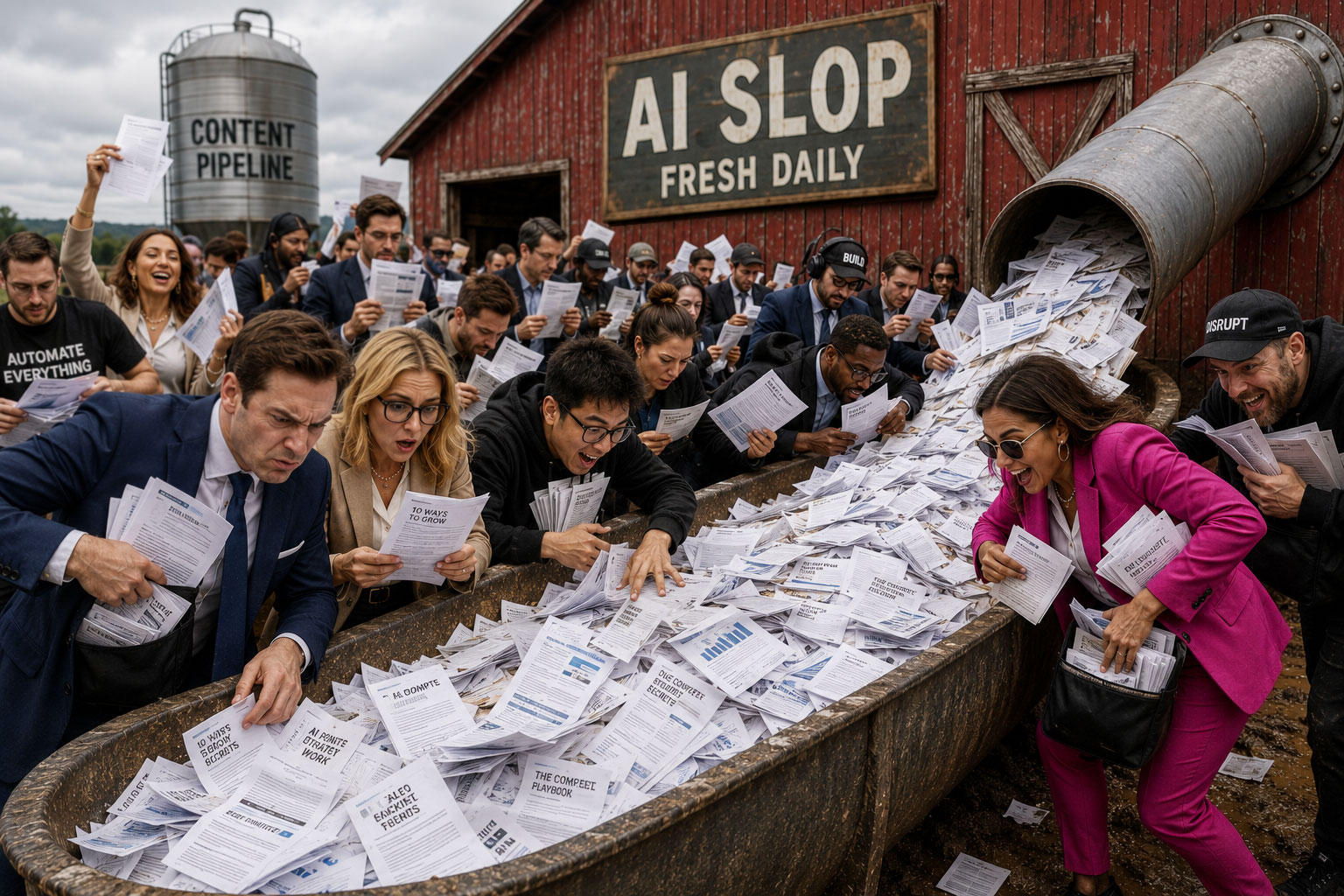
People love to dismiss AI output as “slop.” Sometimes it absolutely is. But we can all agree that so are most of the blog posts, corporate mission statements, and LinkedIn think pieces written by humans. Hot take: has anyone ever written an NDA? AI didn’t invent mediocre writing, it just buried the template and made producing mediocre writing faster.
This is what happens whenever something becomes a commodity.
Hungry for more?
McDonald’s didn’t kill the hamburger. It industrialized it. The result was cheap, predictable, and available almost everywhere. And many people might argue that the average burger declined as a result.
Yet, there has never been a better time to find an incredible burger.
The existence of the Big Mac didn’t eliminate craftsmanship. If anything, it made craftsmanship easier to recognize. Today you can buy a dry-aged wagyu burger on a fresh brioche bun with house-made pickles for $25+, or you can buy a fast food burger for $1.
They aren’t the same product.
And here’s the uncomfortable truth: They serve the same need.
I eat fast food burgers. Not because I think they’re the best burger, but because they often solve the exact problem I have: I’m hungry, I’m in a hurry, and I know exactly what I’m getting. Mission accomplished.
Writing is following that same trajectory.
Some writing exists to inspire, entertain, challenge ideas, or become art. Other writing exists because someone wants to know how to reset their Wi-Fi router or compare two website building platforms. Those are different jobs, and they deserve different tools.
The businesses winning with AI aren’t producing the most words. They’re producing the most useful outcomes. Readers have never rewarded effort—they reward value. Nobody cares how many hours you spent writing documentation if it doesn’t answer their question quickly and efficiently. Likewise, nobody cares if AI drafted your FAQ if customers immediately find what they need.
Utility has always mattered more than process. AI just makes that harder to ignore.
So yes, this article may have been written by AI. Or perhaps it was written by a human using AI. Or perhaps another AI will summarize it into four bullet points before you finish reading, and a different AI will quote those bullets to answer someone else’s question tomorrow.
Ideas will continue to be remixed. Language will continue to be compressed. The pipeline between author and reader will increasingly be filled with machines.
The interesting question isn’t whether the content is slop.
It’s whether it fed someone.
Because if it solved the problem the reader showed up with, maybe that’s exactly what it was supposed to do.
Now if you’ll excuse me, I’m going to get lunch.