A workflow automation consultant maps your repetitive work, decides what should stay human, and builds reliable automations around the rest, usually cutting hours of manual work per week and closing off common error points. Most engagements start the same way:
a short process audit that shows exactly where the fastest payback is hiding. If your team is drowning in manual handoffs, duplicate approvals, or spreadsheet chasing, that audit is the right first call to make.
TL;DR:
- The most valuable automation opportunities often come from process audits that identify manual handoffs, duplicate approvals, and spreadsheet bottlenecks.
- Consultants focus on process discovery, decision logic, and handover documentation, ensuring automations are reliable and maintainable after deployment.
- Key costs include pilot projects in weeks, departmental builds in months, and enterprise orchestration taking longer due to governance and testing demands.
- ROI should be measured through hours saved, error reduction, and cycle time improvements, with follow-up metrics reported monthly after launch.
- Engaging with experienced, outcome-focused consultants who provide clear KPIs and thorough handovers reduces risks and ensures long-term automation success.
Table of Contents
- What Workflow Automation Consultants Actually Do
- Most In-Demand Services From Automation Consultants
- How to Choose and Hire the Right Consultant
- The Typical Engagement: From Audit to Deployment
- Costs, Pricing Models, and What ROI Actually Looks Like
- Real Outcomes and What to Ask Bowtie to Prove
- When to Hire a Consultant vs. Build In-House
- How Bowtie Turns This Into a Working System
- Sources
- FAQ
What Workflow Automation Consultants Actually Do
A workflow automation consultant’s job isn’t installing software. It’s figuring out which parts of your operation are wasting the most human time, then engineering a system that removes that waste without breaking anything downstream. That distinction separates real consulting from a vendor who shows up, connects two apps, and leaves.
The work starts with process discovery: watching how tasks actually move through your team, not how the org chart says they should. Consultants who skip this step tend to automate the wrong thing entirely, which is why Consultport’s service pages and most serious agencies treat audit-first mapping as the non-negotiable opening move. Time-motion analysis, tracking exactly how long a task takes and where it stalls, tells you whether automation will save five minutes or five hours per cycle.

From there, the consultant makes a call that a lot of businesses get wrong on their own: deciding what stays human versus what gets automated. Judgment calls, relationship management, and anything with legal exposure usually stay with a person. Repetitive data entry, status checks, approvals with clear rules, and notifications are prime automation targets.
A competent workflow automation consultant typically delivers:
- Process maps showing every step, handoff, and decision point in the current workflow
- Decision logic and exception handling so the automation knows what to do when a case doesn’t fit the standard path
- SLA definitions for how fast each automated step should complete and what happens if it doesn’t
- Tool selection, choosing between low-code platforms, robotic process automation (RPA), custom API integrations, or AI-assisted steps based on complexity
- Runbooks and dashboards your team can actually operate after the consultant leaves
That last point matters more than most businesses realize going in. Practitioner guidance on workflow architecture consistently stresses versioned runbooks and measurable KPIs handed over at project close, not locked inside a consultant’s head. AI steps get folded in selectively rather than everywhere. Not every task needs a language model deciding its outcome. Some just need a trigger and a rule.
Most In-Demand Services From Automation Consultants
Businesses hiring a workflow automation consultant tend to request the same handful of services, in roughly this order of priority:
- Process audit and bottleneck analysis. This is the diagnostic phase, identifying which workflows cost the most time or generate the most errors before anything gets built.
- Workflow design and orchestration. For processes crossing multiple systems or teams, consultants may use formal notation like BPMN or DMN to map decision logic clearly. UiPath’s orchestration tooling is built specifically for coordinating robots, AI agents, and people inside one governed flow, and it’s worth understanding when a process is complex enough to justify that layer versus a simpler build.
- Systems integration and data synchronization. Most inefficiency lives in the gaps between tools, one system that doesn’t talk to another, forcing someone to copy data by hand.
- Automation builds. This is the actual construction, using low-code platforms, RPA bots, API connections, or custom code depending on what the process demands. Microsoft’s Power Automate is a common example of a connector-rich platform consultants integrate into a client’s existing stack rather than build from scratch.
- AI-assisted steps and ongoing monitoring. Once live, automations need someone watching for drift, failures, and edge cases the original design didn’t anticipate.
Agency service listings, including Make It Future’s workflow consulting page, show these five items as the recurring core offering across the industry. What varies is depth: a small business might need one or two of these; an enterprise rollout typically needs all five running in sequence.
How to Choose and Hire the Right Consultant
Picking the wrong automation partner is expensive in a way that’s easy to miss upfront. You don’t just lose the project fee. You lose months while a brittle system quietly breaks and nobody trusts automation enough to try again. A few criteria separate consultants worth hiring from ones to avoid.
Look for measurable outcome commitments (time saved, error rate reduction, cycle time), documented tooling experience with the platforms your stack actually uses, a track record of clean integrations rather than one-off scripts, and a clear handover plan with documentation. Security and governance should come up unprompted, not as an afterthought when you ask.
Ask these questions in the first conversation:
- How will you measure success on this project, specifically?
- What’s the rollback plan if an automated step fails in production?
- Who owns the credentials and API keys once the project ends?
- What does ongoing maintenance cost, and what’s the response time in the support agreement?
Pro Tip: Ask any candidate to walk you through a project that failed or underperformed. A consultant who can’t name one is either inexperienced or not being honest with you.
Red flags show up early if you’re watching for them: no audit phase before jumping to a build, guarantees offered without any defined KPI to measure against, pricing that stays vague until a contract lands on your desk, and a consultant who pushes one platform for every problem regardless of fit. That last one usually means a reseller relationship, not independent advice.
Engagement models scale with company size. Small businesses generally do better with a fixed-scope pilot targeting one painful process. Mid-market teams often need a phased rollout across departments. Enterprises usually require a longer discovery period and a governance layer before any automation touches production data. Reviewing a software partner selection framework before you sign anything helps you avoid the most common vetting mistakes.
The Typical Engagement: From Audit to Deployment
Most credible engagements follow the same five phases, whether the project takes three weeks or six months.
- Discovery and data collection. Before the first meeting, gather your current process documentation (even informal ones), a list of tools involved, and rough volume numbers, how many times per week or month this process runs. Consultants use this to size the opportunity before proposing anything.
- Design and validation. This phase produces process maps, decision tables, and the KPIs you’ll use to judge success later. Centralizing data into a single source of truth, an Airtable base, a proper database, or an existing CRM, is a common recommendation here, since automations built on scattered data sources tend to break first.
- Build and test. Development happens in a staging environment separate from production. User acceptance testing (UAT) and a documented rollback strategy come before anything touches live data.
- Deploy and monitor. Launch includes runbooks for your team, error handling rules, and a monitoring plan that flags failures before customers or staff notice them.
- Iterate. Almost no automation is perfect on day one. Expect a review cycle in the first 30 to 60 days to tighten exception handling.
Timelines vary by scope. Consulting practitioners generally place small pilots at a few weeks, mid-market rollouts at one to three months, and enterprise orchestration projects, especially ones involving BPMN-level coordination across departments, at several months or longer.
Costs, Pricing Models, and What ROI Actually Looks Like
Pricing shows up in four common shapes: fixed-price pilots for a single well-defined process, time-and-materials for open-ended discovery work, monthly retainers for ongoing support and iteration, and, less commonly, outcome-based pricing tied to a specific metric like error reduction.
Conservative ballparks look roughly like this:
- Single-process pilots tend to run smaller and faster, often wrapped in a few weeks
- Full departmental builds involve more integration work and testing, extending the timeline into months
- Enterprise orchestration spanning multiple systems and teams carries the highest cost and the longest build, given the governance and testing requirements involved
The ROI math is simpler than most businesses expect. Multiply the hours reclaimed per week by the hourly cost of the staff doing that work, then compare it against the project fee to find the payback period. A process that consumes 10 hours a week of a $40 hourly employee’s time represents $400 a week, or roughly $20,800 a year, in reclaimed capacity once automated. Add error-avoidance value (rework costs, compliance risk, customer complaints) and the number usually grows further.
A step-by-step automation checklist built for small businesses is a useful gut check before committing budget, since it forces you to quantify the current cost of manual work before you pay someone to remove it.
Pro Tip: Ask your consultant to report three numbers monthly after launch: hours saved, error rate, and cycle time. If they can’t produce those, you’re not getting a real accounting of the project’s value.
Real Outcomes and What to Ask Bowtie to Prove
The outcomes worth expecting from a well-run engagement are consistent: measurable hours reclaimed each week, a documented drop in manual errors, and faster cycle times on the specific processes targeted. What varies is how much of that value survives past the first three months, and that comes down to documentation and support, not the initial build.
Bowtie approaches this the way enterprise-grade guidance recommends: audit first, automate selectively, and hand over systems your team can actually run without calling a consultant every time something changes. Relevant capabilities include:
- AI agent creation and workflow automation for processes where decision logic benefits from AI, gated with fallback rules rather than blind automation
- AI code reviews and optimization for teams that inherited automation built by a previous vendor or generated with AI tools and need it stabilized
- Continuous monitoring and support so automations don’t silently degrade months after launch
When evaluating any proposal, including Bowtie’s, ask for sample KPIs the consultant has reported on past work, a runbook example so you know what handover actually looks like, and the specific terms of the support plan after go-live. A code audit before a new automation build often catches integration risks that would otherwise surface as production failures later, which is cheaper to fix on paper than in a live system.
When to Hire a Consultant vs. Build In-House
The decision usually comes down to three things: how fast you need ROI, how complex the process is, and whether your internal team has actually shipped automation before. If speed matters and the process crosses more than two systems, hire a consultant. If your team has bandwidth and this is the first of many automations you’ll build, investing in internal capability pays off over time. Most businesses underestimate the complexity threshold and overestimate their internal maturity.
— Chad
How Bowtie Turns This Into a Working System
A direct alternative to hiring a generalist agency for automation work is to engage engineers who audit first, build with production security in mind, and stay on after launch instead of disappearing once the invoice clears. That last part is where most automation projects quietly fail, not at launch, but three months later when nobody’s watching the system.
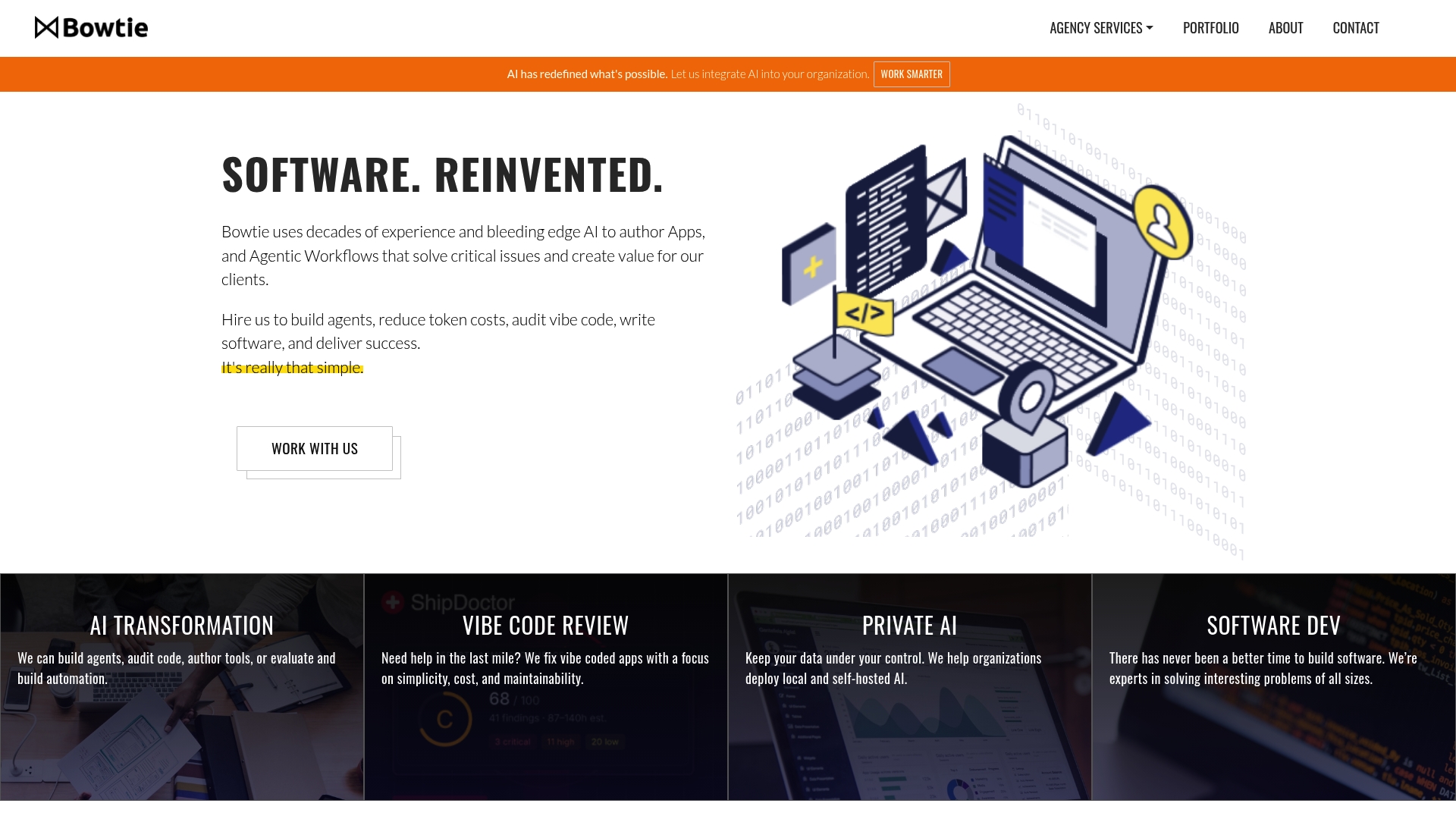
Bowtie’s relevant services include AI agent creation and workflow automation, code audits for automations built by a previous vendor or generated with AI tools, and ongoing monitoring so exception handling gets smarter as your process changes. Starting is simple: a discovery call or a scoped pilot targeting your highest-friction process gives you a working example before you commit to anything bigger.
An initial proposal typically includes a process map, a defined KPI set (hours saved, error rate, cycle time), and a clear handover plan so your team isn’t dependent on outside help forever. If you already suspect your process is bigger than a quick fix, Bowtie’s pricing page lists specific engagement types, including a Senior Developer Review starting at $449, so you can see what a real scope actually costs before you talk to anyone.
FAQ
What Does an Automation Consultant Do?
An automation consultant audits your existing workflows, identifies which steps waste the most time or produce the most errors, and designs and builds automated systems to fix them. The work includes process mapping, tool selection, decision logic design, and handover documentation so your team can run the system after launch, as outlined in Consultport’s service descriptions.
How Much Does Workflow Automation Cost?
Costs depend heavily on pricing model and scope: fixed-price pilots targeting one process cost less than full departmental builds, and enterprise orchestration projects cost the most due to added governance and testing. Bowtie’s Senior Developer Review and full AI-assisted engineering engagements start at prices published on their pricing page, giving concrete reference points for scoping your own budget.
What Is the Highest Paid Type of Consultant?
Pay varies widely by specialty, industry, and geography, and no single consulting category holds a universal top rank. Within technology consulting specifically, specialists who combine deep integration experience with AI-assisted process design, the kind of work a workflow automation consultant does, tend to command higher rates than general process consultants because the skill set is scarcer.
What Does Workflow Automation Do?
Workflow automation replaces manual, repetitive steps in a business process with software-driven rules, triggers, and integrations, cutting the time and error rate involved in tasks like data entry, approvals, and status updates. It works best when paired with clear decision logic and monitoring, rather than simply automating a broken process as-is.
How Long Does a Typical Automation Project Take?
Small pilots targeting a single process often wrap up in a few weeks, while mid-market rollouts across departments typically take one to three months. Enterprise orchestration projects spanning multiple systems and teams can take several months, largely due to added testing and governance requirements noted by practitioner consultants.