
Technical debt remediation is the disciplined process of identifying, measuring, prioritizing, and fixing the shortcuts buried in your codebase, and the goal isn’t a spotless repo. It’s restoring delivery velocity and cutting operational risk. The single most important move you
can make this quarter is making debt visible and giving it a permanent seat at the budgeting table.
Accenture’s research on 1,500 companies found that organizations setting aside roughly 15% of IT budget for modernization see measurably better agility. Do this now:
- Build a debt inventory tagged by module, origin, and business impact
- Assign an owner to every high-churn, high-complexity area
- Lock in 10 to 20% of sprint capacity for remediation, every sprint, no exceptions
Key Takeaways
Technical debt remediation succeeds when teams measure debt with concrete metrics, prioritize using a repeatable framework like PAID, and fund the work with a steady capacity allocation instead of sporadic effort.
| Point | Details |
|---|---|
| Measure before fixing | Track Technical Debt Ratio, PR cycle time, and defect density to find real hotspots. |
| Prioritize with PAID | Sort debt into Prioritize, Address, Investigate, or Document based on business impact. |
| Fund it steadily | Allocate 10 to 20% of sprint capacity every sprint rather than running occasional debt quarters. |
| Watch AI-specific debt | Tag PRs by origin and add comprehension tests to catch debt generated by coding assistants. |
| Get an outside audit when stuck | Bowtie’s code audit process scores debt by severity and business impact and builds a phased remediation plan around it. |
Table of Contents
- What Is Technical Debt Remediation and When Should You Start?
- How Do You Measure Technical Debt Objectively?
- Which Framework Should Decide What Gets Fixed First?
- What’s a Practical Remediation Tactic Playbook?
- How Does AI Change What Counts as Technical Debt?
- How Do You Turn Remediation Into a Lasting Program?
- Which Tools Actually Move the Needle on Remediation?
- What Does a Real Remediation Roadmap Look Like?
- Why Most Remediation Plans Quietly Fail
- Get a Remediation Partner Who Ships Fixes, Not Just Reports
- Frequently Asked Questions About Technical Debt Remediation
- Sources
What Is Technical Debt Remediation and When Should You Start?
Remediation isn’t the same as general code cleanup. Code quality issues are stylistic. Technical debt is a shortcut with a deferred cost, one that compounds interest the longer it sits.
The categories break down cleanly:
- Intentional debt: You shipped fast on purpose, skipping a proper caching layer to hit a launch date.
- Unintentional debt: A junior engineer duplicates logic across three services because nobody documented the shared library.
- Environmental/architectural debt: Your monolith grew module dependencies nobody mapped, so a database migration now touches nineteen files.
- AI-specific debt: A coding assistant generates a working function that nobody on the team can explain six weeks later.
A fintech app might carry unintentional debt in its reconciliation logic. A healthcare platform might carry architectural debt in a patient record schema nobody has touched since 2019. The category matters because it determines the fix, not just the fire drill.
How Do You Measure Technical Debt Objectively?
You can’t prioritize what you can’t quantify. Start with Technical Debt Ratio (TDR), the estimated cost to fix issues divided by the cost to build the code, expressed as a percentage. Pair it with duplication percentage and cyclomatic complexity scores, which flag the modules most likely to break under change.
Delivery metrics tell the other half of the story. Rising pull request cycle time, a climbing mean time to restore (MTTR), or defect density spiking in a specific service usually points straight at debt hotspots.
| Metric | What It Signals | Healthy Target |
|---|---|---|
| Technical Debt Ratio | Remediation cost vs. build cost | Under 5% |
| PR cycle time | Review and merge friction | Trending flat or down |
| MTTR | Speed of incident recovery | Under 4 hours for critical services |
| Defect density | Bugs per KLOC in a module | Below team baseline |
| Onboarding time | New-hire ramp to first merge | Under 2 weeks |
Pro Tip: Run a query pulling PR cycle time by service for the last 90 days before you write a single remediation ticket. The module with the worst trend line is almost always your first target, and you’ll have the data to defend it in planning.
Which Framework Should Decide What Gets Fixed First?
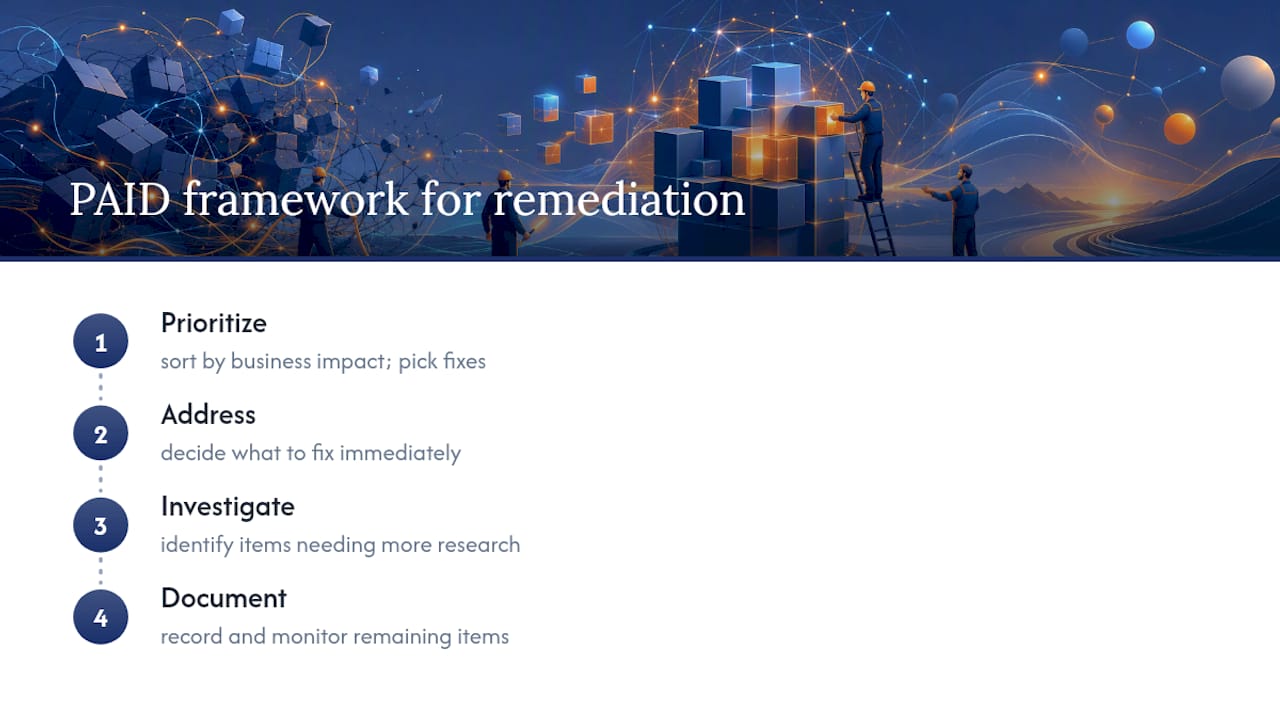
The PAID framework from MIT Sloan gives leaders a four-way sort that keeps debt conversations out of gut-feel territory:
- Prioritize: High business impact, high risk. Fix now.
- Address: Moderate impact. Schedule into the next two sprints.
- Investigate: Unclear impact. Spend a timeboxed spike to find out.
- Document: Low impact, low risk. Write it down and move on.
Layer cost-of-delay scoring on top. Ask three questions for each debt item: how much revenue or velocity does this cost per month it sits unfixed, how strategically aligned is the fix with next year’s roadmap, and does the risk compound (does it get worse the longer you wait)?
- Score each item 1 to 5 on business impact, urgency, and compounding risk
- Multiply the three scores for a composite priority number
- Slot anything above your team’s threshold into the next planning cycle, and document the rest
High-interest-first thinking, treating debt like a loan where some items accrue cost faster than others, keeps this from turning into a popularity contest between teams.
What’s a Practical Remediation Tactic Playbook?
Fixing debt without stalling feature work comes down to sequencing. Here’s a tactical order that works across most stacks:
- Build a golden-path CI/CD pipeline. Automate the deploy path for your most common change type so engineers stop hand-rolling releases.
- Add smoke tests to revenue-critical flows first. Checkout, login, and billing break the business when they break; test those before anything else.
- Document the scary parts. Every codebase has a module nobody wants to touch. Write down what it does and why, even roughly, before someone has to touch it under pressure.
- Remove dead code aggressively. Unused code adds cognitive load and audit surface with zero upside.
- Apply the strangler fig pattern for legacy replacement. Wrap the old system, redirect traffic incrementally, and retire pieces once the new path proves stable, rather than attempting a big-bang rewrite.
- Batch mechanical fixes. A dependency bump or a lint-rule fix that touches forty files doesn’t need forty separate PRs. Sourcegraph’s approach to declarative batch changes across repositories cuts this work down substantially.
Full rewrites are rarely the right call. Reserve a rewrite for cases where the architecture itself, not the code inside it, blocks your roadmap, and only after a governance review confirms the team can maintain feature parity during the transition. Migrations at this scale carry real risk; structured migration guidance is worth reviewing before committing.
Pro Tip: Never schedule a rewrite and a major feature launch in the same quarter. Teams that try both end up shipping neither well.
How Does AI Change What Counts as Technical Debt?
AI coding tools didn’t invent technical debt, but they did invent new flavors of it. Comprehension debt shows up when a generated function works but nobody on the team can explain its logic. Copy-paste debt multiplies when an assistant regenerates near-duplicate logic across files instead of referencing a shared utility. Architectural drift happens when AI-suggested patterns quietly diverge from your team’s conventions, one PR at a time. Prompt brittleness hits teams relying on retrieval-augmented workflows, where a small upstream data change silently breaks a downstream feature.

GitHub’s own guidance recommends tagging pull requests by origin (human-written vs. AI-assisted) as a first audit step, since AI introduces distinct debt categories that need their own detection methods. Add duplication scans, comprehension tests (can a new hire explain this function in five minutes?), and architectural fitness checks to your review gates. Remediation here leans on characterization tests that lock in current behavior before refactoring, plus stricter review rules for anything AI-generated touching a revenue path.
How Do You Turn Remediation Into a Lasting Program?
Remediation programs die the moment they depend on a good quarter. The fix is structural, not heroic. A steady allocation, commonly cited around 15 to 20% of sprint capacity, compounds better than an occasional “debt sprint” that gets canceled the moment a deadline slips.
Three mechanics keep this alive past the first quarter:
- A living debt inventory reviewed quarterly, with named module owners, not a rotating volunteer
- Debt tickets living in the same backlog as feature work, scored with the same rigor
- PR gates requiring test coverage and architectural review before merge, so new debt doesn’t outpace what you’re paying down
Pro Tip: Put a debt-ratio chart on the same dashboard leadership checks for revenue. Debt that’s invisible to executives never survives a budget cut.
Teams evaluating AI readiness for a broader transformation should treat remediation as the prerequisite step, not a parallel track. Debt-heavy codebases make AI rollouts slower and riskier, not faster.
Which Tools Actually Move the Needle on Remediation?
Tool choice matters less than integration discipline. Static analysis platforms like SonarQube catch complexity and duplication issues before merge. Linters like ESLint enforce consistency automatically, removing a whole category of nitpick review comments. Duplication detectors like jscpd flag copy-paste patterns across a codebase in minutes.
For scale, code search and batch-change tooling turns a thousand-file dependency bump into a single reviewable change set instead of a thousand PRs. Pair that with automated test generation for smoke coverage on critical flows, and CI gating that blocks merges below a coverage threshold.
Roll these in one at a time. Turning on five linters and a coverage gate in the same week buries your team in noise and nobody trusts the signal afterward. Start with the highest-churn module, prove the tool reduces defect density there, then expand.
What Does a Real Remediation Roadmap Look Like?
A structured six-month stabilization followed by an eighteen-month strangler rollout is the pattern that repeatedly appears across successful remediation efforts. The first six months stop the bleeding: golden-path CI/CD, smoke tests on revenue flows, scary-part documentation, dead code removal. The following twelve to eighteen months replace the legacy core piece by piece, using the strangler pattern to avoid a risky cutover.
Bowtie runs this exact structure for clients carrying AI-generated and Vibe-coded applications that shipped fast but never got production-hardened. A code audit maps debt by severity and business impact first, then a phased plan sequences fixes so feature delivery never stops.
- Audit deliverable: prioritized debt inventory scored against PAID
- Quick-win phase: CI/CD, tests, dead code removal, typically inside a single quarter
- Modernization phase: incremental replacement with measurable KPIs at each milestone
Pro Tip: Ask any remediation partner for their exact audit deliverable before signing. If they can’t show you a prioritized, scored inventory, you’re buying guesswork with a nicer invoice.
The teams that recover fastest treat debt like a loan they’re actively managing, not a mess they’re ashamed of. The ones that stall out are the ones still hoping the next sprint magically has more room in it.
Why Most Remediation Plans Quietly Fail
The conventional advice on technical debt gets one thing badly wrong: it treats remediation as a technical problem when it’s actually a budgeting problem wearing a technical costume. Every framework in this article, PAID, cost-of-delay, TDR, works fine on a whiteboard. They fail in practice because leadership approves a “debt sprint” once, feels good about it, and then reallocates that capacity the next time a deadline gets tight.
What’s overrated: the rewrite. Engineers love proposing one because it feels like a clean slate, but a full rewrite is the highest-risk, lowest-predictability option on the table, and the strangler pattern beats it in almost every real-world case I’ve seen argued in the research on this.
What’s underrated: comprehension debt. Nobody budgets for “can a new hire understand this,” but as AI-generated code becomes the default first draft across more teams, comprehension gaps are going to cost more than duplication or complexity combined.
Prioritize visibility first, funding second, tooling third. Teams that reverse that order end up with excellent dashboards measuring a problem nobody’s paying to fix.
Get a Remediation Partner Who Ships Fixes, Not Just Reports
Most remediation advice assumes you have the internal bandwidth to run an audit, build the inventory, and execute the roadmap yourself. If your team is already stretched thin keeping features shipping, that assumption doesn’t hold, and a generic consulting engagement that hands you a 40-page PDF and disappears doesn’t help either.

Bowtie runs technical debt audits that end in a scored, prioritized inventory and a phased execution plan, not just a diagnosis. That matters most for teams carrying AI-generated or Vibe-coded applications, where the debt often hides in code nobody on the team wrote or fully reviewed. Bowtie’s code audit service identifies exactly where comprehension debt, duplication, and architectural drift are costing you velocity, then executes the fix alongside your team instead of leaving you to interpret a report.
If you’re evaluating whether to bring in outside help at all, this guide to choosing a software development partner walks through what to ask before signing anything. Start with a code audit and see exactly what your debt is costing you before you commit to a full remediation engagement.
Frequently Asked Questions About Technical Debt Remediation
What is the difference between technical debt and a bug?
A bug is a defect, something broken now. Technical debt is a shortcut that still works today but costs more to maintain or extend later, and that cost compounds the longer it sits.
How much of my engineering budget should go toward remediation?
Most guidance points to a standing allocation somewhere between 10 and 20% of sprint capacity, with Accenture’s research citing roughly 15% as a common benchmark among companies that modernize successfully.
What is Technical Debt Ratio and how do I calculate it?
TDR is the estimated cost to remediate an issue divided by the cost to build the code originally, expressed as a percentage. Most static analysis tools calculate this automatically once configured against your codebase.
Should I ever do a full rewrite instead of incremental remediation?
Rarely. A rewrite makes sense only when the architecture itself blocks your roadmap, not when the code is simply messy. The strangler fig pattern, replacing pieces incrementally while the old system keeps running, carries far less risk in almost every documented case.
How is AI-generated code different when it comes to technical debt?
AI-generated code introduces comprehension debt (working code nobody can explain) and duplication debt at a faster rate than human-written code, because assistants often regenerate similar logic instead of referencing existing shared functions.
What’s the fastest way to find my worst technical debt hotspots?
Cross-reference code churn with complexity scores. Modules that change often and score high on cyclomatic complexity are consistently where delivery slows down and defects cluster, according to Sourcegraph’s analysis.
Can automation really reduce the cost of large-scale remediation?
Yes. Batch-change tooling that applies a single mechanical fix across many repositories at once, rather than opening hundreds of individual pull requests, cuts the manual effort involved in large-scale cleanup substantially.
How do I get leadership to fund remediation work?
Bring metrics, not opinions. A rising PR cycle time or a climbing defect density in a specific module makes a far stronger budget case than a general statement that “the code is messy.”
What is the PAID framework used for?
PAID (Prioritize, Address, Investigate, Document) sorts technical debt items by business impact so teams can decide what to fix immediately, what to schedule, what needs more research, and what to simply record and monitor.
Does remediation work slow down feature delivery?
Not when it’s funded steadily.
What is comprehension debt?
Comprehension debt is code, often AI-generated, that functions correctly but that no one on the team can explain or confidently modify. It’s a growing category as coding assistants author more first-draft code.
How often should a debt inventory be reviewed?
Quarterly reviews with a named owner per module keep the inventory accurate. Debt that isn’t reviewed regularly tends to get deprioritized indefinitely once the original context is lost.
What are quick wins for reducing technical debt in six months?
Golden-path CI/CD, automated smoke tests for revenue-critical flows, documentation of poorly understood modules, and aggressive dead code removal make up the core of most successful six-month stabilization phases.
What is the strangler fig pattern?
It’s a migration approach where a new system gradually wraps and replaces pieces of a legacy system, redirecting traffic incrementally rather than attempting one risky, all-at-once cutover.
How do static analysis tools like SonarQube fit into remediation?
They flag complexity, duplication, and code smells automatically before merge, giving teams objective data to prioritize fixes instead of relying on subjective impressions of “messy code.”
What’s the risk of ignoring technical debt for too long?
Unaddressed debt has been linked to reduced adjusted profit, by roughly 16% in one study, largely from slower delivery, more defects, and higher onboarding costs for new engineers.
Who should own technical debt remediation inside an engineering org?
Named module owners work best, paired with a program-level owner (often an engineering lead or staff engineer) who tracks the inventory and represents remediation needs in planning and budget conversations.
How do I communicate technical debt risk to non-technical stakeholders?
Translate debt into business terms: delivery speed, incident frequency, and cost per feature. A stakeholder who won’t engage with “cyclomatic complexity” will engage with “this module caused three outages last quarter.”
What KPIs should I track during a remediation engagement?
PR cycle time, MTTR, defect density, and Technical Debt Ratio give a rounded view. Track them before and after each remediation phase to prove the work is actually working.
Is technical debt remediation a one-time project or an ongoing process?
Ongoing. Debt accumulates continuously as code changes, so remediation needs a permanent capacity allocation and review cadence rather than a single cleanup project.
Sources
- How to manage tech debt in the AI era (MIT Sloan Management Review)
- What is Technical Debt? | IBM
- How to Reduce Technical Debt in 2026: 9 Proven Strategies | Sourcegraph
- Reduce technical debt with GitHub Copilot (GitHub Docs)