
A software architecture review is a structured evaluation that surfaces high-impact risks and confirms whether design decisions meet stakeholder quality goals before those decisions become expensive to reverse. The immediate action is to grab the checklist in the next section,
gather your artifacts, and run a scoped session this week. Standards bodies like ISO/IEC/IEEE 42030 and the SEI have spent decades formalizing this process, and Bowtie applies the same discipline when we audit client systems.
TL;DR:
- Regular architecture reviews should focus on high-impact risks and involve formal documentation, stakeholder input, and clear ownership for follow-up actions.
- Lightweight, decision-focused techniques suit fast-moving teams or minor component changes, while heavyweight reviews are necessary for critical, regulated, or system-wide changes.
- Preparation with a clear scope, relevant artifacts, and a strict timebox enhances the quality and actionable insights of the review process.
- Balancing quantitative metrics with expert judgment prevents overreliance on easily gamed scores like code coverage or complexity measurements.
- External reviews are particularly valuable for legacy systems, complex systems, or when internal teams lack objectivity due to deadlines or ambiguity in requirements.
Table of Contents
- The Software Architecture Review Checklist You Can Use Today
- Roadmap Reviews vs. Design Reviews: Picking the Right Type
- How To Prepare and Scope Your Review
- Evaluation Techniques That Actually Surface Risk
- Sizing the Review to the System and the Stakes
- Where Architecture Reviews Go Wrong
- Internal Review or External Reviewer: Making the Call
- How Bowtie Supports Your Next Architecture Review
- Standards and Research Worth Bookmarking
- Sources
- FAQ
The Software Architecture Review Checklist You Can Use Today
Before anyone opens a diagram, nail down scope and objectives. Name the specific decisions under review, list the primary stakeholders (engineering leads, product owners, security, operations), and write success criteria that tie directly to business goals and quality attributes like latency targets or uptime commitments.
Then gather the artifacts:
- Current architecture diagrams and any decision records (ADRs) tied to major choices
- Requirements documents, especially non-functional requirements with numbers attached
- Performance targets, SLAs, and existing monitoring dashboards
- CI/CD pipeline configuration and recent test coverage reports
The session itself follows a predictable rhythm: a short architecture presentation, scenario-driven questioning from reviewers, live capture of findings, severity ratings, and named owners for each follow-up item. Skip any of these steps and findings tend to evaporate into a forgotten meeting doc.
Deliverables matter as much as the discussion. Every review should end with a findings log, a risk register ranked by impact, a list of recommended actions, and explicit acceptance criteria for closing each item. Here’s what one row in that log might look like:
| Finding | Impact | Remediation | Owner |
|---|---|---|---|
| Single database instance with no read replica | High: outage risk during traffic spikes | Add read replica, define failover runbook | Platform team lead |
That single row is worth more than a twenty-slide deck nobody reopens.
Roadmap Reviews vs. Design Reviews: Picking the Right Type
A roadmap review asks whether the overall technical direction still serves the business, usually looking six to eighteen months out. A design review asks whether a specific component or subsystem will hold up under real conditions right now. Confusing the two wastes everyone’s time. You don’t need a roadmap-level conversation about cloud vendor strategy when the actual question is whether your new checkout service handles concurrent writes correctly.
Heavyweight inspections and lightweight walkthroughs sit on opposite ends of a trade-off:
- Heavyweight reviews demand full documentation, multiple reviewer sessions, and formal sign-off. They fit regulated systems, safety-critical code, or major platform bets.
- Lightweight walkthroughs run in an hour or two with minimal prep. They fit fast-moving teams validating one architectural decision at a time.
When uncertainty is high, especially around performance or third-party integration behavior, add a proof-of-concept or prototype before committing. Building a two-day spike to test whether a message queue handles your throughput beats discovering the answer in production. Schedule reviews at natural design milestones, not as an afterthought once code is already merged.
How To Prepare and Scope Your Review
Preparation determines whether a review produces sharp findings or vague hand-waving. Follow this sequence:
- Build an expertise matrix mapping reviewers to the concerns they’re qualified to judge (security, data modeling, infrastructure, domain logic).
- Write success criteria that connect directly to business outcomes, not abstract quality language. “Handles 500 concurrent checkout sessions” beats “should be scalable.”
- Assemble a pre-read packet with diagrams, decision records, and target metrics, then send it at least 48 hours ahead.
- Timebox the session. Ninety minutes forces focus; three hours invites drift.
- Assign someone to record decisions and owners in real time, not from memory afterward.
Pro Tip: Cap the pre-read packet at what a reviewer can actually absorb in 30 minutes. A 60-page architecture document guarantees nobody reads it, and an unprepared room produces surface-level questions instead of the sharp ones you actually need.
Evaluation Techniques That Actually Surface Risk
Different questions call for different tools. Reviewers commonly rely on scenario-based, model-based, formal method-based, proof-of-concept, and prototype-based evaluation approaches, and matching the technique to the risk in front of you matters more than picking the most rigorous option available.
- Scenario-based methods work best for quality attributes like performance or maintainability. Walk through “what happens if traffic triples” and trace the architectural consequence.
- Model-based analysis examines structural relationships, component coupling, and dependency direction, useful when you suspect the codebase has drifted from its intended shape.
- PoC-based methods answer performance or compatibility questions empirically instead of theoretically.
- Formal methods apply to systems where a bug means real harm, think aviation or medical device firmware, and are rarely worth the overhead elsewhere.
Decision-centric review, often called DCAR, takes a different angle entirely: it examines the forces behind each major architectural decision and asks whether those forces still hold. A decision made two years ago under a tight procurement deadline might no longer make sense once that constraint disappears. For teams that can’t stop for a full inspection, lightweight techniques like TARA or a focused walkthrough deliver most of the value in a fraction of the time.
Useful question templates by quality attribute: for reliability, ask what happens when a dependency fails silently. For security, ask who can reach this component and what they can do once there. For maintainability, ask how long it takes a new engineer to make a safe change.
Sizing the Review to the System and the Stakes
A single microservice needs a ninety-minute walkthrough with three reviewers. A platform-wide migration justifies a multi-day review with a pre-read week, a full-day session, and a formal follow-up meeting two weeks later to confirm remediation progress.
- Component-level changes: lightweight walkthrough, same-week turnaround
- System-level changes: half-day to full-day session with a written finding report
- Enterprise-wide shifts: extended review with staged sessions and executive sign-off
Continuous delivery has pushed teams toward continuous architecture evaluation rather than a single gate before launch. That means building lightweight architectural checkpoints directly into your CI pipeline and reserving full reviews for trigger events: a major platform migration, a merger integrating two codebases, a security incident, or a sharp roadmap pivot.
Where Architecture Reviews Go Wrong
The most common failure is overreliance on a handful of dashboard metrics. Code coverage percentages and cyclomatic complexity scores can be gamed, gently or not, and pragmatic evaluation research drawn from more than 75 industrial projects recommends balancing quantitative metrics with qualitative expert judgment rather than trusting a single number.
Other recurring pitfalls:
- Running the review after the system is already in production, when fixes cost ten times more
- Leaving out operations or security stakeholders until findings are already locked in
- Treating a checklist as the entire review instead of a starting point for judgment
- Producing a findings list with no owners, so nothing actually gets fixed
The remediation pattern that works: build a prioritized risk register, assign an owner to each item, run a short PoC when a fix is genuinely uncertain, and route any deviation from the agreed decision through a lightweight change control step that documents the rationale. A team that found their session state design wouldn’t survive a regional failover, for instance, didn’t rebuild the whole system. They ran a two-day PoC on a specific failover pattern, confirmed it worked, and shipped the fix inside a sprint.
Internal Review or External Reviewer: Making the Call
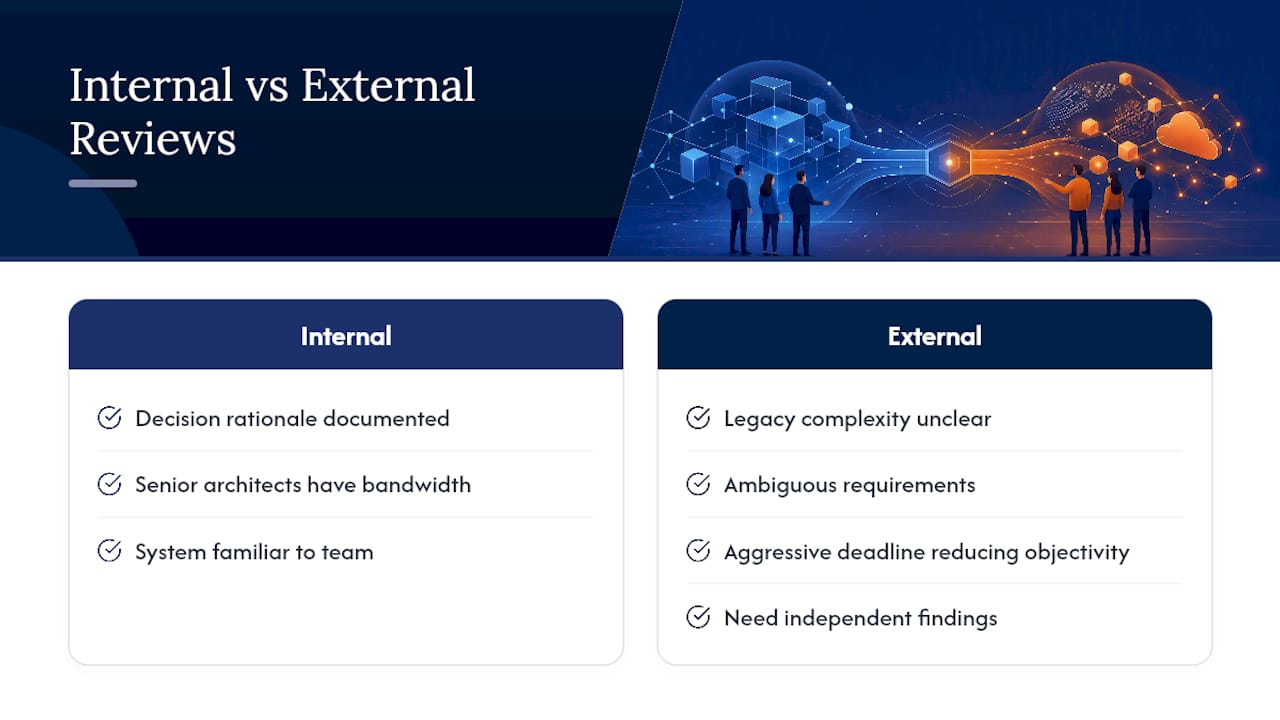
Internal review works well when decision rationale is already documented, senior architects have bandwidth, and the system isn’t dramatically novel to the team. Bring in outside eyes when you’re dealing with legacy complexity nobody fully understands anymore, ambiguous requirements, an aggressive deadline squeezing out objectivity, or a genuine need for findings nobody internal has a stake in softening.
Bowtie runs these engagements regularly, often alongside work described in our guide to technical debt remediation. A typical engagement produces a prioritized findings report, a remediation plan with owners, PoC support for the riskiest assumptions, and optional hands-on delivery if you want us to fix what we find.
— Chad
How Bowtie Supports Your Next Architecture Review
If your last review turned up more questions than answers, or you’re staring down a legacy system nobody on the team fully trusts anymore, that’s exactly the gap Bowtie fills. We bring senior engineers who’ve reverse-engineered undocumented systems and audited AI-generated code that nobody would sign off on internally, and we hand you a prioritized remediation plan instead of a vague “looks fine” report.
Our Senior Developer Review starts at $449 and gives you an experienced second set of eyes on your architecture and codebase. If your review surfaces infrastructure risk specifically, our Infrastructure Assessment at $2,750 digs into deployment, scaling, and failure points. And if the code in question came out of an AI coding assistant with nobody quite sure what’s underneath, our Vibe Check at $449 tells you exactly what you’re working with.
Every engagement starts with a short scoping call, moves into a defined-timeline assessment, and ends with a findings report plus a prioritized remediation plan, not just a stack of vague recommendations. Book a scoping call through Bowtie’s pricing page and find out what an outside review would actually catch in your system.
Standards and Research Worth Bookmarking
- ISO/IEC/IEEE 42030:2019 architecture evaluation framework
- SEI recommended industrial practice
- Pragmatic Evaluation of Software Architectures
- NASA SWE-143 software architecture review guidance
Sources
- Architecture review is a static analysis technique and classification of methods (PMC article)
- Pragmatic Evaluation of Software Architectures (Springer)
- Recommended Best Industrial Practice for Software Architecture Evaluation (SEI)
- ISO/IEC/IEEE 42030:2019 - Architecture evaluation framework (ISO)
- Continuous evaluation of software architectures: an overview (ACM)
FAQ
Is TOGAF Still Relevant in 2026?
TOGAF remains widely used for enterprise architecture governance, though many teams now pair it with lighter, decision-centric review methods like DCAR for day-to-day design decisions rather than relying on it exclusively.
What Is Software Architecture in Simple Terms?
Software architecture is the set of high-level decisions about how a system’s major components are structured, how they communicate, and how those choices satisfy requirements like performance, security, and maintainability.
Is Architecture One of the Hardest Technical Disciplines?
Architecture work is widely considered demanding because it requires balancing competing quality attributes, business constraints, and long-term maintainability under real uncertainty, but difficulty depends heavily on system complexity and organizational context rather than any fixed ranking.
How Much Does an Outside Architecture Review Cost?
Bowtie’s Senior Developer Review starts at $449, while a full Infrastructure Assessment runs $2,750; current pricing for all engagements is listed on Bowtie’s pricing page.