The safest, fastest way to refactor legacy code is incremental and test-first: write characterization tests to lock down current behavior, find the seams where you can safely isolate code, and make small reversible changes behind those tests. For larger subsystems,
wrap the old code and migrate traffic gradually with the Strangler Fig pattern. Your next move this sprint: pick one change point that causes you pain and write a characterization test around it before you touch a single line.
TL;DR:
- Refactor legacy code incrementally using characterization tests to document behavior and safely isolate the system with seams.
- Prioritize modules with high bug counts, slow deployment, or extensive change difficulty, and thoroughly map their dependencies before acting.
- Use simple, reversible techniques like extracting methods or classes within small, test-guarded steps, and gradually route traffic with the Strangler Pattern.
- Leverage AI for analyzing and generating safe transformations, but avoid full rewrites or unconstrained modifications without characterizations.
- Refrain from rewriting unless the existing architecture completely impedes business needs; focus on small, measurable improvements instead.
Table of Contents
- How Do You Decide What to Refactor First?
- What Are Characterization Tests and Why Do They Matter?
- Where Do You Find Seams in Legacy Code?
- Which Refactoring Techniques Actually Work on Legacy Systems?
- Can AI Actually Understand Legacy Code Well Enough to Help?
- Should You Refactor or Rewrite the Legacy System?
- What’s a Practical Sprint Plan for Refactoring Legacy Code?
- What We’ve Learned Running Legacy Modernization Projects
- Get Expert Help Modernizing Your Legacy Codebase
- Sources
- FAQ
How Do You Decide What to Refactor First?
Not every ugly function deserves your attention. Tie refactor decisions to business impact: which modules generate the most bugs, slow down every deploy, or take the longest to change safely? A quick assessment checklist gets you there fast.
- Check churn: which files get modified most often in your git history?
- Identify failing hotspots: where do bugs cluster in your issue tracker?
- Map runtime dependencies: what breaks if this module changes?
- Measure current test coverage: where are you flying blind?
Once you’ve flagged candidates, inventory each one. Trace its entry points, its external integrations (databases, third-party APIs, message queues), and the critical data flows running through it. This gives you a real map instead of a guess, and it tells you exactly where the risk actually lives before you write a single test.
What Are Characterization Tests and Why Do They Matter?
A characterization test doesn’t check that code is correct. It records what the code currently does, including the quirks, the weird edge cases, and the bugs nobody’s bothered to fix. Michael Feathers built this concept as the foundation of safe legacy work: capture behavior first, then refactor with confidence that you’ll know immediately if something changes underneath you, according to Working Effectively With Legacy Code.
You have several ways to build this safety net:
- Golden-file tests: run the current code, save the output, and compare future runs against it.
- Property-based checks: assert invariants that should hold regardless of input.
- Smoke tests: verify the system starts and handles a basic request end to end.
- API-level tests: exercise public interfaces without touching internals.
Operationalizing this matters as much as writing the tests. Wire characterization tests into your CI pipeline as a hard gate, run nightly comparison jobs against production-like data, and where you can, shadow-compare staging output against production before you ship. Established frameworks like JUnit 5, pytest, and Mockito make this practical in Java, Python, and beyond.
Where Do You Find Seams in Legacy Code?
A seam is any point where you can alter behavior without editing the code directly. Feathers’ concept of seams and inflection points is what makes legacy code testable without a full rewrite. An object seam might be a class you can subclass or inject a mock into; a link seam might be a compiled dependency you can swap at build time, according to Working Effectively With Legacy Code.
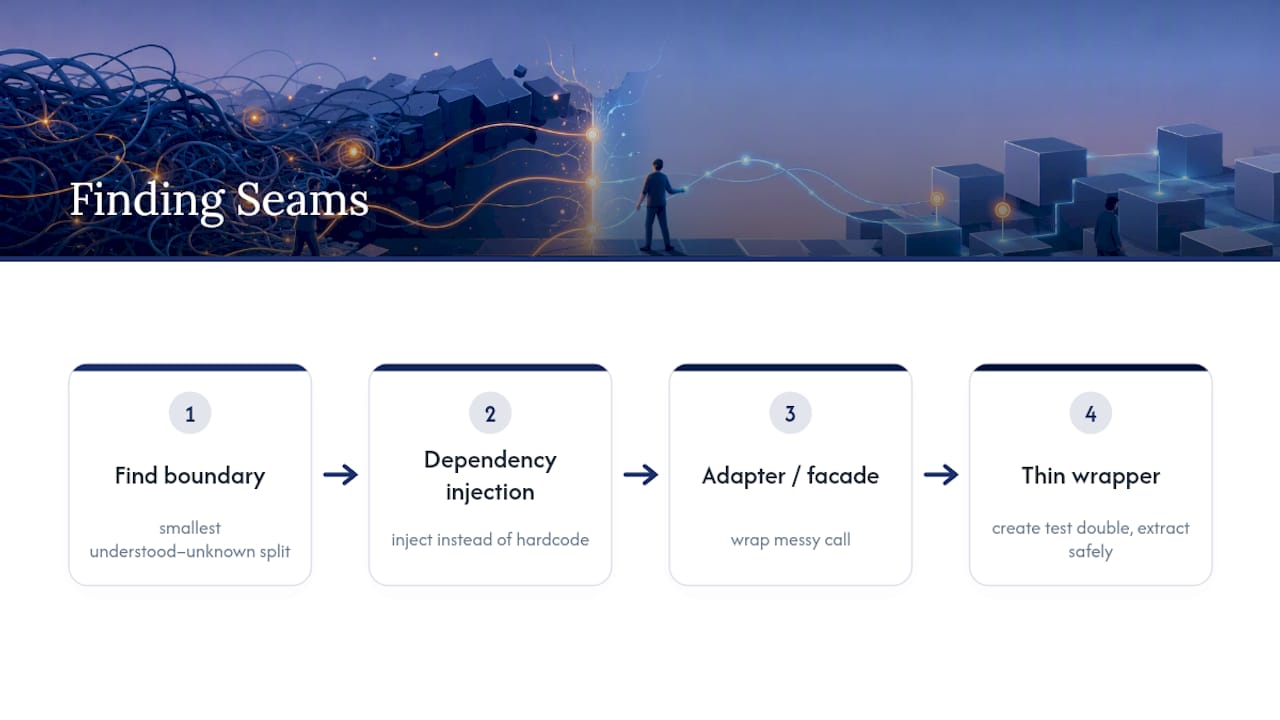
You introduce seams by injecting dependencies instead of hardcoding them, wrapping a messy call behind an adapter or facade, or writing a thin wrapper function around a piece of logic you can’t yet touch safely. To find the best first seam, look for the smallest boundary between “code I understand” and “code I don’t.” That boundary is usually where your first test doubles and your first safe extraction will happen.
Which Refactoring Techniques Actually Work on Legacy Systems?
Once you’ve got a seam and a characterization test guarding it, the actual refactoring work should stay boring and reversible. Complex, clever moves are exactly what gets legacy refactors abandoned halfway through. Here’s the order that tends to work:
- Extract method: pull a chunk of tangled logic into a named function with a single responsibility. This is almost always your first move, because it shrinks the blast radius of everything after it.
- Extract class: once you’ve got several related methods extracted, group them into a class that owns their shared state.
- Replace conditional with polymorphism: when you see a giant switch statement branching on type, that’s usually a sign the branches want to be separate classes.
- Apply the Mikado Method for multi-step changes: map out every prerequisite change as a graph, revert anything that breaks, and work backward from the goal until you find a chain of safe, ordered steps.
- Use the Strangler Fig pattern for whole subsystems: instead of rewriting a feature in place, build the replacement alongside the original, route a slice of traffic to it, and expand that slice as confidence grows. Martin Fowler’s pattern is the standard approach for incremental replacement at scale. Sourcegraph’s guide to legacy modernization lays this out.
Each step should be small enough to revert in minutes if something goes wrong. If a “refactor” can’t be reverted with a single git command, it’s too big.
Can AI Actually Understand Legacy Code Well Enough to Help?
AI tools are genuinely strong at reading legacy code you’ve never seen: summarizing what a function does, flagging hidden business rules, and generating candidate adapters or codemods for mechanical transformations. What AI is bad at is judgment about what should be preserved. Ask a model to “rewrite this file cleanly” and it will confidently discard business logic it doesn’t recognize as intentional, according to FreeCodeCamp’s guide to modernizing legacy applications with AI.
The workflow that keeps AI useful without letting it cause damage looks like this:
- Use AI for analysis first: have it document business rules and dependencies before generating anything.
- Write or update characterization tests based on what that analysis surfaces.
- Constrain AI-generated changes to codemods, deterministic transforms, and adapters, not full rewrites.
- Validate every change with differential testing, ideally against shadow traffic mirroring production requests.
- Roll out in stages, watching error rates before expanding the change.
Tools like OpenRewrite handle deterministic, AST-aware transformations across a codebase, while enterprise code search tools help you scope the blast radius of a change before you make it, per Sourcegraph’s modernization guide. Bowtie builds this kind of AI-assisted modernization workflow directly into client engagements, because unconstrained AI on legacy systems tends to produce confident, plausible, and wrong output.
Pro Tip: Never let an AI tool touch a file that lacks a characterization test. If it breaks something silently, you’ll have no way to know until it’s already in production.

Should You Refactor or Rewrite the Legacy System?
Refactoring wins almost every time you can still test the system and ship incremental changes without violating architecture constraints. A full rewrite is only justified when the current architecture actively blocks the business, not just when the code looks old.
Weigh these factors before you commit either way:
- Testability: can you write characterization tests at all, or is the code too tangled to observe?
- Velocity impact: is the current system slowing every release, or just this one feature?
- Business criticality: how much revenue or risk sits behind this subsystem?
- Cost to carry forward: what does it cost to keep patching versus replacing?
Sourcegraph’s modernization research notes that the highest-value decision is often to retire or repurchase a system entirely rather than rewrite it, since replatforming or buying a solution sometimes beats both options on cost and risk.
What’s a Practical Sprint Plan for Refactoring Legacy Code?
Here’s a runnable sequence you can start this week without waiting on a bigger modernization initiative:
- Pick one high-value change point using the assessment checklist from earlier.
- Write a characterization test that captures its current output, quirks included.
- Introduce a seam (dependency injection, adapter, or wrapper function) around it.
- Perform one small, reversible refactor: extract method or extract class.
- Run the change through CI gates and any shadow-traffic comparison you have available.
- Verify metrics before merging.
A sample ticket “Definition of Done” should require: a passing characterization test committed before the refactor, a code review confirming the change is reversible in one commit, and CI green including the regression suite. Track four metrics across the sprint: regressions caught, time-to-change for that module, deploy success rate, and the delta in test coverage. Incremental changes with CI gates and staged rollouts consistently reduce the blast radius of this kind of work, according to Ardura Consulting’s legacy code recovery guide.
What We’ve Learned Running Legacy Modernization Projects
The biggest trap in legacy refactoring isn’t technical, it’s psychological. Every team eventually looks at a bad codebase and thinks “it would just be faster to rewrite this.” It almost never is. The rewrite temptation kills more modernization projects than bad code ever does, because it trades a known, working system for an unknown one with no safety net.
What actually works is unglamorous: small reversible steps, visible metrics, and refusing to skip the characterization tests even when they feel like busywork. Weak CI is the second-biggest killer we see. A test suite that doesn’t gate deploys isn’t a safety net, it’s decoration.
Disciplined AI use, when it’s constrained to analysis and codemods rather than free rewriting, has measurably shortened modernization cycles on the enterprise projects we’ve supported. It doesn’t replace judgment. It removes the tedious parts so your engineers can spend their time on the judgment calls that actually matter.
— Chad
Get Expert Help Modernizing Your Legacy Codebase
This approach offers specialized services for legacy work including building characterization tests, identifying seams, and running constrained AI workflows as part of modernization engagements.
If you’re staring at a codebase with cross-repo dependencies, no meaningful test coverage, and a business that can’t tolerate downtime, that’s exactly the situation where a structured audit pays for itself. We build the shadow-traffic validation and staged rollout plans that make large-scale changes reversible, and we support the project after launch instead of disappearing once it ships. Explore how Bowtie’s AI integration and modernization services work, or read our practical modernization roadmap for IT leaders planning a larger initiative. Requesting a code audit can help identify the riskiest seams in a codebase before making changes.
Sources
- Working Effectively With Legacy Code (Feathers)
- Modernize legacy applications with AI (FreeCodeCamp)
- Legacy Code Modernization: A Practical Guide for Engineering Teams | Sourcegraph
- JUnit 5
FAQ
How Do You Refactor Legacy Code Safely?
Write a characterization test to capture current behavior, find a seam to isolate the code, then make one small reversible change at a time behind CI gates, expanding to the Strangler Fig pattern for larger subsystems.
Can AI Actually Understand Legacy Code?
AI can analyze legacy code well, summarizing logic and flagging business rules, but it shouldn’t be trusted with unconstrained rewrites since it can’t distinguish intentional business logic from accidental complexity.
How Do You Modernize Legacy Code Without a Full Rewrite?
Use incremental patterns like extract method and extract class behind characterization tests, then apply the Strangler Fig pattern to route traffic gradually from the old subsystem to its replacement.
What Exactly Is Legacy Code?
Legacy code is any code that lacks adequate tests, documentation, or a team that fully understands it, which is why Michael Feathers defines it primarily by the absence of tests rather than its age.
When Should You Rewrite Instead of Refactor?
Only rewrite when the architecture itself blocks the business and no amount of incremental change fixes that. In most other cases, refactoring, repurchasing, or retiring the system carries less risk than a rewrite.