
AI-ready data is trusted, contextualized, and machine-readable data that an AI system can act on without a human double-checking every output. The first step to prepare data for AI is not picking a vector database or a labeling tool. It’s
running a full data audit and quality baseline across your sources. Get that right, and you cut hallucinations, stabilize agent behavior, and get a measurable starting point instead of a guess.
TL;DR:
- Conduct a comprehensive data audit and exploratory data analysis to identify issues like null values, duplicates, and data drift before modeling.
- Use schema validation, data contracts, and automated validation gates to enforce data quality and freshness in production environments.
- Prioritize high-impact, low-effort data sources for cleanup and validation to maximize efficiency and reduce the risk of bad inputs affecting AI performance.
- Implement proper data splitting techniques, such as temporal or group splits, to prevent leakage and ensure validation reflects real-world conditions.
- Apply rigorous privacy, bias, and ethical checks early in the process, including sensitivity tagging and demographic audits, to mitigate risks before deploying models.
Table of Contents
- The Engineering Checklist to Prepare Data for AI
- How Do You Audit Data and Run EDA Before Modeling?
- Cleaning and Validation: Stop Bad Records Before They Spread
- Transformations and Feature Engineering That Actually Move Metrics
- Preparing Unstructured Data for LLMs and RAG Systems
- What Governance Looks Like for Agentic AI Systems
- How Do You Split Data and Catch Leakage Before Training?
- Building Automated Pipelines You Can Trust
- Handling Imbalanced Datasets
- Data Privacy and Ethical Considerations
- Practical Lessons From Implementation
- How Bowtie Turns This Playbook Into Working Systems
- Sources
- FAQ
The Engineering Checklist to Prepare Data for AI
Before writing a single transform script, triage. Score each data source on impact (how much it affects your model or agent) times effort (how hard it is to fix), and work the high-impact, low-effort items first.
- Run a data audit: inventory every source, owner, and refresh cadence
- Complete exploratory data analysis (EDA) to baseline quality
- Deduplicate and clean records before anything touches a model
- Define schemas and data contracts for every critical table
- Set freshness SLAs so stale data can’t silently corrupt outputs
- Build embeddings pipelines for unstructured text, images, or audio
- Split data into train/validation/test sets with leakage checks
- Automate validation gates so fixes hold in production
Data preparation commonly eats 60 to 80% of a typical AI project’s time, so front loading this checklist pays for itself fast.
How Do You Audit Data and Run EDA Before Modeling?
You can’t fix what you haven’t mapped. A data inventory lists every field, its owner, its sensitivity level, and how often it updates. Skip the inventory and you’ll be debugging a model failure three weeks from now with no idea which upstream table changed.
Exploratory data analysis is the diagnostic layer on top of that inventory. It’s where you actually see the shape of your data instead of assuming it.
- Completeness: what percentage of each field is populated
- Distributions: are values clustered where you’d expect, or skewed
- Outliers: values that sit far outside normal ranges and why
- Cardinality and UUID checks: are supposed unique keys actually unique
Log these numbers somewhere visible. A minimal readiness dashboard, even a shared spreadsheet, tracking null rates, duplicate counts, and last-updated timestamps per source beats a polished report nobody revisits. Most organizations’ real blocker isn’t a missing tool. It’s that nobody can find or trust the data they already have, a problem rooted in architecture rather than tooling.
Cleaning and Validation: Stop Bad Records Before They Spread
Cleaning is where most AI projects quietly go wrong, usually because teams clean once and never gate the pipeline against future bad loads. Deduplication should happen on canonicalized values, not raw strings. “NY,” “N.Y.,” and “New York” are the same field value, and your matching logic needs to treat them that way. Typo correction heuristics (fuzzy matching, edit-distance thresholds) catch the rest.
For missing values, don’t default to dropping the column. Imputation, using median values, category-specific averages, or model-based estimates, preserves signal that a dropped column throws away. The exception is columns missing more than 40% of their values. Exclude those unless the field is critical to the business logic, in which case you flag it for manual backfill instead of guessing.
- Canonicalize before deduplicating, never after
- Apply the 40% missing-value threshold as a default exclusion rule
- Build automated quarantine gates that hold anomalous records instead of passing them downstream
- Run anomaly detectors on incoming batches, not just historical data
Pro Tip: Pull a random sample of 50 to 100 records after any automated cleaning run and review them by hand. It takes twenty minutes and catches systematic errors an automated check will miss every time.
Transformations and Feature Engineering That Actually Move Metrics
Standardization and normalization matter, but they’re table stakes, not the differentiator. Categorical encoding (one-hot, ordinal, or embedding-based for high-cardinality fields) and consistent timestamp handling across time zones prevent a whole class of silent bugs.
The real leverage sits in feature engineering. Feature engineering delivers the highest return on model accuracy of any step in the pipeline, more than swapping model architectures or tuning hyperparameters.
- Aggregations: rolling averages, counts per time window
- Ratios: conversion rate, error rate, cost per unit
- Sessionization: grouping events into meaningful user sessions
- Lag features: prior period values that inform trend prediction
Validate new features fast. Run a simple baseline model, check feature importances, and drop anything contributing near zero. You don’t need a full training cycle to know if a feature is worth keeping.
Preparing Unstructured Data for LLMs and RAG Systems
Text, images, audio, and scanned documents need a different playbook than structured tables. Chunking strategy is the first decision: keep chunks consistent in size and semantically coherent, and tag each one with metadata (source document, section, date) so retrieval systems can filter and rank properly.
- Chunk at consistent granularity, not by arbitrary character counts
- Tag every chunk with source metadata for traceability
- Use LLM-assisted labeling for annotation where human review would bottleneck the project
- Generate embeddings in a repeatable pipeline, then deduplicate at the chunk and embedding level
Deduplication at the embedding level matters more than most teams realize. Near-duplicate chunks in a training or retrieval corpus increase memorization risk and inflate apparent performance during evaluation. For scanned documents or audio, quality-check your OCR and speech-to-text output directly. Confidence scores below a set threshold should route to manual review, not straight into your training set.
Pro Tip: LLM-assisted labeling can cut annotation costs by up to 70% compared to fully manual review, but always spot-check the model’s labels against a human-labeled sample before trusting it at scale.
What Governance Looks Like for Agentic AI Systems
Agentic AI raises the stakes on everything above, because an agent acting on bad data doesn’t just produce a wrong answer. It takes a wrong action. That’s why schema enforcement and contractual SLAs running in CI/CD are now the first line of defense, not an afterthought.
A data contract should declare, in a machine-readable format, exactly what a table promises: schema, freshness SLA, and quality gates that can quarantine a bad load automatically. Pair that with a semantic layer, a shared, machine-readable definition of business terms like “active customer” or “revenue,” so different agents and teams aren’t quietly disagreeing on what a metric means.
Treat data contracts like API contracts: version them, validate them in CI, and give them the same breaking-change discipline you’d give a public endpoint.
- Declare schema, freshness SLA, and quality gates in every contract
- Define shared business logic once, centrally, not per team
- Build observability that traces why an agent acted on a given input
- Pilot contracts on your highest-risk dataset before rolling out broadly
Bowtie’s own data governance framework and observability practices follow this same sequence: contract first, then pilot, then scale.
How Do You Split Data and Catch Leakage Before Training?
Splitting sounds mechanical until leakage quietly inflates your validation metrics and the model falls apart in production. Match your split method to your data’s actual shape.
- Use random splits only for genuinely independent, identically distributed records.
- Use stratified splits when class balance matters, especially with imbalanced targets.
- Use temporal splits for any time-series or sequential data. Never let future rows train on past predictions.
- Use group splits when records share an entity (the same user, same account) to keep that entity entirely in one split.
Leakage most often comes from fitting a scaler before splitting, features derived from future events, or group leakage where the same customer appears in both train and test. Run automated scans for these patterns before every training run, and check null-rate parity and class balance across splits. If your pilot model shows a human-correction rate creeping upward after deployment, that’s often a split problem surfacing late, not a model problem.
Building Automated Pipelines You Can Trust
The steps above only compound in value once they run automatically, every time, without someone manually rerunning a notebook. The pattern that works: ingestion, validation, transform, embeddings, storage, in that order, with a validation gate at every handoff.
- Build schema validation and distribution checks directly into CI/CD, not as a separate manual review
- Quarantine failed batches automatically instead of alerting a human to decide in real time
- Evaluate tools by category: orchestration engines, schema validators, vector databases, and monitoring dashboards, rather than chasing a single all-in-one platform
- Capture metadata and lineage automatically at every pipeline stage so any output is traceable back to its source
Automating validation gates and labeling can compress weeks of manual work into a pipeline that runs the same way every time, which is also what makes an audit trail possible six months later.
Handling Imbalanced Datasets
An imbalanced dataset, where one class vastly outnumbers another, is one of the most common reasons a model looks accurate in testing and fails in production. Fraud detection, churn prediction, and medical diagnosis models all face this: the interesting class is often the rare one.
Resist the instinct to just collect more data and hope the ratio improves. It usually doesn’t, and it wastes a preparation cycle. Instead, work the problem from three angles.
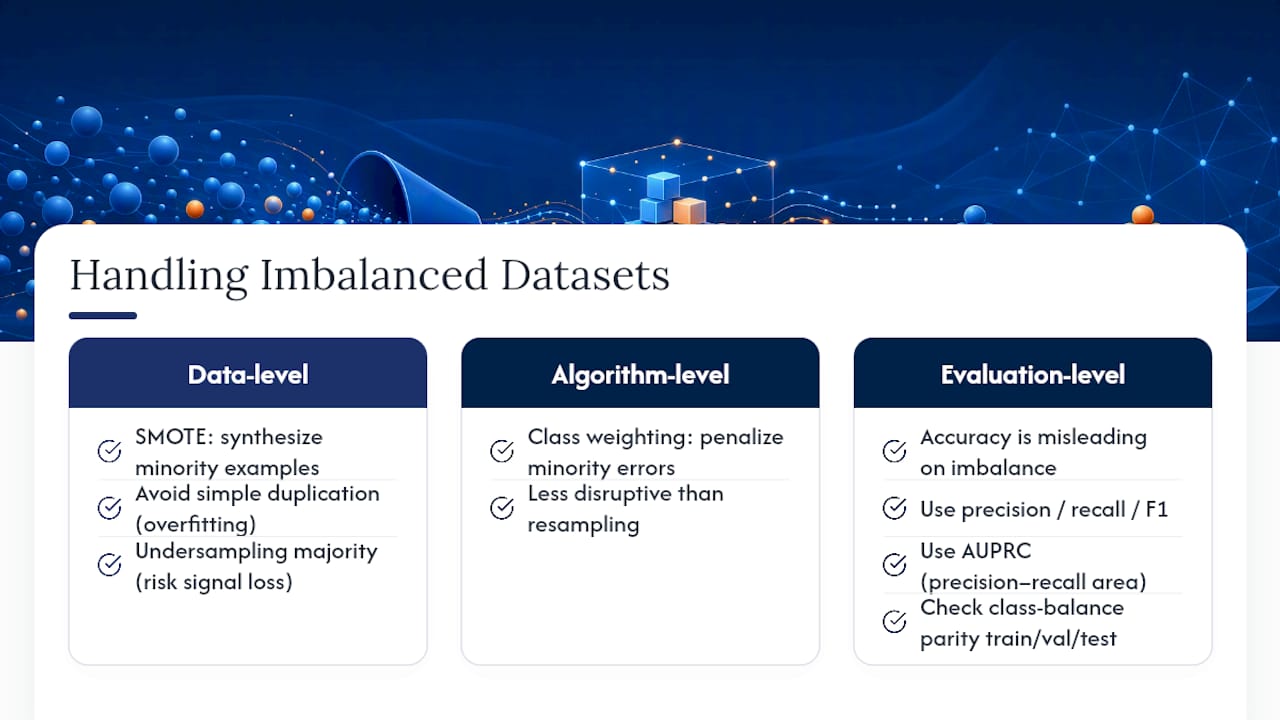
At the data level, oversampling techniques like SMOTE (Synthetic Minority Over-sampling Technique) generate synthetic examples of the minority class rather than simply duplicating existing ones, which helps avoid overfitting to a handful of repeated records. Undersampling the majority class works too, though it risks throwing away useful signal if you’re not careful about which majority records you drop.
At the algorithm level, many model families support class weighting, where you tell the model to penalize misclassifying the minority class more heavily during training. This is often less disruptive to your data pipeline than resampling, since you’re not changing the dataset itself.
At the evaluation level, accuracy is close to useless on imbalanced data. A model that predicts “not fraud” every time can hit 99% accuracy on a dataset where fraud is rare, and still be completely worthless. Use precision, recall, F1 score, and area under the precision-recall curve instead, and always validate class balance parity across your train, validation, and test splits so you’re not accidentally training on a distribution that doesn’t match production.
Data Privacy and Ethical Considerations
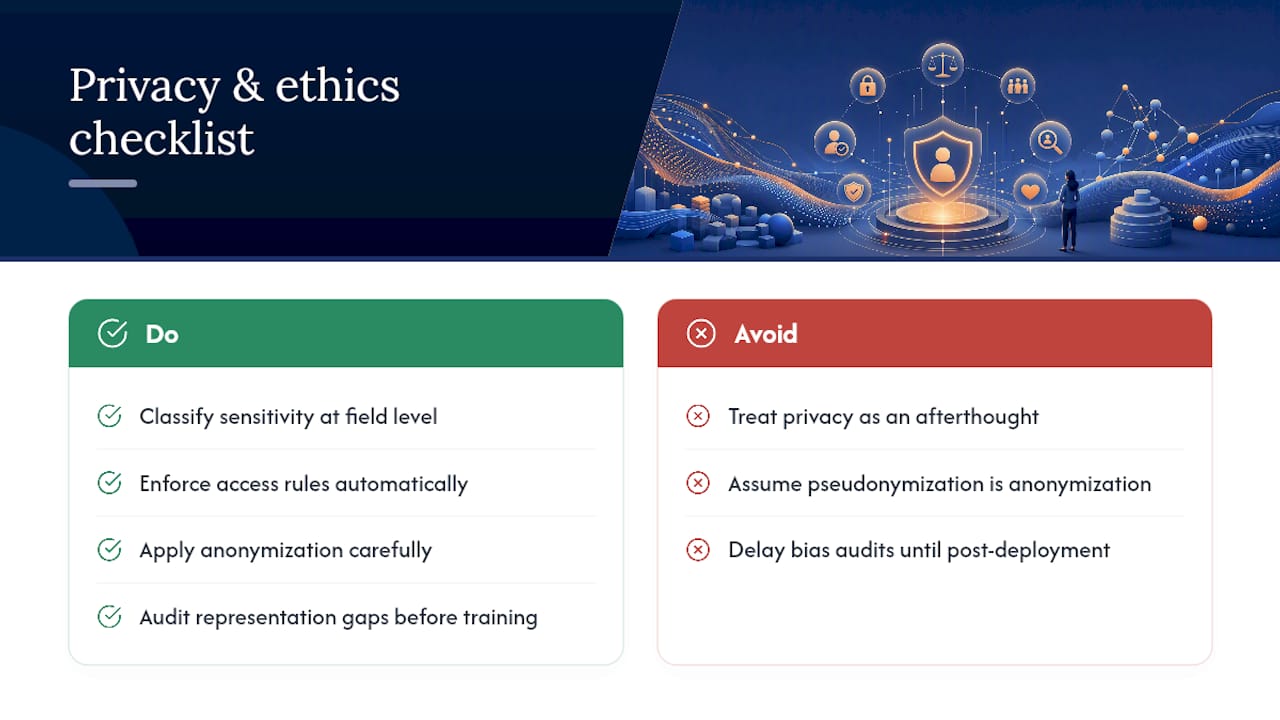
Privacy and ethics in AI data preparation aren’t a legal afterthought bolted on after the pipeline is built. They shape which fields you can use, how long you can retain them, and who’s allowed to see them at all, from day one.
Start by classifying sensitivity at the field level during your initial data inventory, not later. Personally identifiable information (PII), health data, and financial records each carry different regulatory obligations depending on your industry and jurisdiction, and a field-level tag makes it possible to enforce access rules automatically instead of relying on someone remembering the rule.
Anonymization and pseudonymization reduce risk, but they’re not interchangeable. Pseudonymized data (where identifiers are replaced with tokens) can often be re-linked to an individual under the right conditions, which matters if you’re using that data in a context where re-identification would be a real harm. True anonymization is harder to achieve than most teams assume, especially in datasets with many correlated fields.
Bias is the other half of this problem, and it’s an ethical issue as much as a technical one. Data reflecting historical human decisions (hiring records, lending decisions, policing data) often encodes the same biases that produced those decisions in the first place. Auditing for representation gaps across demographic groups before training, not after a model is already in production, is the only point where fixing it is cheap. Once a biased model is deployed and making decisions, the fix becomes a much larger, and much more public, problem.
Practical Lessons From Implementation
The teams that struggle most aren’t the ones with messy data. They’re the ones who try to expand data sources before consolidating what they already have. Every new integration adds risk if the foundation underneath it isn’t stable.
Instrument early. Observability bolted on after a failure is forensics, not engineering. And treat schema as law: the moment a schema change is optional, someone will skip it under deadline pressure, and you’ll spend a month tracing the fallout.
The sequence that holds up: audit, then contract, then pilot, then automate. Skip a step and you’re rebuilding it later, usually at a worse time.
— Chad
How Bowtie Turns This Playbook Into Working Systems
Reading a checklist and running one are two different jobs, and most teams underestimate the gap until they’re three weeks into a pipeline that keeps breaking on edge cases nobody scoped. Specialized teams can close that gap without the overhead of a traditional agency retainer by providing senior engineers who build the data contracts, validation gates, and observability layers this guide describes, then stay accountable for them after launch.
If you’re not sure where your data actually stands, start with AI Engineering Assistance or AI Agent Creation & Workflow Automation to map your sources, contracts, and pipeline gaps before committing to a full build. Teams already running on AI-generated or Vibe-coded infrastructure often need a code and architecture review first to confirm the foundation can actually support production traffic. From there, the model is straightforward: audit, pilot on your highest-risk dataset, then scale the automation across the rest. Check current pricing and engagement options on the Bowtie pricing page and get a plan built around what your data actually needs, not a generic package.
Sources
- Making your data ready for agentic AI — Martin Fowler
- Data Preparation for Your AI Model: Importance & Best Practices - HBS Online
- Gov
FAQ
What Data Is Needed to Train an AI Model?
You need data that’s relevant to the task, sufficiently complete, and representative of the conditions the model will face in production. That typically means structured records (transactions, logs, customer fields) or unstructured content (text, images, audio) with clear provenance and consistent formatting, run through EDA and cleaning before it ever reaches a training pipeline.
What Is the 30% Rule in AI?
If you’ve seen it referenced, it’s typically shorthand for holding out a portion of a dataset for validation and testing rather than training, though the actual split ratio should depend on your data’s shape and volume.
What Is the 80/20 Rule for AI Data Preparation?
The commonly cited pattern is that data preparation consumes 60 to 80% of an AI project’s total time, with modeling and deployment taking up the remainder. It’s a reminder that the audit, cleaning, and transformation work described throughout this guide isn’t a preliminary step. It’s most of the project.
Can You Give an Example of Data Preparation in Practice?
A retailer preparing customer transaction data for a churn model would start with a data audit, then run EDA to check completeness and outliers, deduplicate customer records, engineer features like purchase frequency and days since last order, then split the data using a temporal method so the model is validated on genuinely future behavior. Each step matches the seven-stage preparation workflow covered above.