
Post-launch support is the structured set of activities that stabilizes a product after go-live: monitoring, triage, escalation, and fixes delivered under tighter service levels than normal operations. The right move is a short, time-boxed hypercare window with a named owner
and written exit criteria, followed by a deliberate handoff to business-as-usual support. Name your hypercare lead today and build a priority queue before your next release goes out.
TL;DR:
- Hypercare should be limited to a predefined period of intense support, typically lasting one to eight weeks, tailored to the product’s complexity.
- Exit criteria for hypercare must be set at launch to avoid indefinite support or premature dropping of coverage, ensuring stability before transition.
- Support teams during hypercare need designated roles, clear escalation paths, and proactive communication to prevent burnout and address recurring issues promptly.
- Monitoring key metrics such as ticket volume, critical open issues, and defect patterns daily helps determine if stability thresholds are met for handoff.
- Choosing support models like in-house, partner, or hybrid depends on product complexity and staffing flexibility, with proper onboarding and knowledge transfer essential before engagement ends.
Table of Contents
- What Post-Launch Support Actually Means (And Why Hypercare Isn’t the Same Thing)
- Common Post-Launch Mistakes That Sabotage Stability
- Structuring Hypercare: Phases, Timelines, and Practical Tips
- Choosing Your Ongoing Support Model After Hypercare
- Who You Need on the Team During Hypercare and Beyond
- Metrics That Tell You Hypercare Is Actually Working
- Handing Off From Hypercare to Business-as-Usual
- How an Experienced Partner Handles Hypercare and BAU
- What Actually Separates Stable Launches From Chaotic Ones
- What to Ask Before You Hire a Post-Launch Partner
- Sources
- FAQ
What Post-Launch Support Actually Means (And Why Hypercare Isn’t the Same Thing)
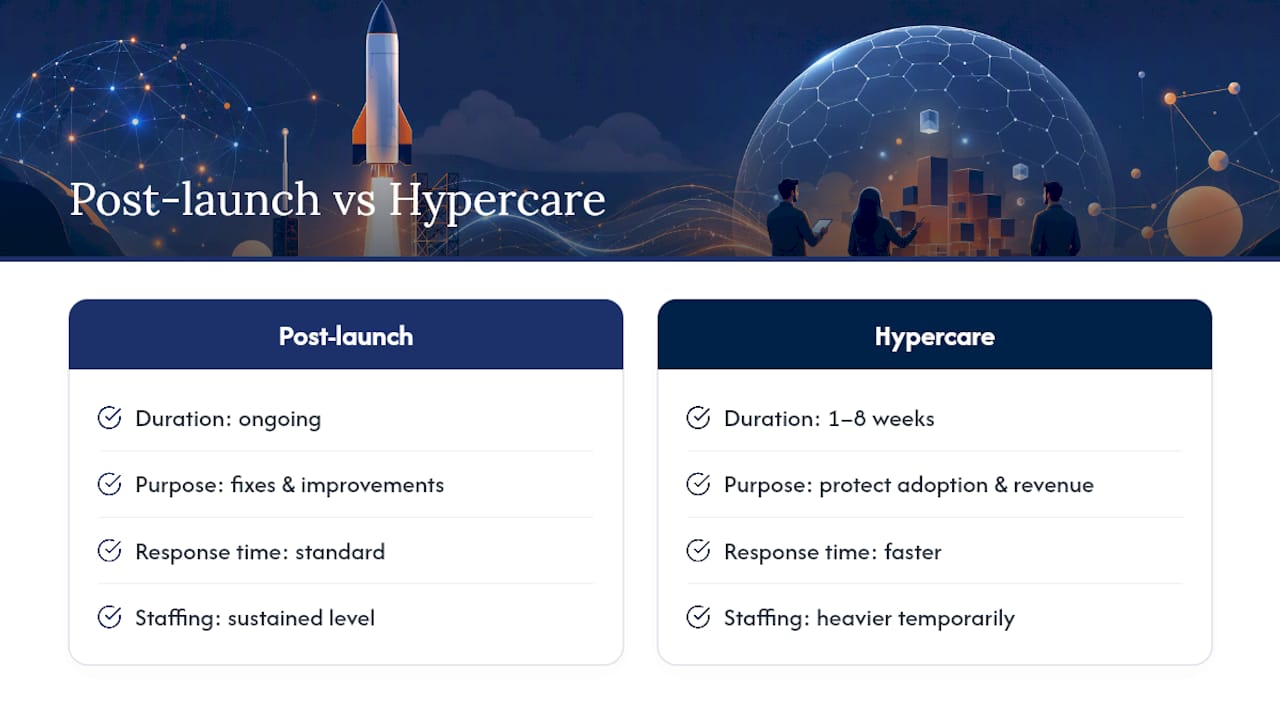
Post-launch support covers everything that happens after your product ships: bug fixes, user questions, performance monitoring, and incremental improvements. Hypercare is a subset of that, a defined, temporary period of elevated attention right after go-live, typically lasting one to eight weeks depending on complexity.
Think of it this way: hypercare is the emergency room, and post-launch support is the ongoing primary care relationship that follows. During hypercare, response times are faster, staffing is heavier, and monitoring is closer than what you’ll sustain long term. Hypercare exists specifically to protect adoption and revenue during the riskiest window of a product’s life, when users are forming their first impressions and edge cases nobody tested are finally surfacing.
Skip this distinction and teams either run hypercare forever (burning out staff and budget) or drop support too fast (letting real defects calcify into churn). Neither is a plan.
Common Post-Launch Mistakes That Sabotage Stability
Most post-launch breakdowns trace back to a handful of repeat offenders. Here’s what to watch for:
- No exit criteria, so hypercare runs indefinitely. Without a defined finish line, “temporary” elevated support becomes the permanent (and unsustainable) staffing model.
- Relying on the same three people for everything. Burning out the original build team instead of planning surge staffing guarantees slower response times by week three.
- Escalation paths nobody actually knows. If a Sev-1 ticket doesn’t have a named owner within minutes, it sits.
- Ignoring recurring defects in favor of new tickets. Triage that treats every ticket as isolated misses the pattern that a single code fix could resolve.
- Silence with users during rocky weeks. Product teams that go quiet during instability lose more trust than the bugs themselves cause.
Structuring Hypercare: Phases, Timelines, and Practical Tips
Hypercare works best as three distinct phases, not one long blur of alertness.
- Readiness (before go-live). Train your support team on the actual product, not just the spec. Update your knowledge base with known issues and workarounds. Define SLAs in writing, and get support involved during user acceptance testing so they’ve handled real scenarios before customers do, a step Microsoft’s implementation guidance flags as one of the biggest predictors of a smooth transition.
- Intensive care (weeks one through four, roughly). Run a dedicated ticket queue separate from your normal support inbox. Hold daily standups reviewing every open Sev-1 and Sev-2. Reach out proactively to flagged users instead of waiting for them to complain.
- Step-down and handover. Publish a taper schedule so stakeholders see coverage decreasing on purpose, not by accident. Document runbooks and open items before the last hypercare shift ends.
Duration depends on complexity: a straightforward B2B SaaS release might stabilize in a few weeks, while a complex ERP rollout can justify a longer period. Extend hypercare if Sev-1 volume is still climbing at your planned exit date; compress it if metrics flatline early and your team is idle.
Pro Tip: Set your hypercare exit date at kickoff, not at the end. A team that knows the deadline behaves differently than one waiting for someone to declare “we’re stable now.”
Choosing Your Ongoing Support Model After Hypercare
Once hypercare ends, you need a standing model, and there are three real options.
In-house support works best for early-stage startups with simple products and founders still close enough to the code to triage personally. It gives you full control but zero staffing flexibility. Cost climbs fast when your headcount needs to double during launches or seasonal spikes.
Retained partner support suits teams that need SLA-backed coverage without hiring a dedicated support org. This model trades some control for elasticity, large organizations often choose exactly this route to get surge staffing and specialized troubleshooting without permanent overhead.
Hybrid support pairs an in-house product lead who owns roadmap decisions with an outsourced team handling ticket volume and routine maintenance. This tends to be the sweet spot for growing product teams.
If you’re evaluating a retained partner, check for:
- A documented knowledge-transfer process before day one
- Written runbooks covering your top 10 known issues
- A regular audit cadence, not a “set it and forget it” contract
Our guide on choosing the right software development partner walks through the vetting questions in more depth.
Who You Need on the Team During Hypercare and Beyond
Hypercare needs five functions covered, even if one person wears two hats on a small team:
- Hypercare manager who owns the exit criteria and reports status daily.
- Support agents handling the frontline queue.
- Escalation engineers who can actually touch the code when a ticket needs more than a workaround.
- Communications lead keeping users informed during rocky stretches.
- Analyst tracking ticket trends so patterns don’t hide inside individual tickets.
| Surge staffing options for teams too small to cover this alone include short-term contractors, a partner call center, or a fixed-length retainer scoped just to the hypercare window — see our GPS Time Tracking Setup Guide | Get Started in Minutes for operational tooling guidance to support surge staffing logistics. Defining local power users who triage common issues before escalating to engineering cuts noise dramatically, even at startup scale. |
Pro Tip: Assign the hypercare manager role to someone with authority to pull in engineering on short notice, not just someone who’s good at answering tickets.
Metrics That Tell You Hypercare Is Actually Working
Track these four numbers daily during hypercare, not just at the end:
- Ticket volume versus baseline (what “normal” ticket flow will look like once things settle)
- Open Sev-1 count at any given moment
- First-contact resolution rate
- Recurring defect count, meaning the same root cause reported by multiple users
Set exit criteria that require these to hold steady for consecutive days, not just touch a good number once.
Close the phase with a stakeholder review that walks through each metric against its target, states explicitly whether criteria were met, and gets a documented sign-off. Agreed customer sign-off on exit criteria matters as much as the ticket numbers themselves, because it turns “we think we’re stable” into a shared decision everyone accepts.
Handing Off From Hypercare to Business-as-Usual
The handoff needs to be a checklist, not a vibe. Cover these steps:
- Publish the taper schedule at least a week before coverage drops, so users and internal teams see it coming.
- Deliver handover artifacts: the runbook, the list of open defects with owners, documented workarounds, and access to monitoring dashboards.
- Run a retrospective that captures what broke, what surprised the team, and which fixes are still pending.
- Feed retrospective findings directly into the product backlog. Recurring hypercare tickets are some of the clearest product signal you’ll get, so don’t let that data die in a closed ticket queue.
How an Experienced Partner Handles Hypercare and BAU
Bowtie treats post-launch work as a continuation of the build, not an afterthought bolted on after delivery. Because our engineering teams write the production code in the first place, continuity carries into support: the same standards for clean, secure, maintainable code apply whether we’re fixing a Sev-1 during hypercare or running a scheduled audit six months into BAU.
In practice, that means surge staffing during a rocky launch week, code audits when recurring defects point to a deeper architectural issue, and documented runbooks that make future maintenance predictable instead of reactive. For teams dealing with AI-generated or vibe-coded applications specifically, this matters even more: a lot of post-launch instability we see traces back to code nobody on the current team fully understands.
What Actually Separates Stable Launches From Chaotic Ones
The teams that avoid post-launch chaos aren’t the ones with the fewest bugs. They’re the ones who named an owner and wrote down what “done” looks like before launch day arrived. Everything else, staffing, tooling, ticket triage, follows from that one decision. Skip it, and even a clean codebase turns into an open-ended fire drill that quietly erodes the adoption you worked to earn.
— Chad
What to Ask Before You Hire a Post-Launch Partner
If hypercare revealed gaps your in-house team can’t close alone, a retained partner fills them without the overhead of a full support org. Bowtie works with product teams both during the intensive hypercare window and afterward as an ongoing maintenance partner, covering everything from surge ticket response to the software maintenance plans that keep a product stable for years, not just its first month.
Before signing with anyone, ask three things: How does onboarding work, and how much time will your team spend transferring knowledge versus just handing over docs? What SLAs apply during a launch spike versus normal weeks? And what happens to institutional knowledge if the partnership ends, do you keep the runbooks, or does that walk out the door too? If you want a second set of eyes on your current post-launch setup, Bowtie’s AI integration and support services are a reasonable place to start that conversation.
Sources
- What Is Hypercare? Definition, Timeline & Exit Criteria
- What Is Hypercare? Benefits & Best Practices | Salesforce
- Transition to support operations (Microsoft Dynamics 365 guidance)
- Hypercare: What it means and why it matters in CX
- Epic Go-Live Project Support and EHR implementation | Stoltenberg
FAQ
What does “post-launch support” mean?
Post-launch support is the ongoing work of monitoring, fixing, and improving a product after it ships, including a heightened hypercare phase followed by standard business-as-usual maintenance.
What does post-launch mean?
Post-launch refers to any activity that happens after a product or feature goes live, spanning everything from the first hour of monitoring to years of routine updates.
What is a post-launch strategy?
A post-launch strategy defines how a team will monitor, support, and improve a product after release, typically including a time-boxed hypercare period with written exit criteria before shifting to standard support.
What is post-launch monitoring?
Post-launch monitoring is the practice of tracking system performance, error rates, and ticket volume immediately after go-live to catch defects before they affect a large share of users.
How long should hypercare last?
Most teams run hypercare for two to six weeks for standard software releases, extending to four to twelve weeks for complex systems, with the actual end date set by exit criteria rather than the calendar.