
Human-in-the-loop AI means a system routes specific decisions to a person for review, correction, or approval before or after the model acts. Teams need it when a decision is high-stakes, uncertain, or agentic enough that a wrong output causes real
damage. Done well, it improves accuracy and creates a paper trail regulators and courts respect. Done badly, it becomes a rubber stamp that gives a false sense of safety.
TL;DR:
- Employing human-in-the-loop AI effectively involves carefully placing intervention points across the entire model lifecycle, from data labeling to continuous retraining, rather than relying on a single checkpoint.
- Proven methods include active learning for efficient labeling, escalation for high-risk decision approval, and well-designed feedback interfaces, which together enhance accuracy and trust without excessive operational costs.
- Proper oversight requires explicit role definitions, detailed system feedback, and governance standards to prevent automation bias and ensure genuine human authority over high-stakes or ambiguous decisions.
- The benefits of human oversight include improved accuracy, accountability, and calibrated trust, but these come with trade-offs such as increased latency, staffing costs, and potential for bias amplification.
- Early-stage design and audits are essential for effective oversight; retrofitting human review onto flawed or unstructured systems leads to inefficiency and undermines safety goals.
Table of Contents
- What Is Human-in-the-Loop AI and Where Does It Fit in the Model Lifecycle?
- Which HITL Methods Actually Work in Production?
- What Do You Actually Gain From Human Oversight, and What Does It Cost?
- Why “More Human Oversight” Doesn’t Automatically Mean Safer
- How Do You Design Human Oversight That Isn’t Just Theater?
- Where Does Human-in-the-Loop AI Actually Get Used?
- Why Bowtie Treats Oversight as an Engineering Problem, Not a Policy Statement
- Get a Second Set of Eyes on Your AI Before You Add Human Oversight to It
- Sources
- FAQ
What Is Human-in-the-Loop AI and Where Does It Fit in the Model Lifecycle?
Human-in-the-loop, often shortened to HITL, is not one checkpoint. It’s a set of intervention points spread across the entire life of a model, from the first labeled example to the thousandth production decision. A systematic review of HITL research recommends organizing these interventions by loop placement and timing, which is a more useful mental model than treating “human in the loop” as a single feature you either have or don’t.
Here’s where humans typically show up in a working pipeline:
- Data labeling and curation. People annotate training examples, resolve ambiguous cases, and flag mislabeled data before it ever reaches a model.
- Evaluation and testing. Reviewers score model outputs against a rubric, catching failure patterns that automated metrics miss entirely.
- Production-time approval. A person signs off on a specific action (a loan denial, a medical flag, an agent’s next move) before it executes.
- Continuous retraining. Feedback collected in production, including corrections and overrides, feeds back into the next training run.
The mechanisms that make this work are less glamorous than the concept. Active sampling picks which examples actually need a human eye, instead of routing everything or nothing. Confidence thresholds decide whether a prediction is trustworthy enough to auto-execute or needs a second look. Routing queues distribute flagged cases to the right reviewer based on skill or workload. Provenance logging records who approved what, when, and on what evidence, which matters enormously the first time someone asks why the system did something.
There’s also a timing question that gets skipped too often: synchronous versus asynchronous review. Synchronous HITL blocks the action until a human responds, which is right for anything irreversible, like releasing funds or greenlighting a medical procedure. Asynchronous HITL lets the model act and routes the decision for review afterward, which works when the cost of a delayed correction is low and throughput matters more than zero-latency oversight. A cybernetic framework for AI oversight describes this as a control loop with explicit monitoring and intervention stages, and the framework’s biggest practical warning is that teams rarely define, in writing, which signals actually reach the human overseer. If the reviewer can’t see the model’s confidence or the reasoning trail, the loop is decorative.
Which HITL Methods Actually Work in Production?
Four patterns cover most real-world HITL implementations, and each solves a different problem.
-
Active learning. The model identifies which unlabeled examples would improve it most, usually the ones it’s least confident about, and routes only those to human labelers. This keeps labeling budgets sane. The design choices that matter are the query strategy (uncertainty sampling, query-by-committee, or expected model change), the sampling budget per cycle, and how you manage a labeler pool so the same three overworked annotators aren’t making every judgment call.
-
Reinforcement learning from human feedback (RLHF). Humans rate or rank model outputs, that signal trains a reward model, and the reward model fine-tunes the base model’s behavior. This is the mechanism behind most modern chat-style AI tuning. The quality of the whole pipeline lives or dies on the rating rubric; vague instructions to raters produce a reward model that optimizes for the wrong thing.
-
Escalation and override for agents. Autonomous agents that take real-world actions, like sending emails, executing trades, or modifying records, need a pause-before-action pattern. The agent proposes an action, states its reasoning at a high level, and waits for approval when the action crosses a defined risk threshold. Below that threshold, it proceeds unsupervised.
-
Feedback UI patterns. How you ask for human input shapes the quality of what you get back. Inline annotation lets reviewers mark up the specific span of an output that’s wrong. Compare-and-rank (showing two outputs side by side and asking which is better) is faster and more reliable than absolute scoring, which is one reason it’s the backbone of most RLHF pipelines. Progressive disclosure hides detail until a reviewer needs it, which keeps simple decisions fast without stripping away depth for hard ones. Google’s PAIR guidebook makes the case that showing system feedback, like confidence intervals and provenance, alongside the request for human feedback, produces better-calibrated reviewers over time.
Pro Tip: Never ask a reviewer for an absolute quality score on a 1 to 10 scale if you can instead ask them to compare two outputs. Humans are unreliable at absolute judgments and quite good at relative ones. Swapping the question format alone can meaningfully improve your labeled data quality.
What Do You Actually Gain From Human Oversight, and What Does It Cost?
The upside of human-in-the-loop AI is concrete, not aspirational. Accuracy improves because humans catch the specific failure modes a model was never trained to recognize, edge cases, adversarial inputs, and situations where the training distribution simply didn’t cover reality. Accountability improves because there’s a named person and a timestamped decision trail behind consequential actions, which matters the moment a regulator or a plaintiff’s attorney asks who approved what. Trust calibration improves too. When people see the system defer to a human on hard cases, they stop treating every output as gospel and start treating it as a well-informed draft, which is the correct posture.
None of that comes free.
- Latency. Every human checkpoint adds wait time, and in agentic systems that can mean an agent stalls mid-task waiting on a person who’s in a meeting.
- Headcount cost. Reviewers, whether contracted labelers or in-house domain experts, are a recurring operational expense, not a one-time engineering cost.
- Inconsistency. Different reviewers make different calls on the same ambiguous case, and without calibration, that inconsistency becomes noise in your training data.
The way experienced teams manage this trade-off is risk-based routing rather than blanket human review. Databricks recommends sending only high-impact or low-confidence cases to a human, letting confidence scores and risk classifications do the triage automatically. A fraud model might auto-approve transactions it scores above 98% confidence, auto-decline the ones it scores as almost certainly fraudulent, and route only the ambiguous middle band, often a small fraction of total volume, to a human adjudicator. That’s how you get the accuracy benefit without paying for human review on every single transaction.
Why “More Human Oversight” Doesn’t Automatically Mean Safer
The most uncomfortable finding in recent HITL research is that adding a human to the loop can make bias worse, not better. A large peer-reviewed experiment found that when AI systems were trained on data with even small human biases baked in, the AI amplified those biases, and then humans interacting with the biased AI absorbed and amplified the bias further in their own subsequent judgments. It’s a feedback loop in the literal sense, and it runs in the wrong direction.
The bias didn’t stay flat as it moved through the system. Small biases in the original human-generated data got amplified by the AI, and then humans who interacted with that already-amplified AI became more biased themselves, creating a compounding cycle rather than a corrective one.
That single finding from the Nature study on human-AI feedback loops should change how any team thinks about “putting a human in the loop” as a bias fix. A human reviewer isn’t a neutral filter. They’re a participant in the same feedback loop, and if the loop’s design assumes the human will always correct the machine, that assumption doesn’t survive contact with the data.
Automation bias compounds the problem. Reviewers who see a model agree with itself confidently, over and over, start rubber-stamping its outputs instead of genuinely evaluating them. This isn’t a character flaw. It’s what happens to anyone doing repetitive approval work where 99% of cases are correctly flagged; vigilance decays because the base rate of catching a real error gets vanishingly small. Scale makes this worse in a different way: once a system processes millions of decisions a day, the human review layer that worked fine at a thousand decisions a day becomes a bottleneck, and teams under pressure quietly widen the auto-approve threshold rather than hire more reviewers.
A few mitigations show up repeatedly in the research and in production practice:
- Build debiased feedback pipelines that audit training data for the kind of small skews that compound, rather than assuming human-labeled data is neutral by default.
- Train evaluators explicitly on what automation bias looks like, and rotate reviewers so no one person rubber-stamps the same category of decision indefinitely.
- Capture feedback provenance (who reviewed it, what they saw, how confident the model was) so drift is detectable rather than discovered after the fact.
- Monitor the ratio of overrides to approvals over time; a ratio that trends toward zero is often a sign of automation bias setting in, not a sign the model got better.
How Do You Design Human Oversight That Isn’t Just Theater?
Stanford HAI’s framing is worth internalizing before you write a line of oversight code: the goal isn’t a human “in the loop,” it’s a human “in charge.” That distinction changes what you build. A human in the loop can be a checkbox. A human in charge has actual authority to override, actual visibility into why the model recommended what it did, and actual consequences tied to their decision.
Here’s a practical build order that holds up across most production systems.
-
Define operative versus evaluative roles explicitly. An operative role executes routine, low-risk actions with the AI’s assistance. An evaluative role judges whether a high-stakes or ambiguous action should proceed at all. Confusing the two is how you end up with a customer support rep both drafting a response and approving it in the same click, which defeats the purpose of separating the roles.
-
Build the runtime surfaces reviewers actually need. A confidence score alone tells a reviewer almost nothing useful. Pair it with an explanation pack (the top features or evidence driving the prediction) and a provenance view (what data the model saw and when it was trained). Google’s PAIR guidebook frames this as system feedback, and it’s the difference between a reviewer who’s calibrated and one who’s guessing.
-
Set operational governance before you scale. This means reviewer qualification standards (not everyone should be allowed to approve a medical flag), routing rules tied to risk category, immutable audit logs, and a documented chain of feedback provenance so a bad label can be traced back to its source. The oversight framework published in AI and Ethics argues this layered accountability, not a single approval button, is what “meaningful” oversight actually requires.
-
Set data pipeline rules that protect quality over time. Label quality gates catch a labeler whose accuracy has degraded before their work poisons a training run. Sample balancing prevents a model from learning a skewed picture of reality because one category of case was overrepresented in the review queue. A retraining cadence, weekly, monthly, or event-triggered, keeps the loop from going stale.
For agentic systems specifically, one pattern deserves special mention: the pause-and-explain checkpoint. Before an agent takes a high-impact action, it produces a brief, plain-language rationale, essentially a goal-alignment check, and waits for a human to read and approve it. This preserves genuine evaluative agency without demanding the reviewer parse a full chain-of-reasoning trace for every single action, which no one has time to do at scale.
Pro Tip: If your reviewers are approving more than 95% of what crosses their desk without any edits, you don’t have oversight. You have a formality. Redesign the routing so the queue is genuinely composed of hard cases, and treat a near-100% approval rate as a signal to audit the pipeline, not a metric to celebrate.

Where Does Human-in-the-Loop AI Actually Get Used?
The abstract version of HITL sounds identical across industries. The practical version looks completely different depending on what’s at stake.
- Clinical diagnostics. A radiologist or pathologist reviews an AI’s flagged finding before it becomes part of a patient record, and that review is almost always synchronous because a delayed correction in medicine can mean a delayed diagnosis. The failure mode here isn’t usually the AI missing something; it’s a clinician, under time pressure and seeing the AI agree with prior cases, deferring instead of independently verifying.
- Content moderation. Platforms route ambiguous posts to adjudication queues where multiple reviewers apply consensus labeling, since a single moderator’s judgment call on a borderline case is far less reliable than three moderators agreeing. Reviewer networks are often distributed globally to handle language and cultural context the base model can’t reliably interpret alone.
- Agentic workflows. An AI agent tasked with, say, managing customer refunds or reconciling invoices pauses before any action above a defined dollar threshold or that touches an irreversible system of record, then routes that specific action for approval rather than blocking the entire workflow.
- Fraud detection. Hybrid scoring systems auto-clear obviously legitimate transactions and auto-block obviously fraudulent ones, sending only the ambiguous middle band, the cases where the model’s confidence sits in an uncertain zone, to a trained adjudicator who can pull additional context the model doesn’t have access to.
What’s consistent across all four is that the domain’s tolerance for delay and its tolerance for error define the entire HITL architecture. A moderation queue can absorb minutes of latency. A fraud-blocking decision on a live transaction often can’t absorb more than a second or two, which is exactly why the human review there happens on a narrow slice of ambiguous cases rather than every transaction.
Why Bowtie Treats Oversight as an Engineering Problem, Not a Policy Statement
Most teams reach for human-in-the-loop AI after something has already gone wrong, an agent took an action it shouldn’t have, or a model’s confidence turned out to be badly miscalibrated in production. We’d rather see it built in before that happens.
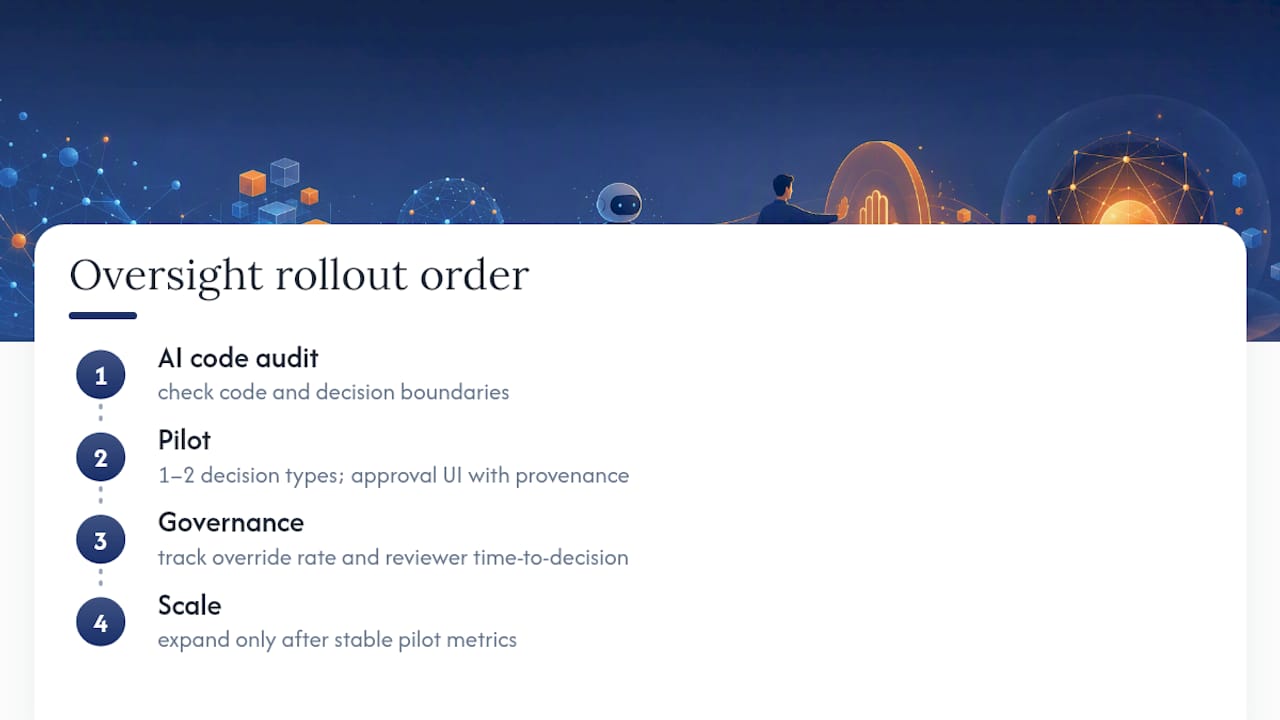
When we recommend a pilot, it’s deliberately small: one or two decision types, a defined evaluative role, and a lightweight approval interface with real confidence and provenance data attached, not a bare “approve or deny” button. We track override rates and reviewer time-to-decision from week one, because those two numbers tell you faster than anything else whether the loop is doing real work or becoming a rubber stamp.
Before any of that, though, we look at the underlying code. Adding an approval layer on top of an agentic system that was never designed with clear decision boundaries just adds a slow, expensive checkpoint to a system with an unstable foundation. That’s why we push clients toward an AI code audit first. Pilot, then governance, then scale, in that order, never reversed.
— Chad
Get a Second Set of Eyes on Your AI Before You Add Human Oversight to It
If your agent, model, or AI-assisted workflow is already live and you’re now trying to bolt on approval steps, escalation logic, or audit trails after the fact, you’re not alone, and it’s usually harder than building it in from the start. Bowtie specializes in exactly that gap: reviewing AI-generated and agentic systems for the decision boundaries, provenance gaps, and silent failure points that make human oversight either meaningless or unnecessarily slow.
Our AI code audit gives you a clear, prioritized picture of where your system needs a genuine evaluative checkpoint versus where it’s safe to run unsupervised, plus a production-ready path to implement it without rebuilding from scratch. Clients ranging from the NFL to early-stage startups have used this process to move from “we think it’s safe” to “we can prove it’s governed.” If you’re weighing an AI integration project that will need real oversight architecture, get an audit before you write the approval UI. Reach out to Bowtie and we’ll tell you honestly whether your system needs a pilot, a rebuild, or just better logging.
Sources
For readers who want to go deeper into the research and frameworks behind this article:
- Human–AI feedback loops amplify human bias (Nature, 2024)
- Keeping an eye on AI: A framework for effective human oversight of AI systems (arXiv, 2026)
- Human-in-the-loop (Databricks blog)
FAQ
What does human-in-the-loop mean in AI?
Human-in-the-loop AI is a design approach where a person reviews, corrects, or approves a model’s output at defined points, rather than letting the system act fully autonomously. It applies most often to high-stakes, uncertain, or agentic decisions where an error carries real cost.
What is the difference between human-in-the-loop and human-on-the-loop?
Human-in-the-loop means a person actively participates in the decision before it takes effect, typically through synchronous approval. Human-on-the-loop means a person monitors the system’s ongoing behavior and can intervene, but the system generally acts on its own unless something triggers a review.
What is human-on-the-loop?
Human-on-the-loop is a supervisory model where AI systems run autonomously under human monitoring, with people watching dashboards, alerts, or aggregate metrics rather than approving each individual decision. It trades per-decision oversight for scalability, which works when errors are recoverable and monitoring can catch drift early.
What is human-in-the-loop for AI agents?
For autonomous agents, human-in-the-loop usually takes the form of a pause-before-action checkpoint: the agent proposes a step, states its reasoning briefly, and waits for approval before executing anything above a defined risk threshold. Below that threshold, the agent proceeds without a human check.