
Enterprise AI development is the discipline of building production-grade, governed agentic AI systems that run inside real business workflows, not sandboxed demos. The core recommendation is straightforward: prioritize model-flexible architectures grounded in your proprietary data, wrapped in governance from day
one. Get that combination right and you get faster, safer, measurable business impact instead of another pilot that quietly dies in a Slack channel.
TL;DR:
- Building flexible, governance-integrated architectures that rely on proprietary data is essential to avoid pilot projects that fail to scale or provide measurable impact.
- Prioritizing use cases like customer service and revenue operations with clear metrics and contained risks helps ensure fast ROI and smoother deployment.
- The technical foundation must include robust data infrastructure, multi-strategy model management, and strict observability to prevent pilot failures from turning into liabilities.
- Scaling from prototype to production requires disciplined validation, behavioral and safety testing, continuous monitoring, and an automated rollback system.
- Embedding governance controls directly into deployment pipelines with proper access, audit trails, and compliance reviews prevents costly incidents and aligns with rapid industry adoption.
Table of Contents
- What Enterprise AI Development Means Now
- Where Should Enterprise AI Development Efforts Focus First?
- What Technical Building Blocks Does Enterprise AI Require?
- How Do You Take Enterprise AI From Prototype to Production?
- What Governance and Security Controls Does Enterprise AI Need?
- Which Architecture Patterns Prevent Vendor Lock-In?
- What Does an Enterprise AI Implementation Roadmap Look Like?
- What Engineering Practices Keep Enterprise AI Reliable?
- How Bowtie Approaches Enterprise AI Development
- The Real Bottleneck Isn’t the Model
- Get Enterprise AI Development Built Right the First Time
- Key Frameworks and Reports Worth Reviewing
- Sources
- FAQ
What Enterprise AI Development Means Now
Enterprise AI development has moved past the “chatbot on top of a document” phase. The work now centers on agentic AI: systems that don’t just answer questions but take actions, call tools, and complete multi-step tasks inside your actual business processes. That shift changes everything about how teams architect, test, and govern these systems, because an agent that can execute a refund or update a CRM record carries very different risk than a model that just generates text.
Three trends are reshaping how serious engineering teams approach this work.
Agentic workflows are replacing single-shot prompts. Instead of one model call producing one output, production systems now chain reasoning steps, tool calls, and validation checks. Oracle’s guidance on enterprise AI development frames this directly: modern deployments rely on selecting foundation models, grounding them in proprietary data, defining agentic workflows, and implementing secure deployment with audit trails. That’s not a checklist you can skip pieces of. Miss the grounding step and your agent hallucinates policy. Miss the audit trail and you can’t explain a bad decision to a regulator or a customer.
Retrieval-augmented generation (RAG) has become the default pattern for unstructured data. PDFs, support tickets, contracts, internal wikis. Treating this material as a first-class input, rather than an afterthought bolted onto a model, is what separates systems that stay accurate from ones that drift into confident nonsense within weeks of launch.
Model-flexible strategies are replacing single-vendor bets. Teams are building semantic and abstraction layers that let them swap models without rewriting application logic. Consider these current shifts happening in parallel:
- Agentic AI is expanding from customer-facing chat into back-office execution
- RAG pipelines are being rebuilt to handle messy, unstructured enterprise data at scale
- Model-flexible architectures are decoupling business logic from any single LLM vendor
- Governance requirements are moving earlier in the development cycle instead of trailing it
That last point deserves attention. IDC’s research on enterprise AI strategy argues that model-flexible, multi-agent architectures are no longer optional for teams trying to control cost, latency, and lock-in risk simultaneously.
Where Should Enterprise AI Development Efforts Focus First?
Not every workflow deserves an AI agent. The teams that get ROI fast pick use cases with clear success metrics, contained blast radius, and enough transaction volume to justify the engineering investment.
Customer service is the proving ground most teams start with. Gartner projects that agentic AI will autonomously resolve a significant portion of common customer service issues without human intervention by 2029. That number should shape how you design fallback handling now, not later, because the agents that fail gracefully into human handoff are the ones that survive contact with real customers.
Sales and revenue operations benefit from agents that draft outreach, enrich lead data, and summarize call transcripts, freeing reps to spend time on actual conversations instead of data entry.
Finance, supply chain, and R&D teams are deploying knowledge assistants that answer policy questions, reconcile discrepancies across systems, and automate document-heavy approval chains. These use cases carry higher compliance stakes, which is exactly why they need governance built in from the start rather than retrofitted after an incident.
Four criteria should drive your pilot selection:
- Measurable baseline exists. You need a “before” number (resolution time, error rate, cost per transaction) to prove impact.
- Contained failure mode. A wrong answer should be embarrassing, not catastrophic.
- Data is already accessible. If the source data requires six months of cleanup, that’s not a pilot, that’s a data project wearing an AI costume.
- A clear owner exists. Someone on the business side must own the outcome, not just IT.
Pick a use case that satisfies all four and you’ll have a defensible case for the next budget cycle. Pick one that satisfies only two and you’ll spend that budget cycle explaining why the pilot stalled.
What Technical Building Blocks Does Enterprise AI Require?
The stack underneath enterprise AI development has three layers, and skipping any one of them is how pilots turn into liabilities.
-
Data infrastructure. Ingestion pipelines, vector stores for semantic search, and a real data catalog with lineage tracking. Without lineage, you cannot answer the question “why did the model say that” when someone asks, and someone always asks.
-
Model selection strategy. Fine-tuning, retrieval, and hosted APIs solve different problems, and conflating them wastes both engineering time and compute budget. Fine-tune when you need consistent behavior on a narrow, stable task. Use retrieval when your knowledge base changes weekly and freshness matters more than latency. Use hosted foundation model APIs when speed to market beats marginal cost savings. Vendor platforms like NVIDIA AI Enterprise package reference architectures for exactly this kind of workload orchestration, which is worth evaluating before building your own from scratch.
-
Model registry, experiment tracking, and FinOps. Every model version, every evaluation run, every prompt change needs a record. Compute orchestration decides which workloads run on GPUs versus CPUs. FinOps discipline, meaning real-time visibility into token costs and inference spend, is what keeps a promising pilot from becoming a line item finance kills without warning.
Get these three layers right and your team can move fast without breaking governance. Skip one, and you’ll eventually rebuild it under pressure, mid-incident, with an executive asking why nobody caught this sooner.
How Do You Take Enterprise AI From Prototype to Production?
A working demo and a production system are not the same artifact, and the gap between them is where most enterprise AI projects die. The lifecycle that actually works looks like this:
- Prototype. Prove the concept works on a narrow slice of real data, not synthetic examples.
- Reproducible experiments. Lock down the environment so results can be replicated by someone other than the person who built it.
- Staging. Run the system against production-like data with real edge cases, not the clean examples from the demo deck.
- Canary rollout. Ship to a small percentage of real traffic and watch closely before expanding.
- Full rollout. Expand only after canary metrics hold steady across a meaningful sample size.
- Continuous evaluation. Treat launch as the beginning of monitoring, not the end of the project.
Testing discipline has to expand beyond traditional unit tests. Agentic systems need behavioral tests (does the agent take the right action given a specific input) and safety tests (does the agent refuse or escalate appropriately when it hits something outside its scope). A model that answers correctly 95% of the time but occasionally takes an irreversible wrong action isn’t 95% safe. It’s a liability with a good average.
Automation has to cover CI/CD for prompts and model versions, not just application code, plus retraining triggers tied to drift detection rather than a fixed calendar schedule. Bowtie’s own guide on AI workflow automation walks through how these agentic pipelines get structured for enterprise workflows in more technical detail.
Pro Tip: Build your canary rollout with an automatic rollback trigger tied to a specific metric threshold, not a manual review. The moment a human has to remember to check a dashboard is the moment a bad rollout runs three days longer than it should.
What Governance and Security Controls Does Enterprise AI Need?
Governance for enterprise AI works best when it’s embedded in the runtime itself, not bolted on as a separate compliance review after the fact. That’s the practical implication of NIST’s framework: traceability, documentation, and auditability are foundational controls, not optional extras for teams with spare engineering time.
Concretely, that means:
- Access control tied to identity, not shared API keys passed around in Slack messages.
- Approval gates on any agent action with financial, legal, or customer-facing consequences.
- Audit trails that log not just outputs, but the retrieved context and reasoning steps that produced them.
- Zero-data-retention patterns for sensitive workloads, where vendor contracts explicitly exclude your data from training pipelines.
- Regular access reviews so permissions granted for a pilot don’t quietly outlive the pilot itself.
Stanford’s AI Index tracks how fast model capabilities and enterprise adoption are both accelerating, and that pace is exactly why governance can’t be an annual review cycle anymore. The 2025 AI Index report documents adoption and capability growth that outpaces most organizations’ existing risk review cadence, which means governance needs to run continuously, embedded in deployment pipelines, rather than as a quarterly checkpoint.
Bowtie’s data governance framework for AI walks decision-makers through building this into the platform layer instead of treating it as paperwork that trails behind actual deployment.
Which Architecture Patterns Prevent Vendor Lock-In?
The teams avoiding painful rebuilds are the ones who decoupled application logic from any single model provider early. A model gateway, an abstraction layer sitting between your application and whichever foundation model you’re calling, lets you swap providers based on cost, latency, or capability without touching business logic. That single decision saves months when a preferred vendor changes pricing or a better model ships.
A RAG layer and standardized tool interfaces do similar work: they keep retrieval logic and tool calls separate from model internals, so a model swap doesn’t mean rewriting your entire pipeline.
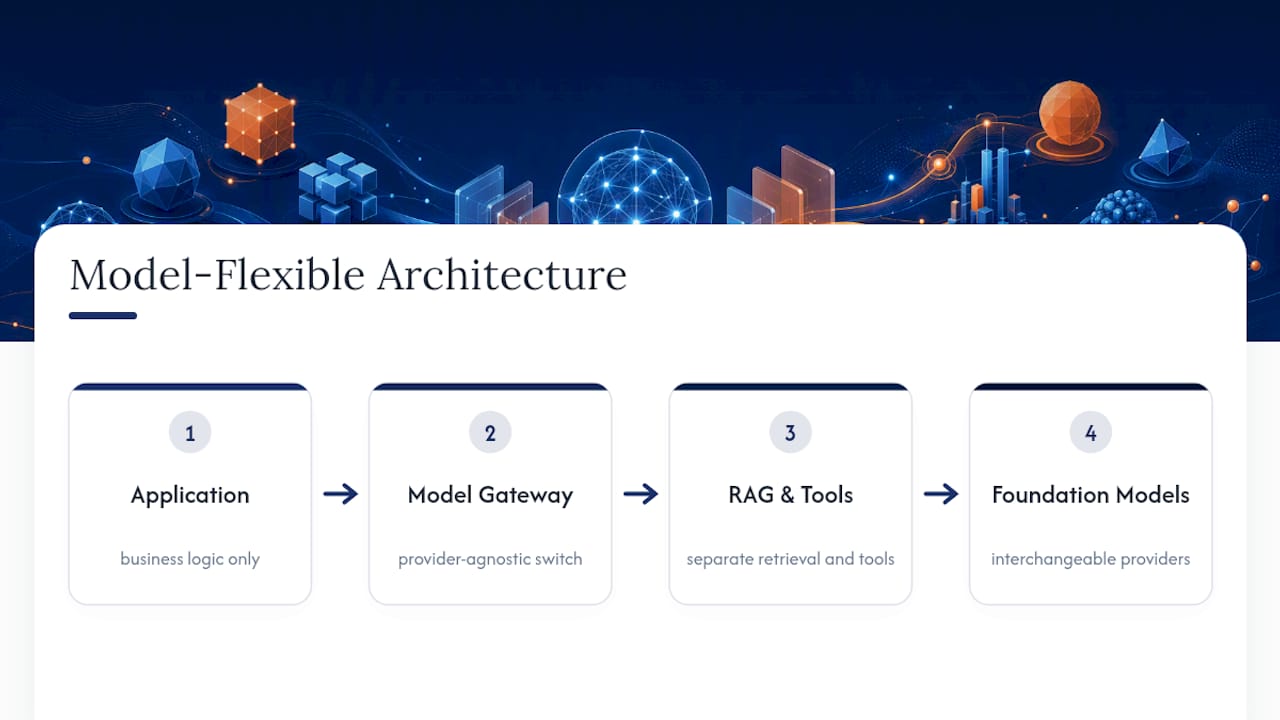
Multi-agent orchestration becomes worth the added complexity once a single agent can’t reasonably own an entire task end to end, think a “research agent” handing structured findings to a “drafting agent,” each with narrower scope and clearer failure boundaries.
What Does an Enterprise AI Implementation Roadmap Look Like?
A realistic roadmap has distinct phases with real risk-review gates between them, not a straight line from idea to production.
- Discovery and use case selection. Identify the pilot, define success metrics, confirm data access.
- Data and architecture design. Build ingestion pipelines, choose the model strategy, design the governance layer.
- Prototype and internal testing. Build the agent, run behavioral and safety tests, get stakeholder sign-off.
- Staging and canary rollout. Test against production-like traffic, then expand to a small live percentage.
- Full production rollout (ongoing). Scale traffic while continuous evaluation runs in the background.
- Maintenance and iteration (ongoing). Scheduled retraining, drift monitoring, and cost review on a fixed cadence.
Each phase should end with a risk-review gate: a specific person, not a committee, who signs off before the project moves forward. Resourcing tends to break down when teams underestimate the data and governance phases, assuming the “AI part” is the hard part when it’s usually the integration and compliance work that eats the calendar.
Pro Tip: Budget for a security and governance readiness audit before your first production rollout, not after. Finding the gap in a pre-launch review costs a week. Finding it after an incident costs your credibility with the executive team.
Bowtie’s AI workflow integration guide breaks down how this roadmap adapts when you’re layering agents onto existing enterprise systems like ERP or CRM platforms, rather than building on a clean slate.
What Engineering Practices Keep Enterprise AI Reliable?
Code quality standards don’t relax just because an AI agent wrote the code instead of a human. If anything, they need to tighten, because agentic tooling that generates commits and pull requests autonomously, the kind of pattern seen in emerging repository-aware coding agents, still needs a human reviewing production-readiness before merge.
- Audit generated and agent-written code against the same security and quality bar as human-written code, with no exceptions for “the AI wrote it fast.”
- Monitor prompts and outputs continuously, watching for drift in response quality as underlying data or model versions shift.
- Track latency and cost telemetry per request, because a slow or expensive agent call multiplied across thousands of daily transactions turns into a budget problem fast.
- Run scheduled retraining and maintain incident runbooks so a bad deployment has a documented rollback path instead of an improvised one.
Bowtie’s guide to AI observability covers the specific monitoring patterns, drift detection methods, and telemetry setups that keep these systems accountable once they’re live.
How Bowtie Approaches Enterprise AI Development
Some companies build custom applications, audit existing code, and create agentic workflows engineered for production, not demo day. That means clean, secure code and governance baked in from the first sprint, not added after a security review flags problems.
When evaluating any partner for this kind of work, ask direct questions: What’s your code audit process? How do you handle access control and audit trails? What’s the support structure after launch, and does it include ongoing maintenance? Bowtie’s approach to choosing a software development partner covers exactly these evaluation criteria in more depth. Clients ranging from major corporations to startups have used this framework to vet vendors before committing budget.
The Real Bottleneck Isn’t the Model
Every enterprise AI project we’ve seen struggle has hit the same wall: not model quality, but lifecycle management at scale. Teams get the prototype working in weeks, then spend the next six months discovering that nobody planned for drift detection, cost overruns, or the access review that should have happened before launch, not after.
Pick one measurable pilot this quarter. Run a security and governance readiness audit before you scale it. Define exactly where a partner’s scope starts and where your internal team’s ownership begins.
— Chad
Get Enterprise AI Development Built Right the First Time
Most enterprise AI projects don’t fail because the model was wrong. They fail because nobody built the governance, testing, and observability layer around it, and by the time that gap surfaces, it’s an incident instead of a code review comment. Some providers focus on that gap: building agentic workflows and custom AI applications with clean, secure, production-ready code from the first commit, and staying engaged after launch instead of disappearing once the invoice clears.
If your team is weighing whether to build in-house, patch an existing AI project, or bring in outside engineering support, Bowtie’s AI integration and enterprise modernization services are built around exactly that decision point. We also audit AI-generated and Vibe-coded applications that need a professional review before they touch production, covered in our breakdown of why every AI application needs a code audit. If you’re planning a pilot this quarter, start with a scoped conversation about your architecture and governance needs before you write a line of code.
Key Frameworks and Reports Worth Reviewing
These sources back the recommendations throughout this guide and reward a closer read:
- NIST AI Risk Management Framework: the standard reference for traceability and audit controls.
- IDC’s analysis of multi-model architectures: why model-flexible design is becoming the norm.
- AWS secure enterprise ML platform whitepaper: concrete infrastructure and controls guidance.
- Gartner’s agentic AI forecast: capacity planning for customer service automation.
- Stanford HAI’s 2025 AI Index: adoption and capability trend data for planning.
Sources
- NIST AI Risk Management Framework
- IDC: Beyond LLMs — multi-model and multi-agent architectures
- Gartner press release on agentic AI adoption
- Stanford HAI — 2025 AI Index report
FAQ
What Is Enterprise AI Development?
Enterprise AI development is the process of designing, building, and operating production-grade AI systems, often agentic ones, that run inside business workflows with governance, security, and auditability built in, as opposed to standalone consumer AI tools.
What Are Enterprise AI Development Services?
Enterprise AI development services typically cover custom agentic workflow design, model selection and grounding in proprietary data, secure deployment with audit trails, and ongoing maintenance. Bowtie offers this full range, from initial architecture through post-launch support.
What Is the 30% Rule in AI?
There’s no single, universally recognized “30% rule” in enterprise AI governance or development. If you’ve seen this term used in a specific context, it likely refers to a vendor’s or analyst’s own framing rather than an industry-wide standard, so verify the source before applying it.
Which Jobs Are Least Likely to Be Automated by AI?
Roles requiring complex human judgment, relationship management, and physical dexterity in unpredictable environments, such as senior clinical care, skilled trades, and high-stakes negotiation, tend to be the most resistant to full automation, since current agentic AI is designed to augment workflows rather than replace judgment entirely.
Do High-Paying AI Roles Really Exist at That Scale?
Reports of very high-compensation AI roles do circulate, generally tied to specialized skills in agentic system design, model architecture, or applied research at large technology firms, but exact figures vary widely by company, role, and equity structure, and no single number applies across the industry.