
Data sovereignty is about which country’s laws can reach your data. Data residency is about which country your data physically sits in. They overlap constantly and get treated as synonyms, which is exactly how compliance programs end up with gaps
nobody notices until an audit or a subpoena forces the question.
Here’s the fast version: if you’re worried about who can compel access to data, you’re asking a sovereignty question, governed by regimes like GDPR, the CLOUD Act, and HIPAA. If you’re worried about where the servers live, you’re asking a residency question, usually a matter of contract terms and region selection.
- Sovereignty triggers: corporate incorporation, court orders, national security law.
- Residency triggers: data center location, region-based storage, customer contract terms.
Prioritize sovereignty analysis first when government contracts, healthcare, or financial data are involved. Prioritize residency controls first when the driver is latency, performance, or a customer’s contractual preference.
Pro Tip: Ask any vendor three questions before you trust a “data stays in your region” claim: what country is the parent company incorporated in, who holds the encryption keys, and can you get a sample of their data access logs?
Key Takeaways
Data sovereignty governs which country’s laws can reach your data regardless of location, while data residency governs the physical region where that data sits, and compliance programs need both addressed separately.
| Point | Details |
|---|---|
| Separate the two concepts | Sovereignty is legal jurisdiction; residency is physical location. Neither substitutes for the other. |
| Check corporate jurisdiction | A vendor’s parent company incorporation can override regional storage promises under laws like the CLOUD Act. |
| Verify transfer mechanisms | GDPR transfers need adequacy decisions, SCCs, or BCRs, plus a Transfer Impact Assessment when none apply. |
| Map every data copy | Backups and disaster-recovery replicas often break residency commitments made for production data. |
| Watch the U.S. patchwork | No federal residency law exists; sectoral rules and DOJ country-of-concern restrictions apply on top of state laws. |
If your organization needs help mapping these controls into actual architecture rather than a policy binder, Bowtie’s AI integration services work through vendor jurisdiction, region selection, and technical controls as part of building or auditing production systems. Teams dealing with AI models trained on regulated data particularly benefit from a professional code audit that checks where training data actually flows, not just where the architecture diagram says it should.
Where to Verify These Claims Directly
- The DOJ’s Federal Register rule for exact licensing and reporting requirements.
- RPC’s overview of the U.S. patchwork for the sectoral and state law landscape.
- Secure Privacy’s explainer on GDPR transfer mechanisms.
- Wire’s analysis of the CLOUD Act for corporate jurisdiction risk.
- GreenCube’s GDPR compliance roadmap for AI-specific transfer obligations.
Table of Contents
- Data Residency vs Sovereignty: What Sovereignty Actually Means
- What Data Residency Means in Practice
- How Do Sovereignty and Residency Compare Side by Side?
- When Does Each Concept Actually Matter?
- What Should Compliance and Legal Teams Verify?
- Turning Requirements Into Technical and Contractual Controls
- Common Pitfalls That Trip Up Compliance Programs
- How Are U.S. Rules on Data Transfers Changing?
- Frequently Asked Questions
- Sources
Data Residency vs Sovereignty: What Sovereignty Actually Means
Data sovereignty determines which country’s laws and enforcement bodies can compel access to, regulate, or seize your data, regardless of where a server happens to sit. It’s a legal concept, not a technical one. A file stored in Frankfurt can still be subject to U.S. law if the company managing it is American.
Sovereignty gets triggered by several overlapping factors: where the data is physically stored, where the controlling entity is incorporated, and where the data subject lives. Splunk’s comparison of the two concepts frames sovereignty as fundamentally about legal authority over data, not geography. Enforcement comes from several directions at once:
- National data protection authorities (like Ireland’s DPC or Germany’s BfDI)
- National security and law enforcement orders (subpoenas, warrants, the CLOUD Act)
- Courts applying extraterritorial statutes, including GDPR’s reach over any company processing EU residents’ data
GDPR shows sovereignty following the person, not the server. A U.S. company with zero European offices still owes GDPR obligations if it processes EU residents’ data. Meanwhile, the CLOUD Act shows sovereignty following the company: as IBM’s analysis notes, residency alone doesn’t determine which laws apply, since factors like data collection origin and control also matter.
Legal teams assessing sovereignty exposure need a jurisdictional risk matrix: where is the vendor incorporated, where is the parent company incorporated, what government orders has that jurisdiction issued in the past three years, and what notice rights does your contract preserve?
What Data Residency Means in Practice
Data residency is simpler on its face: it’s the physical or regional location where your data is stored, processed, or backed up. Choose the “US East” region on a cloud console, and you’ve made a residency decision.
Residency is not the same as localization, even though people use the terms interchangeably. Localization is a legal mandate requiring data to stay inside a specific territory. Residency is often a voluntary architectural choice made for performance or contract reasons, with no law forcing it.
Three drivers typically push organizations toward specific residency choices:
- Latency and performance: keeping data close to users speeds up applications.
- Contractual or customer requirements: enterprise clients often demand region guarantees in writing.
- Risk management: concentrating sensitive data in fewer, better-controlled regions simplifies audits.
Two technical controls make residency real instead of aspirational: explicit region selection at the infrastructure level, and region-locked backup policies, since a backup replicated to the wrong continent quietly undoes your residency commitment.
Pro Tip: Build data-flow maps that tag every dataset with its storage region and every downstream copy. When an auditor asks where a customer’s data lives, “we think it’s in Virginia” is not an acceptable answer.

How Do Sovereignty and Residency Compare Side by Side?
| Dimension | Data Sovereignty | Data Residency |
|---|---|---|
| Legal authority / enforcement | Governed by the laws of the jurisdiction with legal claim over the data or the entity handling it | Governed by contract and internal policy, not automatically by law |
| Physical location vs logical controls | Independent of physical location; can follow the corporate entity or the data subject | Defined entirely by physical or regional storage location |
| Typical use cases | Government contracts, national security data, cross-border personal data flows | Latency optimization, customer contract terms, regional performance needs |
| Technical measures that satisfy each | Corporate jurisdiction review, warrant-shielding clauses, key management outside reach of foreign law | Region selection, region-locked backups, data-flow mapping and tagging |
| Operational impact | Can restrict vendor choice entirely regardless of hosting location | Affects latency, availability, and potential vendor lock-in per region |
Sovereignty trumps residency when a government contract, classified data, or a “country of concern” restriction is in play. No amount of clever region selection fixes a sovereignty problem rooted in corporate jurisdiction. Residency takes priority when the concern is purely operational, such as a customer in Singapore complaining about page load times.
Localization sits between the two: it’s a legal residency mandate, essentially residency with teeth. When you draft an RFP or a data processing agreement, require vendors to specify key management location, any warrant-shielding commitments, and which cross-border transfer mechanism applies to each data flow.
When Does Each Concept Actually Matter?
Certain scenarios force the sovereignty-versus-residency question whether you’re ready or not:
- Handling EU personal data as a non-EU company
- Bidding on government contracts requiring domestic processing
- Managing classified or government-related datasets
- Healthcare data under HIPAA
- Financial data under GLBA
- Training AI models on sensitive or regulated datasets
Cloud architecture decisions compound this. Choosing a public cloud region is a residency choice; choosing a sovereign cloud offering (built specifically to keep both data and operational control within a jurisdiction) is a sovereignty choice. Multi-region replication for uptime can quietly undercut both if backups land somewhere unintended.
Cross-border transfers add another layer entirely. GDPR does not actually require EU data to stay in the EU; it requires a legal mechanism, adequacy decisions, Standard Contractual Clauses, or Binding Corporate Rules, and a Transfer Impact Assessment when none apply cleanly.
Three quick scenarios show the pattern:
- An EU customer’s data sits in a U.S. region, transferred lawfully under SCCs, satisfying sovereignty requirements without residency in the EU.
- A government contract mandates domestic processing, making residency and sovereignty requirements identical and non-negotiable.
- A healthcare vendor stores data in-region but remains subject to a foreign parent company’s legal obligations, breaking the assumption that residency equals protection.
Check corporate jurisdiction first, transfer mechanism second, and technical region controls third, in that order.
What Should Compliance and Legal Teams Verify?
GDPR transfers rely on three mechanisms: adequacy decisions (the EU deeming a country’s protections sufficient), Standard Contractual Clauses, and Binding Corporate Rules for intra-company transfers. Absent any of these, a Transfer Impact Assessment becomes mandatory before data moves.
The U.S. picture looks different by design. There is no single comprehensive federal data residency law; compliance runs through sector-specific rules like HIPAA and GLBA plus a growing patchwork of state privacy statutes such as California’s CPRA. National security law adds another layer on top of the sectoral patchwork, restricting certain data transactions tied to specific foreign jurisdictions.
Build your contract review around these steps:
- Confirm the transfer mechanism (adequacy, SCCs, or BCRs) named explicitly for each cross-border flow.
- Require data location guarantees with named regions, not vague “EU-based” language.
- Limit subcontractors and require disclosure of any new ones before onboarding.
- Secure audit rights and access-log commitments in writing.
- Negotiate law-enforcement notice provisions wherever legally permitted.
Enforcement risk is not theoretical. Ireland’s Data Protection Commission fined Meta €1.2 billion in 2023 for unlawful international data transfers, the largest GDPR penalty on record and a direct consequence of getting the transfer mechanism wrong.
Turning Requirements Into Technical and Contractual Controls
Legal requirements mean nothing until engineering and procurement teams turn them into working systems. Split the work into four tracks:
- Technical: region selection, VPC and network isolation, encryption at rest and in transit, customer-managed keys, and split-key architectures with HSM placement for the most sensitive datasets.
- Operational: data classification, data-flow mapping, environment tagging, and region-tied backup and retention rules, with incident response playbooks written per jurisdiction rather than one generic version.
- Contractual: DPA clauses, a current subprocessors list, audit and inspection rights, access-logging commitments, and warrant-shielding language requiring notice before disclosure where the law allows it.
- Governance: named owners for each jurisdiction, a living jurisdictional risk register, and scheduled Transfer Impact Assessments tied to vendor renewal cycles.
Two clause patterns worth building into templates:
- A data-location clause naming the specific region and requiring advance written notice before any change.
- An audit clause granting the right to request evidence of technical controls, not just a policy document, on a defined schedule.
Bowtie’s work auditing AI-generated and vibe-coded applications regularly turns up exactly this gap: an app that “looks” compliant in its architecture diagram but has never actually verified where its data or its vendor’s parent company sits. Reviewing cloud provider selection through the lens of enterprise AI integration catches these issues before they become contractual disputes.
Common Pitfalls That Trip Up Compliance Programs
Most residency and sovereignty failures trace back to a handful of repeated mistakes:
- Treating “our data stays in the EU” as proof of sovereignty, when the parent company’s jurisdiction may override it entirely.
- Trusting vendor marketing copy over contract language and actual technical evidence.
- Ignoring corporate jurisdiction of subcontractors buried three layers deep in a vendor’s supply chain.
- Failing to map backups and disaster-recovery copies, which often live in a different region than production data.
Watch for vague vendor language like “regional storage” with no supporting documentation. Ask for a data center location certificate, sample access logs, and the actual SCC or Transfer Impact Assessment paperwork before signing.
Pro Tip: Budget a genuine residency or sovereignty program in months, not weeks. Data mapping alone across a mid-sized organization typically takes several sprints before you even start on contract renegotiation.
How Are U.S. Rules on Data Transfers Changing?
The U.S. approach remains deliberately fragmented. There’s no omnibus federal residency law; HIPAA governs health data, GLBA governs financial data, and state laws like California’s CPRA fill in gaps state by state.
What’s shifted recently is the national security layer. A Department of Justice rule effective in early 2025 restricts bulk transfers of U.S. sensitive personal data and government-related data to designated “countries of concern,” including China, Russia, Iran, North Korea, Cuba, and Venezuela. The Federal Register rulemaking lays out prohibited and restricted transaction categories along with new licensing, recordkeeping, and reporting obligations.
- Vendors handling bulk sensitive personal data now face licensing requirements tied to the destination country.
- Recordkeeping and reporting obligations apply even to some restricted (not fully prohibited) transactions.
- Penalties for violations sit alongside existing GDPR-style fines as a second, distinct enforcement track.
This rule doesn’t replace the sectoral patchwork; it stacks a national-security filter on top of it, meaning a transaction can clear HIPAA and GLBA review and still trip the DOJ’s country-of-concern restrictions.
A practitioner’s take on prioritizing tradeoffs
Balancing latency, cost, and sovereignty risk starts with classification, not architecture. Three rules hold up consistently: classify data before choosing regions, assume sovereignty exposure the moment government involvement appears, and reserve sovereign cloud offerings for the subset of data that actually requires them rather than defaulting to them everywhere.
Pro Tip: During vendor due diligence, ask who the vendor’s cloud subprocessors are and where those subprocessors are incorporated. That’s usually where hidden jurisdictional risk hides, not in the vendor’s own headquarters.
Frequently Asked Questions
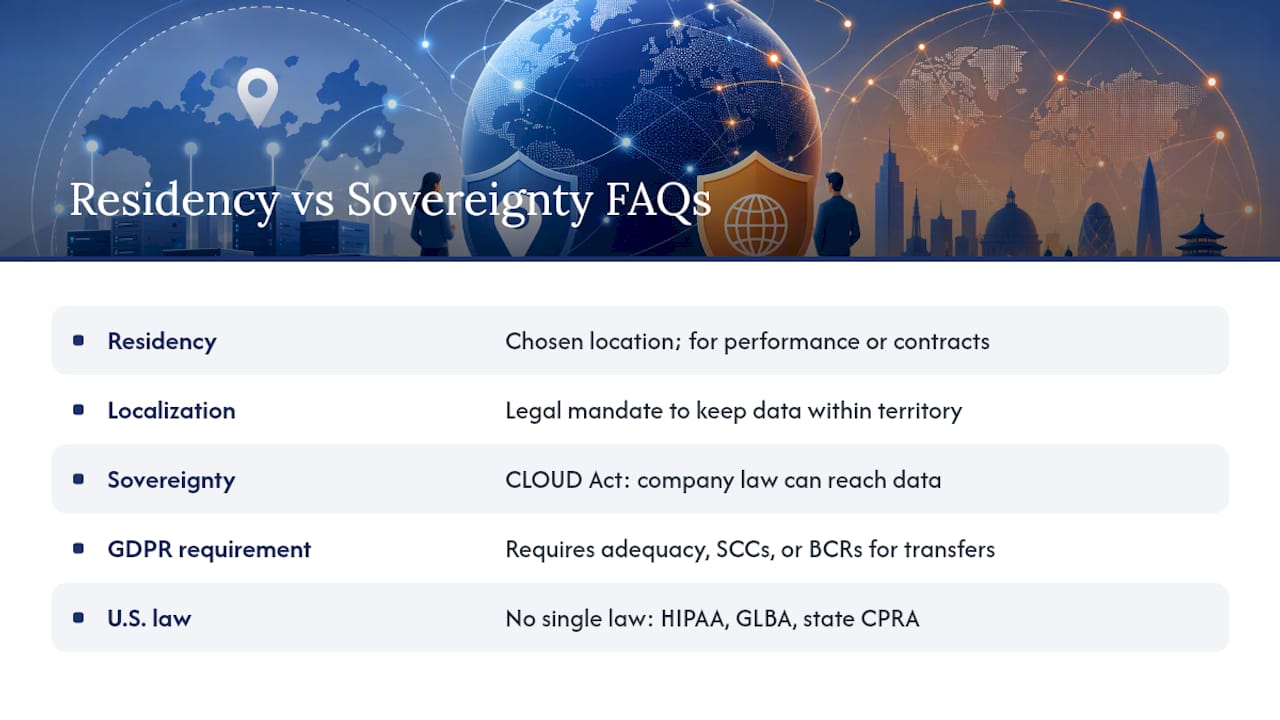
Is data residency the same as data localization? No. Residency is a chosen storage location, often driven by performance or contract terms. Localization is a legal mandate requiring data to stay within a specific territory, with penalties for noncompliance.
Can a company have data residency without data sovereignty? Yes, and it happens constantly. Data stored in an EU region can still be subject to U.S. law if the company managing it is American, thanks to statutes like the CLOUD Act.
Does GDPR require data to stay in the EU? No. GDPR requires a lawful transfer mechanism, such as an adequacy decision, Standard Contractual Clauses, or Binding Corporate Rules, when data leaves the EU, not physical confinement within EU borders.
What U.S. law governs data residency? No single federal law does. HIPAA covers health data, GLBA covers financial data, and state laws like California’s CPRA fill remaining gaps, creating a sector-by-sector compliance patchwork.
Why does corporate jurisdiction matter more than server location? Because laws like the CLOUD Act reach the company, not the server. A U.S.-incorporated provider can be compelled to produce data stored anywhere in the world, regardless of the region selected.
This article is general information, not a substitute for advice from a qualified lawyer. Consult a qualified legal professional about your own circumstances before acting on anything here.
Sources
- Federal Register: Rule implementing restrictions on transactions involving government-related data and bulk U.S. sensitive personal data
- The patchwork of federal data protection laws
- Data Sovereignty vs. Data Residency
- data-residency-requirements-eu-vs-us-explained