A small MVP typically runs $40,000 to $150,000, a mid-size business app lands between $150,000 and $400,000, and enterprise platforms often start at $400,000 and climb past $1.5 million. If a vendor quote lands outside these bands without a clear
reason, run a short discovery session before you sign anything.
TL;DR:
- Small or MVP projects usually cost between $40,000 and $150,000, with a timeline of three to five months, covering a single workflow and basic integrations.
- Mid-size business applications range from $150,000 to $400,000, typically taking six to nine months, with multiple roles, reporting, and several integrations.
- Enterprise platforms start at $400,000 and can exceed $1.5 million, lasting from nine months to over two years, requiring compliance, multiple modules, and deep integrations.
- Variations in scope, complexity of integrations, data migration difficulty, and team composition are the main drivers that push costs between project bands.
- Accurate estimates depend on detailed scope documentation, clear assumptions, change-order controls, and a thorough discovery process before contracting.
Table of Contents
- What Does Custom Software Cost? A Quick Breakdown by Project Size
- Seven Cost Drivers That Move a Project Between Bands
- How Team Location and Hourly Rates Actually Change the Math
- What Does It Cost to Add AI Features in 2026?
- Maintenance, Hosting, and the Real 3-to-5-Year Cost of Ownership
- How to Get an Accurate Estimate: A Scoping Checklist
- Publisher Perspective: How Bowtie Approaches Cost Control
- Top Red Flags in a Low Bid
- Get a Scoped Quote Instead of a Guess
- Sources
- FAQ
What Does Custom Software Cost? A Quick Breakdown by Project Size
The honest answer to “what does custom software cost” depends entirely on what you’re actually building, but the ranges cluster predictably once you know what to look for.
A small or MVP build usually covers one core workflow, a handful of user roles, and basic integrations, think a booking tool or an internal inventory tracker. Expect $40,000 to $150,000 and a three to five month timeline.
A mid-size business application adds multiple user roles, reporting dashboards, and two or three third-party integrations, like a CRM tied to a billing system. That typically runs $150,000 to $400,000 over six to nine months.
Enterprise systems bring compliance requirements, dozens of integrations, and modules built for scale across departments or locations. Those projects commonly exceed several hundreds of thousands of dollars and can reach into the millions, with delivery windows stretching nine months to two years or more.
| Project size | Typical range | Timeline | What it buys |
|---|---|---|---|
| Small / MVP | $40,000 to $150,000 | 3 to 5 months | Single workflow, 1 to 3 user roles, basic integrations |
| Mid-size business app | $150,000 to $400,000 | six to nine months | Multiple roles, reporting, 2 to 3 integrations |
| Enterprise platform | $400,000 to $1.5M+ | 9 to 24 months | Compliance, multi-module scale, deep integration |
Here’s what catches most first-time buyers off guard: two vendors bidding on the identical brief can land $80,000 apart, and both quotes can be “correct.” One assumed you’d provide clean data for migration; the other assumed they’d have to clean it themselves. That gap is why a written scope document matters more than any single number a salesperson gives you over the phone.
Seven Cost Drivers That Move a Project Between Bands
Most budget overruns trace back to a small set of variables that decision-makers underestimate at the proposal stage. Knowing them lets you push back on a quote or decide which features to cut before you’re locked into a contract.
- Scope and feature count. Every additional screen, role, or workflow adds design, engineering, and testing hours. This is the single biggest lever on final price.
- Integrations and API work. Each third-party connection, a payment processor, an ERP, a legacy database, typically adds its own discrete chunk of engineering time, and undocumented APIs can double that estimate.
- Data migration complexity. Moving records from an old system involves mapping, cleaning, reconciliation, and cutover testing, and messy legacy data is one of the most reliably underestimated line items in any proposal.
- UX and design polish. A public-facing consumer app needs research, prototyping, and iteration that an internal admin tool simply doesn’t.
- Nonfunctional requirements. Performance under load, uptime guarantees, encryption standards, and regulatory compliance (HIPAA, SOC 2, PCI) add engineering and QA time that rarely shows up in a feature list.
- Team composition and seniority. A team heavy on juniors costs less per hour but often needs more hours and more rework; a lean team of seniors costs more per hour but frequently finishes faster with fewer defects.
- Decision latency on your side. Slow approvals, indecisive stakeholders, and requirement changes mid-sprint generate change orders, and change orders are where fixed-price budgets quietly become time-and-materials budgets.
Pro Tip: Rank your feature list into “must have for launch” and “everything else” before you talk to a single vendor. Every feature you defer to phase two is a direct cost reduction on your first invoice, not just a scheduling trick.
The methodology matters here too. Agile engagements tend to bill closer to time-and-materials, which spreads risk between you and the vendor but makes total cost harder to predict up front. Waterfall projects often quote fixed price, which feels safer, but only if the initial scope document was airtight, because any gap becomes a change order under a Waterfall contract, while Agile can absorb small pivots inside existing sprints.
How Team Location and Hourly Rates Actually Change the Math
Rate sheets are where most budgeting mistakes start, because a lower hourly rate doesn’t automatically mean a lower total invoice.
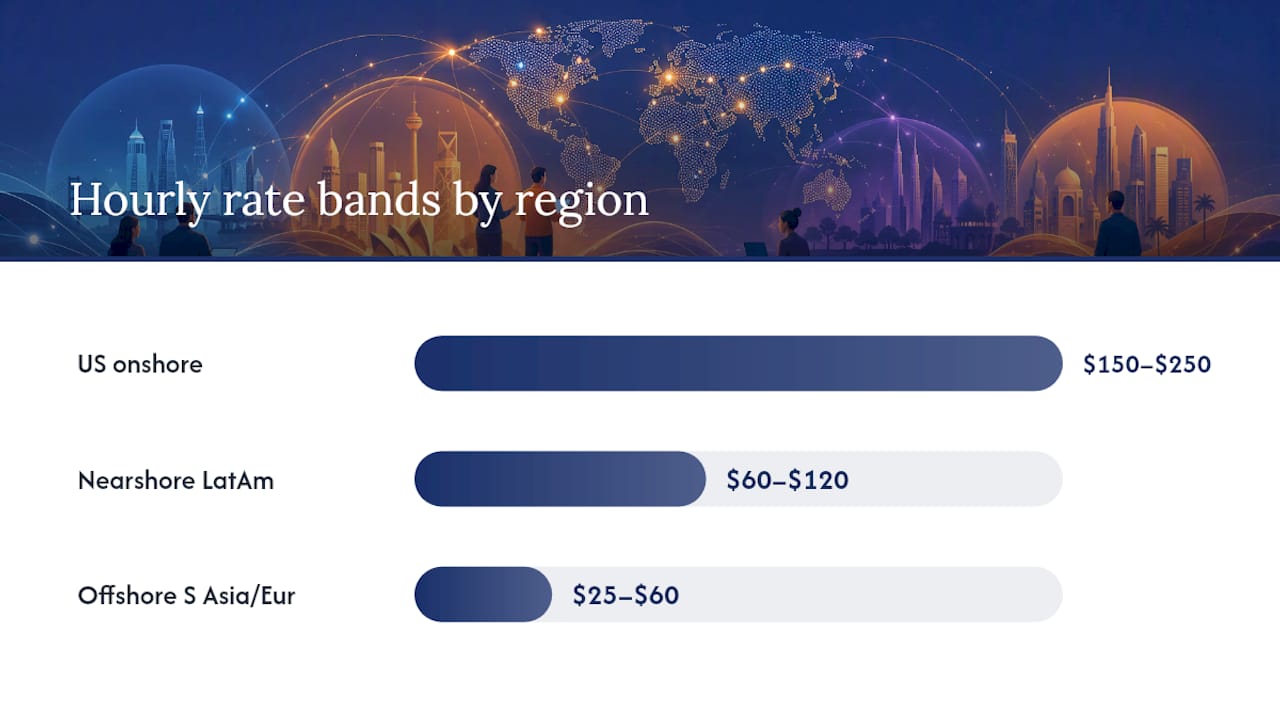
Representative hourly rate bands vary sharply by region and firm type:
- US onshore firms: roughly $150 to $250 per hour, often higher for specialized senior talent
- Nearshore teams (Latin America): roughly $60 to $120 per hour
- Offshore teams (South Asia, Eastern Europe): roughly $25 to $60 per hour
- Blended teams (onshore lead, offshore execution): a mix that averages somewhere in between, depending on the ratio
Here’s the math that trips people up. A $40 per hour offshore team quoting 1,200 hours looks like $48,000. A $180 per hour onshore team quoting 700 hours looks like $126,000. The offshore bid appears to win by $78,000. But if communication lag, time zone gaps, and rework push the offshore hours to 1,900 (a common outcome when specs get misread across a nine hour time difference), the real total climbs to $76,000, and you’ve also lost a month to review cycles. The gap shrinks fast once rework enters the equation.
None of this means offshore or nearshore is a bad choice. It means the hourly rate is only useful once you multiply it against a realistic hours estimate, not the optimistic one on the cover page of the proposal. Reserve onshore senior talent for the parts of the project where mistakes are expensive, security architecture, core data models, compliance-sensitive modules, and consider nearshore or blended teams for well-specified, modular work where requirements are unlikely to shift. For a deeper look at when outsourcing makes sense, our guide to outsourcing software projects walks through the trade-offs in more detail.
Growing demand for application development services keeps vendor supply healthy across every region, but that supply doesn’t erase the rate dispersion. It just means you have more options at every price point, which makes comparing bids on scope and total cost, not headline rate, even more important.
What Does It Cost to Add AI Features in 2026?
AI is no longer a separate line item you can ignore in a software budget, but it doesn’t have to be the most expensive part of the project either.
| AI implementation type | Typical cost range | Best fit |
|---|---|---|
| API integration (GPT, Claude, existing models) | $5,000 to $50,000 | Chatbots, content generation, basic automation |
| Low-code AI platforms | $5,000 to $50,000 | Quick pilots, non-technical teams |
| Custom AI development | $40,000 to $250,000 | Domain-specific models, proprietary data advantage |
| Enterprise AI systems | $250,000+ | Regulated industries, large-scale automation |
Those ranges hold across most industries, but the drivers that push a project toward the higher end are consistent: data readiness (is your data clean and labeled, or does someone need to spend weeks preparing it?), infrastructure needs, fine-tuning requirements, and ongoing monitoring to catch model drift or bad outputs before customers see them.
Start with an API integration or a low-code platform unless you have a specific performance ceiling or regulatory requirement that only a custom model can clear. Most businesses get real value from a well-integrated existing model long before they need to train their own.
Pro Tip: Budget for AI operating costs separately from the build cost. API calls, compute, and monitoring bill monthly and scale with usage, so a feature that costs $20,000 to build can still cost several thousand dollars a month to run at scale.
Maintenance, Hosting, and the Real 3-to-5-Year Cost of Ownership
The build price is never the full price. Skip this math and you’ll be blindsided by the second and third year of owning custom software.
A reasonable maintenance budget covers security patches, dependency upgrades, bug fixes, and small enhancements. Recurring maintenance and periodic refactors can add up to a substantial share of your original build cost over three to five years, which is exactly why so many teams get surprised by year two.
Recurring costs to budget for monthly or annually:
- Hosting and cloud infrastructure fees, which scale with usage and data volume (see how to estimate DaaS cost)
- Third-party API and licensing fees for anything you integrated rather than built
- Monitoring, logging, and error tracking tools
- Security audits and compliance recertification, where applicable
Certain events reliably trigger large unplanned spend: a major framework or platform reaching end of life, a compliance audit that surfaces gaps, or a growth spurt that exposes a system built for far less traffic than it now carries. Research on build versus buy outcomes suggests that vendor experience and post-launch support materially affect whether a project succeeds long term, which is a strong argument for weighing a vendor’s maintenance track record, not just their build price.
When you compare custom software against an off-the-shelf or SaaS tool, run the math over three to five years, not one. SaaS often wins on year one price and loses on year three once seat costs and feature limitations accumulate; custom software often loses on year one and wins on year three once you own the platform outright. A practical maintenance checklist can help you estimate what ongoing support will actually cost before you sign a build contract.
How to Get an Accurate Estimate: A Scoping Checklist
Comparable quotes come from comparable scope documents. If two vendors are estimating two different mental pictures of the project, their numbers will never mean the same thing.
- Require discovery outputs before you compare pricing. Ask for documented user journeys, a prioritized feature backlog, a full integration inventory, and acceptance criteria for each major feature. A vendor unwilling to produce these before quoting is guessing, and so are you.
- Ask every vendor the same clarifying questions. What assumptions does this estimate rest on? What’s explicitly excluded? Is this time-and-materials or fixed price, and what happens if scope shifts mid-project?
- Build change-order controls into the statement of work upfront. Define how new requests get priced, who approves them, and how they affect the timeline, before the project starts, not after the first one lands.
- Insist on acceptance testing and a warranty period. A reasonable statement of work ties milestone payments to accepted deliverables, not just elapsed time, and includes a defined bug-fix window after launch at no extra charge.
A typical payment schedule splits into three or four milestones tied to discovery completion, a design or architecture sign-off, a mid-build demo, and final delivery, rather than one lump sum at the end. Treating discovery as a paid deliverable rather than a free sales pitch is one of the most effective ways to lock in assumptions before the real estimate gets written.
Pro Tip: Send the exact same one-page brief to at least three vendors and ask for a range, not a fixed number, on the first call. A vendor who won’t give you a range without a full scoping call is usually the more disciplined choice, not the less helpful one.
If you’re still deciding who to trust with the build itself, our guide to choosing a development partner covers the questions worth asking before any contract gets signed.
Publisher Perspective: How Bowtie Approaches Cost Control
We build software differently than most shops, and it shows up directly in the numbers our clients see over time. AI-assisted development can reduce the hours spent on boilerplate code, repetitive testing, and documentation, which can lower the labor cost of the build phase without cutting corners on quality.
That same AI-driven discipline carries into code audits. Identifying fragile parts of a codebase in Vibe-coded or AI-generated applications early can prevent costly rewrites down the line. That’s the real lever on total cost of ownership: catching structural problems while they’re still cheap to fix.
Some clients have valued an approach that treats maintenance and long-term stability as part of the original engagement, rather than as an afterthought billed separately once issues arise.
Top Red Flags in a Low Bid
The cheapest quote in a stack of proposals is rarely the cheapest project. Watch for three warning signs before you sign anything.
First, no discovery phase. A vendor who quotes a fixed price without a scoping session is pricing blind, and you’ll pay for that blindness in change orders. Second, missing integrations. If the proposal doesn’t name every system your software needs to talk to, assume that cost isn’t in the number yet. Third, vague acceptance criteria. If “done” isn’t defined in writing, you have no leverage when the delivered product falls short.
Negotiate on scope clarity before you negotiate on price. Ask for a fixed-price quote only after discovery, and keep time-and-materials for anything genuinely exploratory. The fastest way to a reliable number is a short, paid discovery call that turns assumptions into a written scope.
— Chad
Get a Scoped Quote Instead of a Guess
You’ve seen why two bids on the same brief can differ by tens of thousands of dollars, and the fix is always the same: real discovery before real pricing. Bowtie runs that process directly, combining AI-assisted development with senior oversight to keep your build lean and your maintenance costs predictable instead of surprising.
An engagement with Bowtie starts with a discovery session that maps your user journeys, integrations, and acceptance criteria, moves into a scoped quote you can actually compare against other vendors, and ends with delivery backed by ongoing support rather than a one-time handoff. Whether you need a new build, a code audit on an existing app, or help modernizing a legacy system, the path starts the same way. Book a discovery call and get a scoped estimate instead of a ballpark guess.
Sources
- How Much Does AI Cost? The Complete Guide For 2026
- How Much Does Custom Software Cost in 2026? Real Pricing Breakdown | LinkTech Solutions
- How Much Does Custom Software Cost? A Real 2026 Breakdown
FAQ
How Much Does Custom Software Cost on Average?
Most custom software projects fall between $40,000 for a small MVP and $1.5 million or more for an enterprise platform, with the median mid-size business app landing between $150,000 and $400,000.
How Long Does a Custom Software Project Take?
A small MVP typically takes three to five months, a mid-size app takes six to nine months, and enterprise builds often run nine months to two years, though industry surveys show durations ranging from 2 to 12 months for smaller projects.
Is Fixed Price or Time-and-Materials Better for Budgeting?
Fixed price offers more budget certainty but only works well when the scope is fully documented upfront; time-and-materials suits projects with evolving requirements but requires closer cost monitoring throughout.
How Much Does It Cost to Add AI to Existing Software?
API integrations with existing AI models typically cost $5,000 to $50,000, while custom AI development for domain-specific needs runs $40,000 to $250,000 or more.
Is Custom Software Cheaper Than SaaS Long Term?
SaaS usually costs less upfront, but custom software often costs less over three to five years once you factor in per-seat SaaS fees, feature limitations, and the fact that you own the platform outright with a custom build.
How Do I Compare Quotes From Different Vendors?
Compare bids on scope, blended hourly rate, and forecasted total cost of ownership rather than the headline number alone, and require a documented discovery output from each vendor before treating any quote as final.