Default to buying or a buy plus build hybrid for most AI capabilities. Build only when the feature runs on proprietary data, delivers competitive differentiation you can defend for years, and you can staff the ongoing engineering. Flip to build
when auditability or regulatory control demands it. When that flip happens, Bowtie can help you scope and ship the custom build without the usual cost overruns.
TL;DR:
- Building AI is justified only when the feature requires proprietary data, offers long-term competitive differentiation, and your team can sustain ongoing engineering efforts.
- The total cost of ownership includes long-term maintenance, monitoring, retraining, and opportunity costs, which often outweigh initial development estimates.
- Buying AI solutions is generally faster and more cost-effective for commodity tasks like summarization, while building makes sense for unique, data-driven capabilities.
- Hybrid approaches, such as fine-tuning vendor models with your own data, are optimal when you seek improved relevance without full ownership complexities.
- Governance and regulatory requirements often dictate the decision, with centralized control favored for compliance-heavy workflows and live pilots for scoped builds.
Table of Contents
- What Is the Fastest Path to a Build vs Buy AI Decision?
- How Do You Compare Total Cost of Ownership for Build vs Buy AI?
- How Long Does Building AI Take Compared to Buying It?
- What Hidden Costs Turn a Buy Decision Into a Build Decision?
- Should You Buy, Boost, or Build AI Features?
- How Do You Run a Build vs Buy AI Decision Workshop?
- What Governance Controls Should Shape Your Build vs Buy AI Choice?
- What Does a Practical Hybrid AI Architecture Look Like?
- What Most Executives Get Wrong About Build vs Buy AI
- How Bowtie Helps You Build the Right AI, Not Just Any AI
- Sources
- FAQ
What Is the Fastest Path to a Build vs Buy AI Decision?
You don’t need a six-week strategy offsite to make this call. Most teams can reach a defensible answer in about the time it takes to run a working session, provided you ask the right questions in the right order.
Start with the decision tree:
- If your timeline is three months or less, buy. Vendor tools are built to be live fast, and speed usually beats a marginal accuracy gain.
- If you need to own the intellectual property and you have proprietary data no competitor can replicate, build.
- If neither condition is a clean yes, consider a boost or hybrid: buy the foundation model or platform, then layer your own data and retrieval on top.
Run this scorecard in the room, scoring each item 1 to 5:
- Speed pressure: how much revenue or risk is tied to shipping this quarter?
- Differentiation: does this feature change how customers perceive you, or is it table stakes?
- Data exclusivity: is your training data unique, or could any vendor buy similar data?
- Compliance load: does a regulator need to see inside the model’s decisions?
- Talent bandwidth: do you have engineers who can own this for years, not months?
Low scores across the board point to buy. High scores on differentiation and data exclusivity point to build. A mixed scorecard is your signal to boost. Whatever the outcome, the next move is concrete: a 30-day pilot, a shortlist of three vendors, or a one-page build proposal for engineering leadership.
How Do You Compare Total Cost of Ownership for Build vs Buy AI?
The number that kills most build decisions isn’t the initial development estimate. It’s everything that shows up after launch and never gets modeled up front.
A real TCO comparison, run over a three to five year horizon, needs to include every one of these line items:
- Upfront development and design time
- Infrastructure and compute (training and inference)
- MLOps tooling and pipeline maintenance
- Ongoing monitoring, alerting, and drift detection
- Retraining cycles as data and behavior shift
- Licensing fees or per-seat vendor costs
- Integration work with your existing systems
- Vendor price escalation at renewal
Most build estimates stop after the first two items. That’s the mistake advisory practices flag most often: undercounting maintenance and engineering opportunity cost is the single largest error organizations make when they run these numbers.
Opportunity cost deserves its own line. Every engineer maintaining an internal AI system is an engineer not building the product features that actually differentiate you in the market. Price that time at fully loaded salary, not just the hours logged against the AI project, and the build column gets a lot more expensive.
Scale changes the math, too. Gartner projects that 40% of enterprise applications will feature task-specific AI agents by the end of 2026, up from under 5% in 2025. If your organization is planning for that kind of agent sprawl, model your TCO against a future with ten times the current agent count, not today’s single pilot.
How Long Does Building AI Take Compared to Buying It?
Timeline is where the buy argument usually wins on its own merits, before cost even enters the conversation.
Buying an enterprise AI feature, whether it’s a summarization tool, a support agent, or a classification model, typically takes four to twelve weeks from contract to production with proven real productivity gains and ROI. Building the equivalent in-house runs six to eighteen months or longer, depending on scope, data readiness, and how much of your stack the new system has to touch.
Three timeline traps catch teams that lean toward building:
- The pilot mirage. A working demo in six weeks feels like proof the full build will be fast. Production readiness, security review, and integration testing routinely take three to four times longer than the demo did.
- The data prep gap. Most build timelines assume clean, labeled data exists. It rarely does, and preparing it can eat months before a single model gets trained.
- The maintenance cliff. Teams budget for launch day and stop planning there, missing the fact that the real work starts once the system is live.
Quick pilots do justify a build decision when the scope is small, contained, and strategically central. A narrow anomaly-detection model trained on your own transaction data can go from prototype to production in weeks if the problem is tightly scoped and someone owns it full time.
What Hidden Costs Turn a Buy Decision Into a Build Decision?
Vendor pricing pages show you the sticker price. They don’t show you what happens eighteen months in, when your usage has scaled and the contract renews at a very different number.
Watch for these recurring costs before you sign anything:
- Model drift remediation. Every model degrades as real-world data shifts away from training data. Someone has to monitor for it and retrain on a schedule, whether you built the model or bought it.
- Monitoring and labeling pipelines. Ongoing quality checks require a steady stream of labeled examples, and that pipeline doesn’t run itself.
- Incident response overhead. When an AI system makes a bad call in production, someone needs a playbook, not a shrug.
- Vendor lock-in and escalation. Contracts that look reasonable at signing often carry usage-based pricing that scales faster than your budget expects.
- Post-sale integration and customization. “Enterprise-ready” rarely means “ready for your specific stack” without additional engineering.
- Regulatory and explainability requirements. If an auditor needs to see why a model made a decision, a black-box vendor tool can become a liability rather than a shortcut.
Any one of these can flip a buy decision into a build or boost decision once you price it honestly.
Pro Tip: Before signing a multi-year vendor contract, ask for the usage-based pricing tiers in writing, not just the entry-level rate. That’s where lock-in risk actually lives.
Should You Buy, Boost, or Build AI Features?
MIT Sloan frames this as three distinct paths: buy, boost, or build. Treating it as a binary choice is where most decision frameworks go wrong.
Buy makes sense for commodity capabilities: meeting summarization, basic document classification, standard chatbot support. The vendor market for these is mature, competition keeps quality high, and speed matters more than a marginal accuracy gain.
Boost means taking a vendor’s foundation model and adding your own data through fine-tuning or retrieval augmentation. This is the right call when you need better accuracy or relevance than the off-the-shelf version offers, but full ownership isn’t worth the overhead. MIT Sloan notes that boosting increases relevancy at the cost of higher usage and governance burden, so it’s not a free upgrade. It’s a trade.
Build is reserved for capabilities that create defensible differentiation. KPMG’s guidance is blunt on this point: build when the feature is a genuine competitive advantage, and buy when it isn’t.
A financial services firm detecting fraud patterns unique to its own transaction history has a build case: no vendor has that data, and the differentiation compounds over time. A company that needs its team to summarize meetings faster does not have a build case, no matter how tempting it feels to “own the stack.” Same underlying technology, opposite decisions, because the differentiation math is completely different.
How Do You Run a Build vs Buy AI Decision Workshop?
A good decision framework survives contact with legal, procurement, and a skeptical CFO. Here’s the six-step version we run with clients before any contract gets signed or any sprint gets planned.
- Discovery interviews. Sit down with the actual users of the future system and define outcome metrics before you define features. What does success look like in numbers, not adjectives?
- Map critical versus commodity features. Not every feature in the request needs the same treatment. Separate what’s core to your differentiation from what’s simply expected to exist.
- Build a constraint map. Document security requirements, compliance obligations, hard timelines, and vendor concentration risk before you evaluate a single option.
- Run a talent and TCO realism check. Include engineering opportunity cost explicitly. If your best engineers would be pulled off revenue-generating work to maintain this system, say so in dollars.
- Design a rapid pilot. Set measurable success criteria up front, not after the demo looks good. A pilot without a kill criterion isn’t a pilot, it’s a sunk cost waiting to happen.
- Plan for scale and governance. Decide how the system rolls out, who monitors it, and what triggers a cost review before you’re locked into a growth curve you didn’t model.
A short, repeatable framework like this one prevents the most common execution errors teams make when they skip straight from “we need AI” to a contract signature. Run it with product, engineering, legal, and procurement in the room together, not in sequence. Sequential sign-off is where good decisions die three months later.
If the outcome points toward a build or hybrid path, an outside software development partner can pressure-test the pilot scope before your team commits real engineering time to it.
What Governance Controls Should Shape Your Build vs Buy AI Choice?
Explainability and audit requirements often decide this before cost or timeline ever get a vote. Governance and operating-model readiness are frequently the real blocker that rules a buy option out for regulated workflows, not technical capability.
Run every option, buy or build, against this checklist:
- Can the system explain individual decisions to a non-technical auditor?
- Are audit logs retained and queryable for the length your regulator requires?
- Are there human approval gates before high-stakes actions execute?
- Who controls data access, and can that access be revoked instantly?
- Where does the data physically reside, and does that satisfy residency rules?
Centralized orchestration tends to win for regulated workflows because a single control point is easier to audit. Hybrid or federated orchestration patterns trade some of that auditability for resilience and scale, which matters more once you’re running dozens of agents instead of one. Ask any vendor to demonstrate these controls live during evaluation, not just describe them in a sales deck.
What Does a Practical Hybrid AI Architecture Look Like?
The pattern that works for most mid-size and large organizations: buy the foundation model, build the retrieval layer that makes it yours.
That usually means a retrieval-augmented generation setup with a proprietary data layer sitting on top of a vendor’s foundation model, plus custom orchestration logic that routes tasks to the right agent or tool. Own the orchestration and the data pipeline. Outsource the model training and the raw compute.
Centralized orchestration fits regulated workflows where a single audit trail matters most. Hybrid orchestration fits organizations scaling past a handful of agents into dozens. Start a pilot scoped to one business unit and one clear outcome metric before extending the pattern company-wide.
What Most Executives Get Wrong About Build vs Buy AI
The conventional wisdom treats this as a cost comparison. It isn’t. It’s a differentiation audit dressed up as a spreadsheet exercise, and most teams fill out the spreadsheet before they’ve done the audit.
Here’s what gets missed most often: teams anchor on the wrong question. They ask “can we build this?” when the real question is “does building this make us structurally harder to compete with in three years?” Almost any competent engineering team can build a passable version of most AI features. That was never the constraint. The constraint is whether owning it compounds into an advantage or just compounds into a maintenance line item nobody budgeted for.
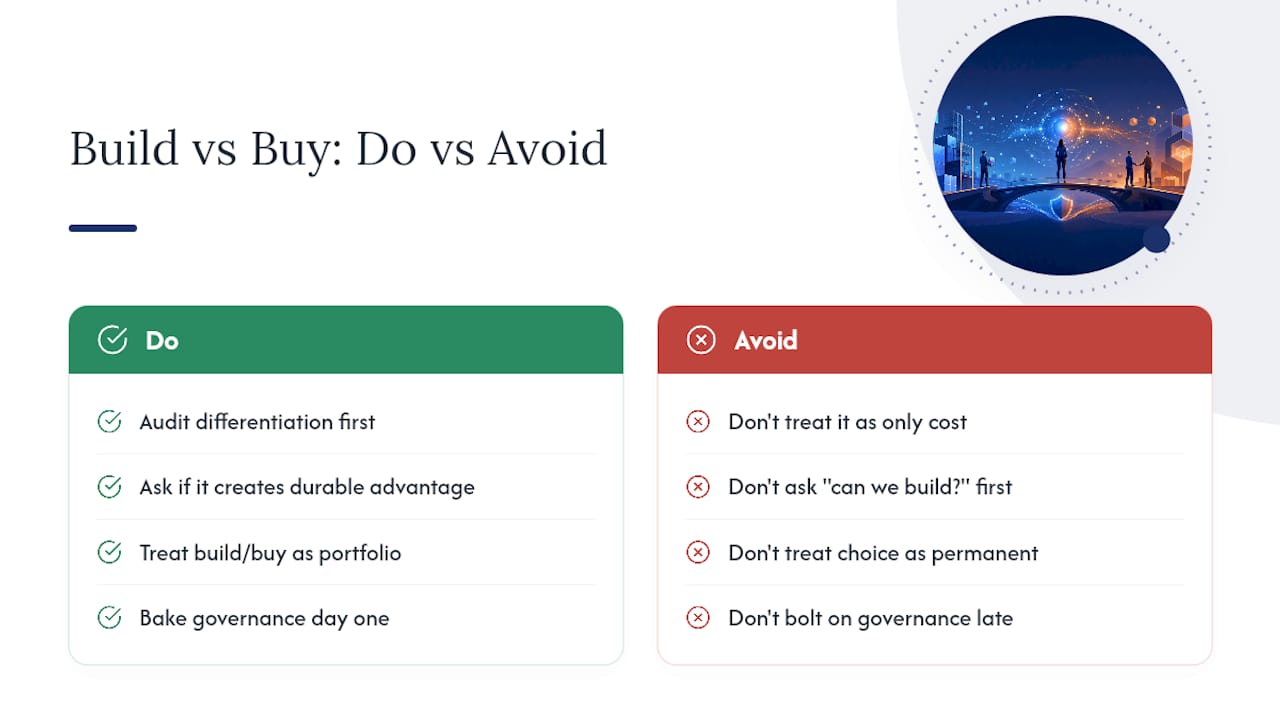
The other pattern we see constantly: organizations treat build and buy as a permanent choice instead of a portfolio decision that gets revisited. What’s commodity today, like basic document summarization, may still be commodity in two years. What’s differentiating today, like a fraud model trained on proprietary transaction data, stays differentiating precisely because the data can’t be bought. Sort your AI roadmap by that test, not by internal politics about who gets to “own AI” at the company.
Governance is the piece that gets treated as an afterthought and shouldn’t be. A TRiSM-style control layer, meaning trust, risk, and security management built into the system from day one, isn’t a compliance checkbox you bolt on before an audit. It’s frequently the actual reason a buy option gets ruled out, long before cost does. Teams that treat governance as step six instead of step one end up re-architecting under deadline pressure, which is the most expensive way to build anything.
— Chad
How Bowtie Helps You Build the Right AI, Not Just Any AI
Bowtie is the option for organizations that have already run the framework above and landed on build or hybrid, and now need it done without the cost overruns that make build decisions look risky in the first place. Bowtie’s AI integration and enterprise modernization work focuses on production-ready systems, not prototypes that stall out before launch.
If your team has already written AI-generated code or shipped a fast prototype that needs to survive contact with real users, a professional code audit is often the fastest way to find out exactly how far that prototype is from production, and what it will actually cost to close the gap. Bowtie also supports agentic workflow design, giving you the custom orchestration layer that sits on top of foundation models without the governance blind spots that trip up DIY builds.
If your TCO workshop just confirmed you need to build or boost, start with a scoped pilot conversation rather than a full commitment. Get in touch about your AI integration project and bring the scorecard from your decision meeting. That’s the fastest way to find out what a real timeline and real cost look like for your specific case.
Sources
- Gartner press release: 40% of enterprise apps will feature task-specific AI agents by 2026
- Buy, boost, or build? Choose your path to generative AI — MIT Sloan
- The evolution of build vs buy — KPMG
FAQ
What Is Build vs Buy in the Context of AI?
Build vs buy AI is the decision between developing a custom AI capability in-house versus purchasing an existing vendor solution, with a middle path called “boost” that combines a vendor model with your own proprietary data.
How Much Does It Cost to Build AI In-House?
Costs vary widely by scope, but the full total cost of ownership includes development, infrastructure, MLOps, monitoring, retraining, and engineering opportunity cost, which is frequently the largest and most underestimated line item in the model.
Which AI Option Is Better to Buy?
Buying tends to win for commodity capabilities like summarization or basic classification, where the vendor market is mature and speed matters more than deep customization; KPMG’s guidance is to buy unless the feature creates real competitive differentiation.
What Does “Building AI” Actually Mean?
Building AI means developing and owning a custom model, agent, or system trained on your own data and infrastructure, rather than licensing a vendor’s existing product, which gives you full control but also full responsibility for maintenance and drift management.
When Should a Company Choose a Hybrid AI Approach?
A hybrid, or “boost,” approach fits when you need better accuracy or relevance than an off-the-shelf tool provides but don’t need full ownership, typically by fine-tuning or adding retrieval on top of a vendor’s foundation model.