An AI software consultant turns strategic AI opportunities into production software and measurable outcomes. The right first step isn’t a full transformation program. It’s a focused assessment or a time-boxed pilot that proves the ROI case before you commit real
budget. Done right, that engagement gives you two things: a working system that survives contact with real users and numbers your board can actually evaluate.
TL;DR:
- Engaging a consultant early is crucial if your pilot has stalled, if data gaps exist, or if rapid deployment is essential due to competitive, regulatory, or integration pressures.
- Choose a partner with proven ROI, strong production engineering skills, and real domain experience, and always request tangible artifacts like code audits and KPI improvements before proceeding.
- Pricing varies based on scope, from fixed assessments to ongoing support, with clear milestones and success metrics necessary to avoid budget overruns and ensure measurable outcomes.
- Internal preparation should include decisive ownership, data access readiness, explicit success metrics, and planning for post-launch support to prevent project delays and system degradation.
- The most common project failures stem from poorly defined goals, lack of operational ownership, and assuming activity equals outcomes; setting clear metrics and defining readiness criteria from the start is essential.
Table of Contents
- What Does an AI Software Consultant Do?
- When Should You Hire an AI Software Consultant?
- How Do You Choose the Right AI Software Consultant?
- What Do Engagement Models and Pricing Actually Look Like?
- A Practical Roadmap From Assessment to Full Operation
- What Proof Points Should You Ask a Consultant to Show?
- What Contract Terms Should You Expect and Negotiate?
- How Should You Prepare Internally Before Hiring a Consultant?
- Author’s Perspective: The Three Mistakes That Sink Otherwise Good AI Projects
- How Bowtie Approaches AI Software Consulting
- Sources
- FAQ
What Does an AI Software Consultant Do?
The title “AI software consultant” covers a wider range of work than most buyers expect, and that’s exactly where procurement mistakes happen. Some firms sell strategy decks. Others sell shipped code. The best ones sell both, in sequence.
Here’s the fuller service map you should expect to see on a capable AI implementation services provider’s offering list:
- Strategic assessment — mapping business goals to feasible AI use cases and ranking them by ROI and technical risk.
- Data readiness review — auditing what data exists, where it lives, and whether it’s clean enough to train or fine-tune on.
- Prototype and pilot development — building a narrow, testable version of the system to validate the concept with real users.
- Production engineering — rewriting or hardening the prototype into secure, maintainable software that can run at scale.
- MLOps and monitoring — setting up CI/CD pipelines for models, drift detection, and alerting so performance doesn’t quietly decay.
- Code audits and security reviews — checking existing AI-generated or vendor-built code for vulnerabilities, dead ends, and technical debt.
- Team upskilling — training internal staff so the capability doesn’t evaporate when the consultant leaves.
The split between advisory firms, engineering-first shops, and hybrid partners matters more than most RFPs acknowledge. A pure advisory firm is strong on strategy and weak on shipping. An engineering-first shop can build fast but sometimes skips the diagnostic work that keeps a project aimed at the right problem. A hybrid partner does both, which is why enterprises increasingly ask for assessment and delivery under one contract rather than stitching two vendors together.
“Production-ready” is the phrase that separates a real deliverable from a demo. It means the code is secure by design, documented well enough that a new engineer can maintain it, wired into a CI/CD pipeline that handles model updates without downtime, monitored for performance drift, and backed by runbooks for when something breaks at 2 a.m. A flashy prototype that lacks any of that isn’t a product. It’s a liability with a nice UI.
When Should You Hire an AI Software Consultant?
You don’t need external help for every AI initiative, but certain signals mean waiting will cost you more than engaging now.
- A pilot has stalled. If a proof of concept has been “almost ready” for two quarters, the gap is usually engineering discipline, not the underlying idea.
- Your data or engineering foundation has real gaps. Teams without ML infrastructure experience often lose months rebuilding what a specialist could reuse.
- Speed to market is a competitive necessity. In fast-moving categories, an outside team with existing patterns can compress a 12-month build into a fraction of that.
- You’re in the middle of M&A or a major systems consolidation. Merging data platforms and AI capabilities under deadline is a specialty skill, not a side project.
- Regulatory pressure is rising. Sectors facing new AI governance rules need audit-ready documentation that most internal teams haven’t built before.
The highest-value enterprise use cases right now cluster around document intelligence (contract review, claims processing), agentic workflows that chain multiple tasks together, recommendation engines, and predictive analytics for operations or churn. If your use case falls into one of those categories, the pattern has already been solved elsewhere. That’s exactly what a good consultant brings.
The make-versus-buy call comes down to timeline and repetition. Buy expertise when you need speed or you’re solving a problem once. Build internal capability when the use case will recur across the business for years. Many enterprises do both: hire a consultant for the first production system, then absorb the patterns and team into an internal capability afterward.
How Do You Choose the Right AI Software Consultant?
Selecting the wrong partner is expensive in a way that doesn’t show up until month six, when the “finished” pilot turns out to be unusable in production. Weight your evaluation toward these axes, roughly in this order:
- Proven ROI on comparable work — not just logos, but specific before/after metrics.
- Production engineering capability — ask directly whether they run code audits, maintain CI/CD for models, and monitor for drift.
- Team seniority — who is actually writing the code, not just who is in the sales call.
- Domain experience — healthcare, finance, and logistics all carry different data and compliance realities.
- Security and compliance posture — especially if you handle regulated data.
- Post-launch support terms — what happens the week after go-live matters as much as the launch itself.
- Pricing transparency — vague scopes are the leading cause of budget overruns in this category.
In the first meeting, ask pointed questions: “Show me an architecture diagram from a comparable project.” “What did the client’s key metric look like before and after your engagement?” “Who handles a production incident at 3 a.m. after launch, and what’s the response SLA?” If the answers are vague or entirely hypothetical, keep looking.
Build your RFP around concrete requested artifacts rather than open-ended capability claims: sample deliverables, anonymized KPI improvements, a redacted runbook, and at least one reference you can actually call. Executives are increasingly expecting measurable outcomes and adoption evidence before greenlighting further investment, so build that expectation into your vendor selection from day one, not after the contract is signed.
Watch for a few reliable red flags: a consultant who can’t produce a single anonymized metric from past work, one who won’t put post-launch support terms in writing, or one whose “team” turns out to be a rotating cast of subcontractors you never meet before signing. Our guide on choosing the right software development partner goes deeper into the vetting process if you want a fuller checklist.
Pro Tip: Ask every finalist to walk you through a real code audit they’ve delivered, not a sanitized case study. How they explain a client’s technical debt tells you more about their honesty than any pitch deck.
What Do Engagement Models and Pricing Actually Look Like?
Pricing structures in AI consulting vary more than most buyers expect, and the variance usually tracks scope discipline rather than vendor quality.
The common engagement shapes:
- Fixed-fee assessments — a scoped diagnostic, usually the cheapest and lowest-risk entry point.
- Time-boxed pilots — a defined sprint to build and test an MVP against real data.
- Time-and-materials sprints — flexible scope, billed by hours, best for exploratory work.
- Fixed-price deliverables — a locked scope and price for a defined production build.
- Retainers — ongoing support, monitoring, and iteration after launch.
Cost drivers are predictable once you know what to look for: how mature your data infrastructure already is, whether you’re operating under regulatory constraints, and how much production engineering rigor the use case demands. A document classification pilot for an unregulated small business costs a fraction of a claims-processing system for a regulated insurer, even if both start from a similar model architecture.
What Shapes Your Timeline: Discovery and assessment engagements typically run a few weeks. Pilots usually extend several weeks to a few months, depending on data readiness and scope. Production scale-up depends entirely on what the pilot revealed. Consultants who quote a fixed production timeline before finishing discovery are usually guessing.
Gate each phase with a go/no-go decision tied to a specific metric, not a vague sense that things are “going well.” If the pilot didn’t move the KPI it was built to move, don’t fund the scale-up. That single discipline prevents more wasted budget than any contract clause. Consulting economics are shifting toward this outcome-linked structure industry-wide, with buyers increasingly negotiating milestones tied to results rather than paying flat fees for strategy work alone.
A Practical Roadmap From Assessment to Full Operation
Every credible AI engagement moves through the same five phases, whether the vendor calls them that or not. Skipping one is how pilots become permanent.
- Assess. Audit your data quality, map existing systems, and baseline the KPI you’re trying to move. Deliverable: a scoped opportunity map and a data readiness report. Success metric: a clear go/no-go recommendation with cost estimates attached.
- Design. Define the architecture and build a prioritized backlog. Deliverable: an architecture diagram and sprint plan. Success metric: sign-off from both technical and business stakeholders before a single line of production code gets written.
- Pilot. Build a minimum viable version and test it against real users or an A/B split. Deliverable: a working MVP and a performance report against baseline. Success metric: the target KPI moves in the right direction by a defined margin.
- Scale. Rebuild the pilot into production grade software with proper MLOps, monitoring, and security review. Deliverable: production code, CI/CD pipeline, and a code audit report. Success metric: the system passes load testing and a third-party security check.
- Operate. Maintain the system under a support agreement with defined SLAs. Deliverable: monitoring dashboards and incident runbooks. Success metric: uptime and drift metrics stay within agreed thresholds month over month.
Governance should shift with each phase. Business stakeholders own the KPI definition during Assess and Design. Technical leadership owns architecture sign-off during Design and Scale. Whoever owns the P&L for the affected process should sign off on the Pilot results before Scale funding gets approved. Two workable examples of governance KPIs: a document-processing pilot tracked “average manual review time per claim” and required a defined percentage reduction before scale approval; a churn-prediction system tracked “precision at top decile” and needed sustained performance over a full sales cycle before the retainer renewed.
Pro Tip: Put the go/no-go metric in writing before the pilot starts, not after you see the results. Retroactively defined success criteria are how mediocre pilots get rebranded as wins.
What Proof Points Should You Ask a Consultant to Show?
A case study without numbers is a marketing page. A credible one names the scope, states a timeline, and shows a specific metric moving from a baseline to a result, even if the client’s identity or exact figures get anonymized for confidentiality.
Before signing anything, request these documents directly:
- A code audit report from a past engagement, even a redacted one, showing what problems were found and fixed.
- A sample runbook showing how the team documents incident response.
- A monitoring dashboard screenshot or walkthrough showing how they track model performance in production.
- Anonymized KPI improvements with a clear before/after comparison and a stated timeframe.
Independent practitioners in this space describe starting every engagement with measurable business goals and tying pilots directly to KPIs, then scaling by codifying the systems that replace manual work. That discipline, more than any specific technology stack, is what separates consultants who ship from ones who present.
A consultant who can hand you a real code audit, a working runbook, and a specific number that moved after launch has already answered the hardest question in procurement: can they actually finish what they start?
Bowtie treats this kind of documentation as standard practice rather than a special request, because clients ranging from major enterprises to early-stage startups have all asked the same question eventually: what happens after launch? Our code audit work exists specifically to answer that for AI-generated and vibe-coded applications that never got a proper production review.
What Contract Terms Should You Expect and Negotiate?
Standard AI consulting contracts cover scope, IP ownership, data handling, SLAs, and payment milestones. Read each closely, because the details vary more than boilerplate suggests.
IP ownership should default to you, the client, for anything custom-built, with the consultant retaining rights only to their own reusable frameworks or libraries. Data handling clauses need to specify where your data lives during the engagement and what happens to it after termination. Service level agreements for post-launch support should name specific response times for critical incidents, not vague language like “prompt attention.”
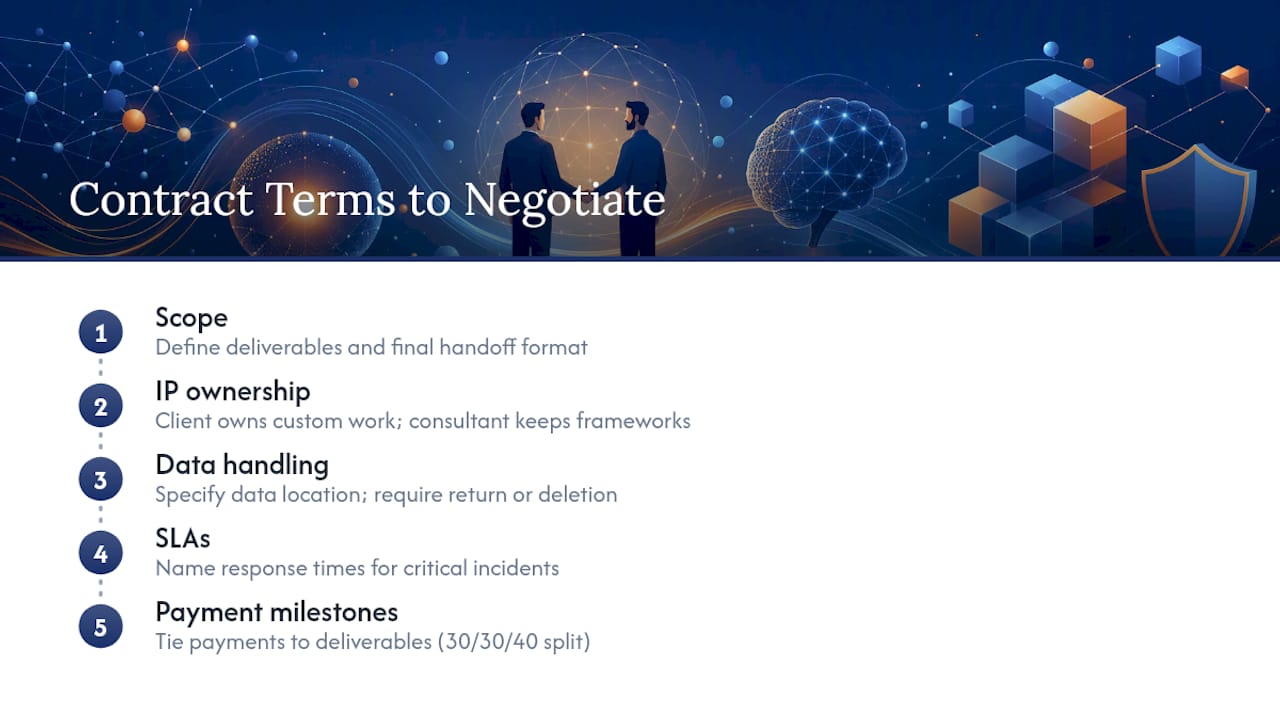
Negotiate milestone payments tied to working deliverables rather than time elapsed. A 30/30/40 split tied to assessment completion, pilot validation, and production go-live protects you far better than a flat monthly retainer with no defined output. Push back on any contract that doesn’t name a specific handoff point, meaning the exact date and format in which your team receives documentation, credentials, and training.
Also negotiate an exit clause. If the relationship isn’t working after the assessment phase, you should be able to walk away with your data and any completed work product intact, without a penalty beyond what you’ve already paid for that phase. A consultant confident in their work won’t object to this term.
How Should You Prepare Internally Before Hiring a Consultant?
The engagements that go sideways almost always trace back to internal readiness gaps, not vendor selection mistakes.
Before you sign anything, assign a single internal owner with authority to make decisions, not a committee that needs to reconvene every time a scope question comes up. Consultants lose weeks waiting on approvals that one empowered stakeholder could grant in a day.
Get your data access sorted ahead of kickoff. If engineers spend the first two weeks of a paid engagement requesting database credentials, that’s budget you’re paying for administrative friction, not AI work.
Define your success metric before the first call, not during it. “Improve efficiency” isn’t a metric. “Reduce average claims processing time by a stated percentage within a defined quarter” is. Vendors can’t hit a target you haven’t set.
Finally, budget for what happens after launch. Enterprises that treat the production system as one line item and support as a separate, unfunded afterthought consistently end up with systems that degrade quietly within a year. Enterprise AI education consistently points to the same lesson: capability building inside the organization, not just the initial build, determines whether AI investment sticks.
Author’s Perspective: The Three Mistakes That Sink Otherwise Good AI Projects
Pilot purgatory is the most common failure mode I see, and it’s rarely a technology problem. Teams keep “improving” a prototype for a year because nobody defined what “done” meant. The fix is boring: set the go/no-go metric before the pilot starts, not after you like the demo.
The second mistake is treating operational ownership as someone else’s job after launch. If no one owns monitoring and maintenance, the system decays within months. The third is confusing activity for outcomes: a working dashboard isn’t success unless it’s tied to a number the business actually cares about.
If you take one checklist away from this, make it three lines: define the outcome metric before you sign anything, require production-readiness (not a demo) as the pilot’s exit criteria, and lock in post-launch support before you need it.
— Chad
How Bowtie Approaches AI Software Consulting
Bowtie is built for the exact gap most AI engagements fall into: the space between a working demo and a system your team can actually run. We handle strategic assessments, production engineering, code audits for AI-generated and vibe-coded applications, and agentic workflow builds, then stay on for the support most consultants disappear after delivering.
What sets an engagement with us apart isn’t a longer sales deck. It’s that we treat the code audit and MLOps handoff as part of the deliverable, not an upsell you discover later. Many clients have used that approach to move from stalled pilot to production system without starting over from scratch. If you’re staring at a prototype that never quite shipped, our code audit service is often the fastest way to find out exactly what’s blocking it.
The first step is straightforward: a scoped assessment or a time-boxed pilot, sized to your specific use case rather than a generic package. Visit our AI integration and enterprise modernization page to see how that engagement gets structured, or reach out directly to scope a pilot around the KPI you actually need to move.
Sources
FAQ
How Much Do AI Consultants Get Paid?
Compensation varies widely by engagement type and seniority, with independent specialists and boutique firms often pricing by project scope rather than a flat rate; fixed-fee assessments tend to cost less than full production builds, which scale with engineering complexity and regulatory demands.
Are AI Consultants in High Demand Right Now?
Yes. Enterprise leaders and major consultancies are repositioning AI as a core transformation capability, and boards increasingly expect measurable adoption evidence before approving further AI budget.
How Much Do People Typically Charge for AI Consulting?
Pricing shapes range from fixed-fee discovery assessments at the low end to retainer-based ongoing support at the high end, with the total cost driven mainly by data readiness, regulatory scope, and how much production engineering the use case requires.
How Do I Become an AI Consultant?
Most practitioners combine hands-on machine learning or software engineering experience with a track record of shipping production systems, often supplementing that with structured training such as the programs associated with Andrew Ng’s educational work.
What Makes Bowtie Different From a Typical AI Software Consultant?
Bowtie pairs strategic assessment work with production engineering and code audits under one engagement, so the deliverable is working, secure software rather than a strategy document handed off to another vendor to build.