Technical AI governance consulting delivers a hardened production path for AI systems: an audited codebase, a hardened runtime isolated for security, a governed tool registry, enforced guardrails, statistically validated testing, and an incident runbook you can actually execute at 2
a.m. It’s built for CTOs, engineering leads, and product teams who need to move agentic workflows from a demo into production without inheriting an unbounded liability. If that’s your problem right now, the next move is simple: scope an audit or pull a hardening checklist from a partner who does this work daily.
TL;DR:
- Technical AI governance consulting involves comprehensive code audits, runtime hardening, and incident response planning, with evidence artifacts like immutable audit trails.
- A solid control environment includes sandboxed execution, a fully documented tool registry, input/output guardrails, and monitoring that detects and contains failures early.
- Isolating agent runtimes requires matching the threat model, with options like ephemeral containers, microVMs, or full VMs, all enforced through policy-as-code before deployment.
- Testing probabilistic AI systems demands statistical validation with hundreds of runs, adversarial testing, and structured audit logs to detect drift and prevent incidents.
- A detailed incident runbook should prioritize immediate containment, credential revocation, blast radius assessment, remediation, and comprehensive documentation for post-incident review.
Table of Contents
- What Does AI Governance Consulting Actually Cover?
- What Are the Seven Control Areas Every Agentic System Needs?
- How Should You Isolate and Deploy Agent Runtimes?
- Why Does Tool Governance Determine Your Real Attack Surface?
- How Do You Test and Monitor Systems That Behave Probabilistically?
- What Belongs in an Agent-Specific Incident Runbook?
- What Should Go in Your RFP for a Governance Consultant?
- Why Containment Beats Cleverness
- How Bowtie Hardens Agentic Systems for Production
- Sources
- FAQ
What Does AI Governance Consulting Actually Cover?
Ask ten vendors what “ai governance consulting” means and you’ll get ten different answers. In the technical sense, it’s a defined scope of deliverables, not a slide deck.
A serious engagement produces:
- A code audit report that treats AI-generated output as untrusted input, including static and dependency analysis and secret scanning findings
- A runtime hardening plan (sandboxing, egress rules, credential scoping)
- A tool registry documenting every callable function, its owner, and its risk rating
- Guardrail integration for input and output filtering, including PII handling
- A testing plan with adversarial and statistical validation, not just unit tests
- Monitoring and audit exports that hold up as evidence, not just logs
- An incident runbook including kill switches and rollback procedures
- A maintenance or retainer arrangement for ongoing hardening as agents change
Engagements typically run as a one-off audit, a full implementation project, or an ongoing retainer once the system is live. Whichever model you choose, insist on evidence artifacts: immutable audit trails, infrastructure-as-code definitions, and prompts managed as versioned code rather than loose text in a config file.
What Are the Seven Control Areas Every Agentic System Needs?
A useful way to audit your own readiness, or a vendor’s proposal, is to run down a fixed list of control areas rather than a vague “responsible AI” checklist. Open Security Architecture’s SP-047 pattern lays out seven areas that map cleanly onto engineering work:
- Execution environment and boundary protection — Sandboxing, ephemeral containers, or VM isolation with enforced egress rules. If an agent can reach the open internet or your production database without a proxy in between, this fails.
- Tool registry and tool governance — Every tool an agent can call is inventoried, whitelisted, and risk-rated.
- Guardrails and information-flow enforcement — Input and output filtering, with explicit rules for PII and sensitive data.
- Data flows and delegation boundaries — Flow policies that track how data moves between agents and tools, similar to what AgentFlow formalizes with runtime verification.
- Cost and autonomy bounds — Quota proxies, token limits, and step caps that stop a runaway loop before it becomes a runaway bill.
- Multi-agent communication controls — Rules governing how agents talk to each other and how consensus or handoffs get validated.
- Failure detection and containment — Circuit breakers, kill switches, and per-run audit logs that let you isolate a compromised agent without taking down the whole system.
Three governance principles hold this together: a business owner signs off on autonomy decisions, monitoring runs continuously rather than at launch, and no team stands up a shadow agent outside the registry. That last one is the failure mode nobody budgets for.
Pro Tip: Run this checklist against a system you already have in production, not just the one you’re about to build. Most teams find their “temporary” internal agent from months ago has zero controls from this list.
For a deeper breakdown of how these controls interact, our AI agent security playbook walks through prioritization when you can’t fix everything at once.
How Should You Isolate and Deploy Agent Runtimes?
Isolation strategy should match your threat model, not your comfort level with the tooling. Anthropic’s own containment engineering, which cut permission prompts by 84% after sandboxing controls went in, treats the environment layer as the primary safety boundary, with model-level guardrails as a backup, not the main event.
Three isolation tiers, roughly in order of increasing overhead:
- Ephemeral containers — Fast to spin up, fine for low-risk read-only agents, but weaker isolation guarantees under kernel-level exploits.
- gVisor or Firecracker microVMs — Stronger syscall interception, the right default for agents touching customer data or write access.
- Full VM isolation — Reserved for agents with production credentials or financial system access, where the blast radius of a breakout has to be near zero.
Infrastructure-as-code and immutable, cryptographically signed images matter here as much as the isolation choice itself. If you can’t reproduce an environment byte-for-byte from a signed artifact, you can’t audit it after an incident.
CI/CD gating should enforce policy-as-code before any agent config or prompt reaches production, an approach AWS recommends explicitly for agentic AI security. Prompts get promoted through pull requests like any other code change, with a deterministic policy check and a statistical behavior check required to pass before merge.
Why Does Tool Governance Determine Your Real Attack Surface?
Every tool an agent can call is a new door into your systems, and that’s true even when the tool itself is fully trusted. Tool output is an attack vector on its own, since a compromised or spoofed response can steer an agent’s next action regardless of how the tool was vetted going in, a point SP-047’s tool governance section makes directly.
Build a central tool registry before you scale past a handful of agents:
- Every tool gets an owner, a data classification, a list of agents allowed to call it, and a risk rating
- Third-party MCP servers get provenance checks and pinned versions, never “latest”
- Tool calls route through a runtime proxy that inspects output, not just input
- Staging environments test new tools before production exposure, with a clear deprecation path for anything flagged
If you’re evaluating third-party MCP infrastructure, a server like Shurq’s MCP offering is a useful example of what a vetted, purpose-built tool server looks like versus a hand-rolled integration nobody’s reviewed since launch. Compromised tools need an automated disable switch, not a Slack message asking someone to remember to turn it off.
How Do You Test and Monitor Systems That Behave Probabilistically?
Standard unit tests don’t work on a system that can give three different answers to the same prompt on three different runs. Validation has to be statistical: run the same scenario dozens or hundreds of times and measure the failure rate, not just whether one run passed.
- Build attack suites covering prompt injection and delegation-chain attacks, then run them on every release candidate
- Red-team your own guardrails on a schedule, not just before launch, and gate releases on the results
- Log structured audit trails (OpenTelemetry or equivalent) for every agent action, with anomaly detection watching for drift over time
The value of many-run testing over single-pass checks shows up starkly in formal verification work. AgentFlow’s runtime verifier reduced confirmed compromise rates from 33.0% to 0% on one benchmark suite and from 73.5% to 0% on another, with individual property verification running in under half a second per check. A single clean test run tells you almost nothing about a probabilistic system; a few hundred runs against an adversarial suite tells you a great deal.
What Belongs in an Agent-Specific Incident Runbook?
An incident runbook for an agent is different from a standard outage playbook, mainly because the “outage” might look like the system working perfectly while doing something it shouldn’t.
- Kill the agent first. Pull the kill switch, then pull the run_id audit export before anything else changes state.
- Revoke and isolate. Rotate any credentials the agent held and quarantine the tools it called in its last active window.
- Assess blast radius. What data did it touch, what did it write, and did it hand anything off to another agent or a human?
- Remediate. Roll back writes where possible, requarantine affected tools, and confirm the fix against the same test suite that missed the issue.
- Document and hand off. Deliver a reproducible evidence export and a timeline for post-mortem review, not a verbal summary.
Skip any of these steps and your next incident review turns into guesswork about what actually happened.
What Should Go in Your RFP for a Governance Consultant?
Turning this into a hiring decision means writing specific, checkable requirements instead of asking for “AI safety expertise.”
- State your objectives explicitly: audit only, full implementation, or ongoing retainer
- Specify your environments and data sensitivity so isolation recommendations aren’t generic
- Require an audit-grade evidence export as a contractual deliverable, not an afterthought
- Ask vendors directly how they handle runtime isolation, SBOM and SCA processes, and what their red-team methodology actually tests
- Set acceptance criteria up front: signed IaC with a reproducible runtime, passing adversarial test results, a delivered audit export, and a knowledge-transfer session so your team isn’t dependent on the vendor forever
If a vendor can’t answer the isolation and SBOM questions with specifics, that’s your answer about whether they can deliver the rest. Reviewing existing code before any new build starts is worth its own line item; see why a professional code audit matters before you commission new agent work on top of an unreviewed base.
Why Containment Beats Cleverness
The trade-off nobody says out loud in this field: every layer of containment you add makes an agent slightly less capable and considerably more boring to operate. That’s the point. A fully unconstrained agent is more impressive in a demo and more dangerous in production, and most teams don’t realize which side of that trade they’ve made until something breaks.
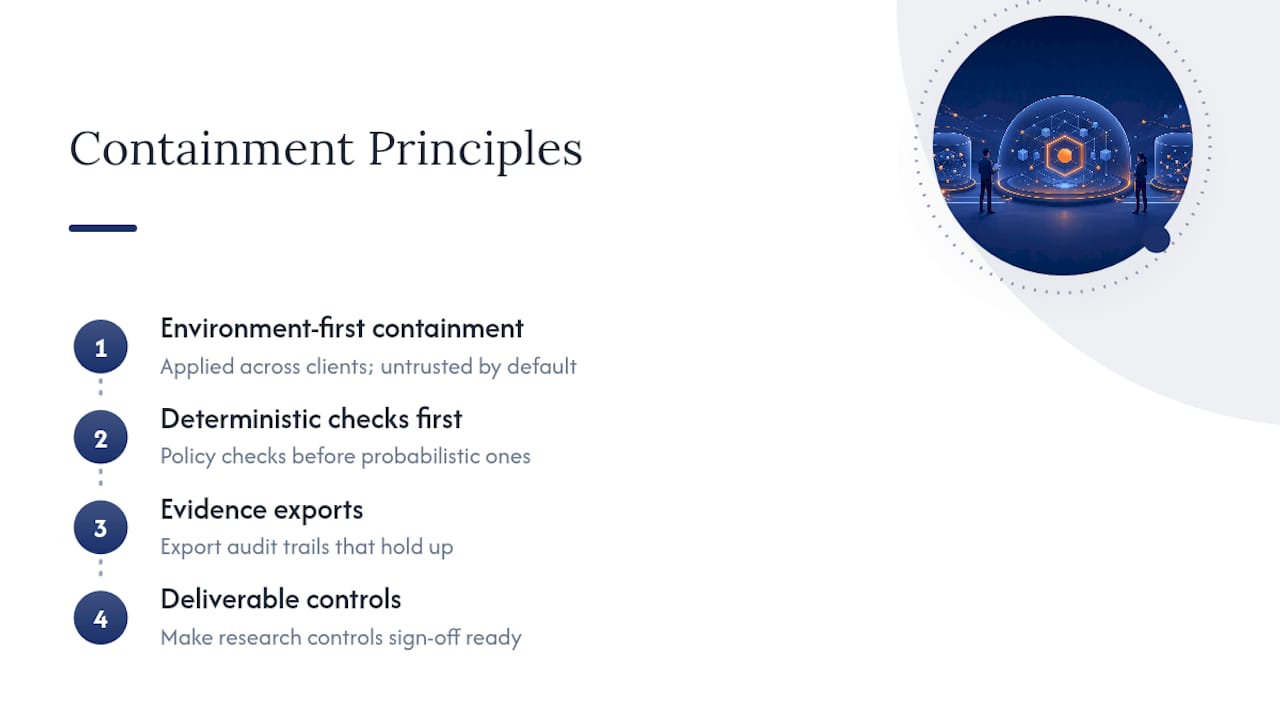
We’ve built our approach to code audits and agent hardening around exactly this bias: environment-first containment, deterministic policy checks before probabilistic ones, and evidence exports that hold up when someone asks what happened. This discipline is applied across a range of clients, treating AI-generated and Vibe-coded applications as untrusted by default, until proven otherwise.
Chad leads Bowtie’s engineering practice on AI code audits and agent hardening, with a focus on turning research-grade controls like flow verification and sandboxed execution into deliverables a CTO can actually sign off on.
— Chad
How Bowtie Hardens Agentic Systems for Production
Bowtie is the technical partner CTOs bring in when an internal team has shipped an agent that works in the demo but nobody can explain what happens when it fails. Where a generalist agency hands you a policy document, Bowtie hands you an audit report, a hardened runtime, and a tested runbook.
A typical starter engagement moves through four stages: an audit of your existing code and agent architecture, a hardening plan scoped to your actual risk, implementation of the isolation and guardrail work, and a retainer to keep controls current as your agents evolve. That last step matters more than most teams expect. An agent that once passed audit can later drift into risky configurations if not monitored if nobody’s watching the tool registry.
If you’re staring down an agent deployment that’s outgrown your team’s bandwidth to secure it properly, start with an AI code audit scoped to your current codebase, or explore enterprise AI integration support if you’re building the hardened pipeline from scratch.
Sources
- How we contain Claude across products Anthropic
- AWS prescriptive guidance - Security for agentic AI on AWS
- AgentFlow (arXiv)
- Secure Agentic AI Frameworks (SP-047) Open Security Architecture
FAQ
What Is Technical AI Governance Consulting?
It’s a code-level and runtime-focused engagement covering audits, sandboxing, tool registries, guardrails, testing, and incident runbooks for AI systems already in or heading toward production.
How Is This Different From Enterprise AI Policy Consulting?
Technical AI governance consulting deals with engineering controls, code, runtime isolation, and testing, rather than board-level policy documents or compliance frameworks.
What’s the First Deliverable I Should Expect?
A code audit report that treats existing AI-generated code as untrusted input, flagging SAST, dependency, and secret-scanning issues before any hardening work begins.
How Do I Know If a Vendor’s Testing Methodology Is Rigorous Enough?
Ask whether they run statistical validation across many runs and adversarial red-team suites, not just single-pass functional tests, since agentic systems behave probabilistically.
Does Bowtie Handle Ongoing Maintenance After the Initial Audit?
Yes, Bowtie offers retainer-based support to keep tool registries, guardrails, and monitoring current as agent workflows change over time.