Use RPA for deterministic, high-volume tasks with structured inputs, and use AI agents for unstructured, judgment-heavy work that keeps breaking your scripts. Many enterprise automation programs combine the two: agents typically handle interpretation and decisioning, while RPA executes deterministically. Below
is the diagnostic and integration pattern we use to decide which piece goes where.
TL;DR:
- RPA is best for high-volume, structured, and regulated tasks where consistent output and audit trails are critical, such as claims processing or payroll runs.
- AI agents excel at unstructured data, complex reasoning, and workflows with frequent exceptions, like contract review or intent recognition in support tickets.
- Combining RPA and AI involves deploying agents for interpretation and decision-making, then handing off to RPA for repeatable execution, reducing maintenance and increasing resilience.
- Monitoring and governance differences mean RPA costs are predictable, while AI inference costs can fluctuate with usage, requiring dedicated oversight of confidence scores and model drift.
- The optimal approach depends on input stability, judgment needs, and compliance requirements, with small pilots suggested to evaluate escalation rates over raw accuracy.
Table of Contents
- AI Agents vs RPA: What Each Technology Actually Does
- Where RPA and AI Agents Really Diverge
- When To Use RPA, AI Agents, or Both
- Building the Brain-and-Hands Architecture
- What Governance and Cost Actually Look Like Day to Day
- A Three-Question Diagnostic for Your Next Pilot
- How RPA and AI Agents Got Here
- The Real Limits of AI Agents Next to RPA
- Where This Is Headed Next
- Bowtie’s Take: Architecture Beats Allegiance
- How Bowtie Helps You Build the Right Automation Stack
- Sources
- FAQ
AI Agents vs RPA: What Each Technology Actually Does
RPA (robotic process automation) runs scripted bots that click through interfaces or call APIs to move data, following the exact same path every time. It’s best for structured inputs, deterministic execution, and compliance-heavy workflows where you need the same output every single run.
AI agents work differently. Built on large language models, they’re goal-directed: given an objective, they reason through steps, call external tools, and adapt when the situation changes instead of replaying a fixed script. That flexibility comes at a cost. Agentic AI handles unstructured data and decision-making but introduces non-determinism and governance overhead that a traditional bot never has to worry about.
“Agentic” in enterprise automation just means the software makes its own calls about what to do next, within guardrails you define. It’s not magic. It’s a probability engine with tools attached.
Where RPA and AI Agents Really Diverge
The decision comes down to five practical axes, and they matter more than any vendor pitch you’ll hear this year.
- Inputs handled: RPA wants structured, templated data (a fixed-format invoice, a form with the same fields every time). Agents can work with messy, unstructured formats like scanned contracts or freeform emails.
- Output determinism: RPA gives you the same result every time you feed it the same input. Agents reason probabilistically, so two runs of the same task can produce slightly different paths to the same goal.
- Auditability: RPA’s fixed logic makes it easy to trace exactly why a bot did what it did. Agentic decisioning needs an added validation layer, because combining the two increases governance burden and requires confidence thresholds before you trust an output.
- Implementation and compute cost: RPA is lighter on infrastructure. Agentic deployments can carry meaningful inference and latency costs that scale with usage, so budget compute separately from any RPA licensing fee.
- Maintenance and resilience: This is the one people underestimate.
Maintenance is often the deciding factor. RPA teams can spend 30 to 70 percent of their effort remapping selectors and scripts every time a vendor redesigns a portal or moves a button. Agents that reason over page state at runtime don’t need that rebuild, which is a real advantage for any workflow tied to a third-party UI you don’t control.
When To Use RPA, AI Agents, or Both
Pick the technology based on what the process actually looks like, not what’s trendy.
- Choose RPA when the inputs come from stable templates, volume is high, and you operate in a regulated environment where every step needs an audit trail. Think claims processing, payroll runs, or standardized data entry between two legacy systems.
- Choose AI agents when the documents vary in format, exceptions happen constantly, and the task requires multi-step reasoning rather than a fixed path. Think contract review across dozens of vendor templates, or a support agent that has to interpret intent before routing a ticket.
- Combine them when the job has both a reasoning problem and an execution problem. Intelligent document processing is the classic case: an agent classifies and extracts meaning from an unstructured invoice, then hands clean, structured data to an RPA bot that posts it into the ERP system. Employee onboarding and tiered IT support follow the same pattern, agent up front for judgment, RPA in back for repeatable execution.
Building the Brain-and-Hands Architecture
The cleanest way to combine these tools is to stop thinking of them as competitors and start treating them as layers. Agents reason, RPA executes. That’s the brain-and-hands model, and it’s how most mature enterprise programs are already structured.
Architecturally, this means the agent sits on top of your existing bot portfolio rather than replacing it. Integration patterns like the Model Context Protocol (MCP) let an agent call an RPA bot as a tool, passing it structured instructions once the agent has made sense of messy input. You keep your existing automation investment and add a reasoning layer on top of it.
To keep this safe, build in three controls before you go live:
- Confidence thresholds that route low-confidence agent decisions to a human reviewer instead of letting them execute automatically.
- Human-in-the-loop escalation for any transaction above a defined dollar or risk threshold.
- Traceable logging that records the agent’s reasoning path alongside the RPA bot’s execution log, so an auditor can reconstruct the whole chain.
Security controls belong at the handoff point between agent and bot. Restrict what tools the agent can call, and never let it write directly to a production system without passing through the same permission layer your RPA bots already respect.
Pro Tip: Log the agent’s confidence score on every decision, not just the final output. When you review escalations later, that score tells you whether the model is genuinely uncertain or just poorly prompted.
What Governance and Cost Actually Look Like Day to Day
The budget conversation splits cleanly along licensing versus inference. RPA costs are predictable: per-bot or per-license fees you can forecast a year out. Agent costs scale with usage, since every call to a model burns tokens, so a pilot needs a usage cap before it touches production data.
Monitoring looks different for each, too.
- RPA monitoring focuses on uptime and exception rates, since the logic itself doesn’t drift.
- Agent monitoring needs confidence-score tracking, drift detection as underlying models get updated, and a retraining or reprompting cadence you actually schedule, not one you get to when something breaks.
- Incident playbooks for agents should define what happens the moment confidence drops below threshold, not after a customer complains.
- Staffing shifts too: RPA maintenance leans on developers who know the target UI, while agent maintenance leans on people who understand prompt behavior and model evaluation.
Security deserves its own line item the moment an agent calls external APIs or touches personally identifiable information. Every external tool call is a new attack surface, and every PII field an agent reads needs the same access controls you’d apply to a human employee, not looser ones because “it’s just a bot.” Pilot costs and expected productivity gains from this kind of AI adoption are documented in broader AI productivity research worth reviewing before you size a rollout.
A Three-Question Diagnostic for Your Next Pilot
Before you build anything, run the process through three questions.
- Are the inputs structured and consistent? If yes, default to RPA. It’s cheaper to build and easier to audit.
- Does the process require judgment or handle frequent exceptions? If yes, that’s an agent’s job. RPA breaks on anything it wasn’t explicitly scripted for.
- Is determinism or auditability a legal or operational requirement? If yes, keep RPA in the execution seat even if an agent handles the upstream reasoning.
Score your pilot candidate against these three, and the technology choice mostly picks itself. Success metrics differ too: measure RPA pilots on exception rate and uptime, measure agent pilots on escalation frequency and confidence-score trends over the first few weeks.
Pro Tip: Run the smallest possible pilot first and watch the escalation rate, not the accuracy rate. That number tells you when an agent is genuinely production-ready.
How RPA and AI Agents Got Here
RPA has been around since the early 2010s, when vendors packaged screen-scraping and macro recording into enterprise-grade platforms that could log into a system, copy a field, and paste it into another without a developer writing custom code for every step. By the late 2010s, RPA had become a fixture in finance, insurance, and healthcare back offices, prized precisely because it never improvised.
AI agents are a much younger category. The shift started once large language models became capable enough to reason across multi-step tasks rather than just generate text, roughly 2023 onward, and accelerated as frameworks emerged for giving those models access to external tools and memory. That’s a decade-plus head start for RPA in terms of production hardening, audit tooling, and vendor maturity.
The practical result: agentic AI remains more experimental at enterprise scale, while RPA platforms are well-established with a much longer track record of large deployments. That gap is closing fast, but it hasn’t closed yet, and it’s a reasonable factor in how much of your budget goes to each technology in 2026.
The Real Limits of AI Agents Next to RPA
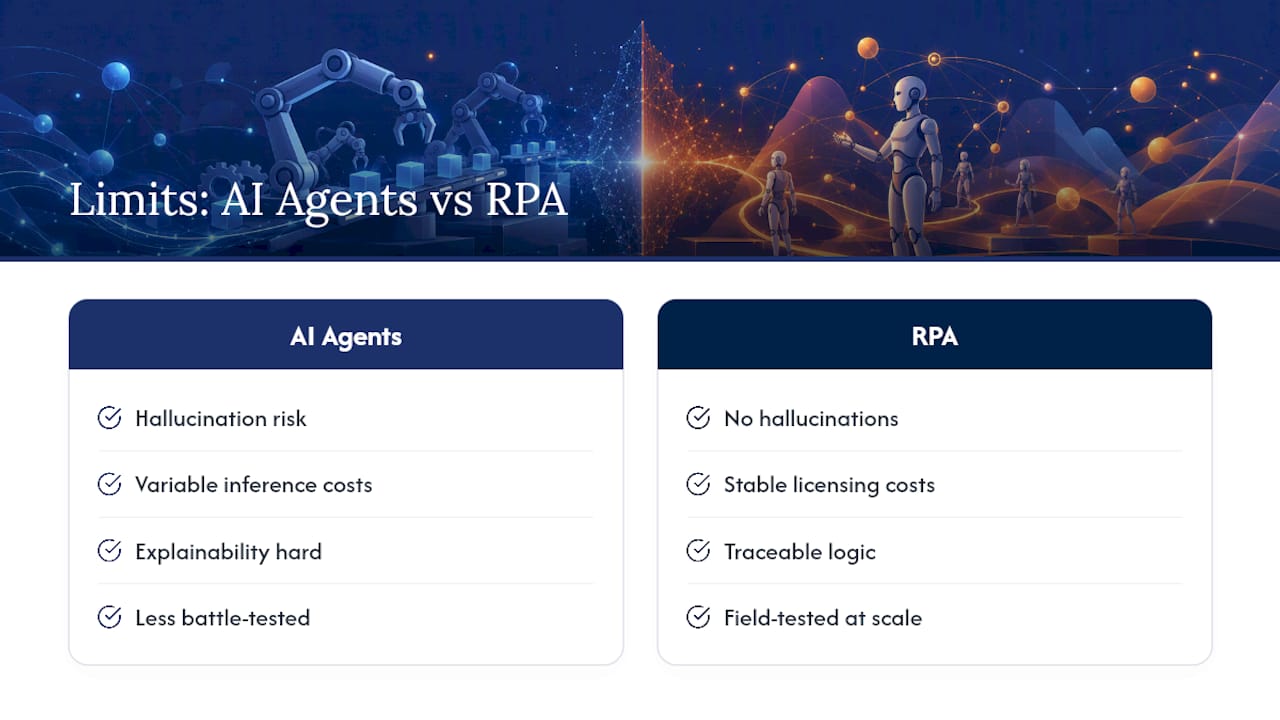
Agents solve problems RPA can’t touch, but they carry limitations that don’t show up in a demo. The biggest one is hallucination risk: an agent can generate a confident, wrong answer and hand it downstream unless something catches it. RPA never does this. A bot either follows its script or throws an exception; it doesn’t invent a plausible-sounding but incorrect result.
Cost predictability is another gap. Inference costs scale with usage and model version changes, so a workflow that ran cheaply last quarter can get more expensive after a model upgrade, with no code change on your end. RPA licensing doesn’t move like that.
Explainability is harder, too. When an RPA bot fails, you can trace the exact line of logic that broke. When an agent produces an unexpected result, reconstructing why it made that specific call requires logging its reasoning chain, not just its output, which is why traceable logging matters so much in production agent deployments.
Finally, agents are simply less battle-tested. Agentic AI remains experimentally deployed at scale and needs oversight for hallucination risk, which means fewer organizations have hit the edge cases RPA vendors solved years ago. None of this makes agents a bad bet. It makes them a different bet, one that needs validation layers RPA never required.
Where This Is Headed Next
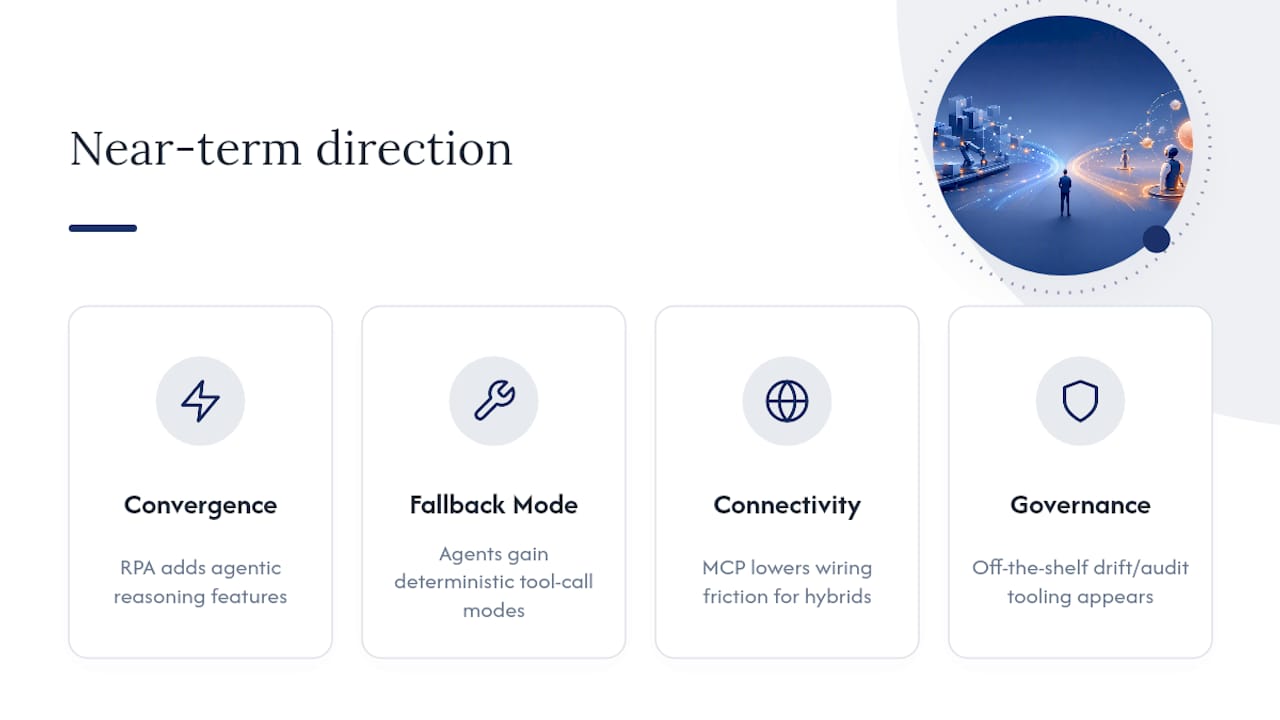
The next few years will likely blur the line between these categories rather than settle a winner. Expect RPA vendors to keep bolting agentic reasoning onto their platforms, and expect agent frameworks to keep adding deterministic “tool call” modes that behave more like traditional bots when precision matters more than flexibility.
Standardized connection protocols are the piece to watch closest. As patterns like MCP mature, the friction of wiring an agent to an existing RPA fleet keeps dropping, which means more companies will pilot hybrid architectures without a full platform rebuild. That lowers the barrier for mid-size companies that couldn’t previously justify a ground-up agentic rollout.
Governance tooling is catching up too. Confidence-threshold dashboards, drift detection, and agent-specific audit trails are moving from custom-built scripts into off-the-shelf features, which will shrink the governance gap between the two technologies over time. Don’t expect that gap to close entirely soon. Determinism is a structural property of RPA, not a feature you can bolt onto a probabilistic system, so RPA will likely keep its edge in the most regulated, audit-heavy corners of the enterprise even as agents take over everywhere else.
Bowtie’s Take: Architecture Beats Allegiance
Every “AI agents vs RPA” debate we’ve watched play out in client conversations eventually resolves the same way: the teams that win aren’t the ones that pick a side, they’re the ones that design the handoff between reasoning and execution carefully.
We’ve seen the hybrid pattern deliver real results specifically because it plays to each technology’s strength instead of forcing one system to do a job it’s bad at. A document-heavy intake process that used to choke every time a vendor changed a form layout stops breaking once an agent handles interpretation and a lightweight execution layer takes over from there, cutting the constant script maintenance that used to eat a developer’s week.
The threshold for bringing in outside help isn’t complexity for its own sake. It’s the moment your governance requirements outpace your team’s ability to validate agent decisions safely, or your existing bot portfolio has grown too tangled to know where reasoning should even plug in. That’s an architecture problem, not a tooling problem, and it’s worth solving before you scale either technology further.
— Chad
How Bowtie Helps You Build the Right Automation Stack
Bowtie is the practical alternative to guessing your way through an agentic rollout: we build the reasoning-and-execution architecture directly, instead of selling you a platform license and leaving the integration work to your team.
If you already run RPA and want to add agentic reasoning without rebuilding your bot portfolio, our AI integration and enterprise modernization work covers exactly that handoff, from confidence thresholds to audit logging. And if you’re not sure whether your existing automation is production-ready or held together with duct tape, a code audit will tell you before a compliance review does.
Bowtie clients range from national brands to early-stage startups, and every engagement includes ongoing support after launch, not a handoff and a wave goodbye. If you’re weighing a pilot right now, the next step is a scoping call: bring your current process map, and we’ll tell you honestly whether RPA, an agent, or both is the right first move.
Sources
- Compare AI agents vs. RPA: Key differences and overlap — TechTarget
- AI agents vs RPA: What every business leader needs to know — Forbes
- AI agent vs RPA — Octoparse
- RPA vs AI agents: Comparison guide — Skyvern
FAQ
Can AI Agents Replace RPA?
Not entirely. Agents handle unstructured, judgment-heavy work well, but RPA still wins on deterministic, high-volume tasks where audit trails and consistent output matter, so most organizations run both rather than swap one for the other.
Are RPA and AI the Same Thing?
No. RPA executes fixed, rule-based scripts with deterministic output, while AI, particularly agentic AI, reasons probabilistically over unstructured input and can adapt its approach mid-task.
What Are the Three Main Types of RPA Tools?
RPA tools generally fall into three categories: attended bots that work alongside a human operator, unattended bots that run independently on a schedule, and hybrid bots that switch between the two depending on the task.
How Do AI Agents Improve Automation Compared to Traditional RPA?
Agents extend automation into unstructured formats and exception-heavy workflows that scripted bots can’t handle, and they reduce maintenance on UI-heavy processes since they reason over page state instead of replaying a fixed path.
Should a Small IT Team Pilot RPA or AI Agents First?
Start with RPA if your process has stable, structured inputs. If your bottleneck is unstructured documents or constant exceptions, an agent pilot with a firm-scoped budget, guided by a firm like Bowtie, is the faster path to value.