
If you run an online store, you should be piloting an AI agent right now, not next quarter. For most merchants, the highest-leverage starting point is either an agentic storefront integration through Shopify’s tooling or a customer support agent wired
into your existing help desk. Pick whichever one touches more of your revenue today.
Here’s the next step: scope a 4 to 8 week pilot around one agentic surface, backed by clean structured product data. Not a six-month platform overhaul. A tight, bounded test that proves the concept before you spend real money on it.
Why this order, and why now:
- Conversion upside is already showing up in the data. AI-driven traffic to U.S. retailers rose 393% in Q1 2026, and TechCrunch tied that surge to real revenue gains for the merchants capturing it.
- You keep the customer relationship. Shopify’s Agentic Plan routes orders placed through AI channels back into your admin with referrer attribution intact, so you’re not handing your customer list to a third party.
- The minimal build is faster than you think. A working agentic flow, from product discovery to checkout to order tracking, can be stood up in a development environment in about five minutes using Shopify’s quickstart tooling. Production takes longer, but the barrier to a proof of concept is lower than most owners assume.
Key Takeaways
Agentic commerce succeeds when merchants fix their product data first, pilot one narrow agentic surface, and build human-in-the-loop guardrails before scaling to production.
| Point | Details |
|---|---|
| Start with data, not vendors | Audit your product feed for schema markup and completeness before evaluating any agent platform. |
| Pilot small and fast | Scope a 4 to 8 week pilot around one agentic surface rather than a full platform overhaul. |
| Keep humans in the loop | Route high-value or unusual transactions through human confirmation instead of full autonomy. |
| Choose your delivery model deliberately | Platform-native tools and SaaS options move fast; custom builds win on control and data ownership. |
| Bring in Bowtie for custom integration | Bowtie scopes, builds, and audits agentic workflows connected to your existing Shopify, PIM, and CRM systems. |
Table of Contents
- What Are AI Agents for Ecommerce and How Do They Differ From Chatbots?
- Which AI Agent Types Deliver the Most Value for Online Stores?
- How Do AI Agents Connect to Your Existing Ecommerce Stack?
- Should You Buy, Extend, or Build Your AI Agent?
- What Are Your Vendor and Delivery Model Options?
- How Long Does an AI Agent Pilot Take and What Should You Budget?
- What Operational Risks Do AI Agents Introduce and How Do You Guard Against Them?
- How Does Bowtie Take an Agentic Pilot From Idea to Production?
- What Actually Determines Whether an Agentic Pilot Succeeds?
- Get Your Ecommerce Stack Ready for Agentic Commerce
- Sources
What Are AI Agents for Ecommerce and How Do They Differ From Chatbots?
An AI agent for ecommerce is autonomous, multi-step software that completes a task from start to finish. It moves through product discovery, cart building, checkout, and often post-purchase follow-up without a human clicking through each stage. A chatbot answers a question. An agent finishes a job.
That distinction sounds academic until you see it in practice. A chatbot might tell a shopper “yes, that jacket comes in medium.” An agent checks live inventory, adds the medium to a cart, applies a valid discount code, and completes checkout, all inside one conversational thread, using tools and APIs rather than scripted replies.
The technical gap comes down to three things. Chatbots operate on pre-written decision trees or single-turn language model responses. Agents call external tools through protocols like the Universal Commerce Protocol (UCP) and Model Context Protocol (MCP), which give them the ability to search live product catalogs, manage cart state, and in some cases execute a direct checkout under a trusted agent profile. A misconception worth killing early: agents are not “smarter search bars.” Mirakl’s research on agentic commerce points out that agents execute complete transactions and actively favor merchants with clean technical data and competitive pricing over those without it.
Three capabilities separate a true agent from a glorified chat widget:
- Tool use. The system can call APIs, fetch real-time inventory, and query pricing engines rather than relying only on pre-trained knowledge.
- Stateful conversation. It remembers what the shopper said three messages ago and carries that context through cart building and checkout.
- Order lifecycle management. It can monitor an order after purchase, via webhooks, and handle exceptions like a shipping delay or a return request.
If a vendor pitches you a “shopping agent” that lacks all three, you’re looking at a chatbot with better marketing.
Which AI Agent Types Deliver the Most Value for Online Stores?
Not every agent type deserves equal investment. Some move revenue immediately. Others protect margin quietly in the background. Knowing which is which keeps your pilot budget pointed at the right target.
- Agentic storefront and checkout agents. These let AI channels like ChatGPT or Google’s AI Mode surface your products and complete a purchase directly, with the order attributed back to you in Shopify admin. Primary outcome: incremental conversion from AI-native discovery traffic.
- Customer support agents. These resolve order status questions, returns, and product fit issues without a human ticket. Primary outcome: reduced support cost per ticket and faster response time.
- Personalized recommendation agents. These use browsing and purchase history to surface relevant products in real time. Primary outcome: higher average order value and repeat purchase rate.
- Inventory and replenishment agents. These monitor stock levels against sales velocity and trigger reorders before a stockout happens. Primary outcome: fewer missed sales from out-of-stock SKUs.
- Dynamic pricing agents. These adjust prices based on demand, competitor movement, or inventory age. Primary outcome: margin protection during demand swings.
- Automated product description generation. These write and update listing copy at catalog scale, which also improves the structured data agents need to find you in the first place. Primary outcome: better organic and agentic discoverability.
- Cart recovery agents. These re-engage shoppers who abandon checkout with targeted, conversational follow-up. Primary outcome: recovered revenue from an already-warm lead.
- Fraud-detection agents. These flag suspicious order patterns before fulfillment. Primary outcome: fewer chargebacks.
- Visual search agents. These let shoppers upload an image and get matching or similar products. Primary outcome: conversion lift for visually driven categories like apparel and home goods.
Statistic to anchor your planning: the 393% jump in AI-driven retail traffic that TechCrunch documented for Q1 2026 is not evenly distributed. It concentrates on merchants whose product data is structured well enough for an agent to actually find and transact against. That’s the filter that decides who benefits from this shift and who watches it happen to competitors.
How Do AI Agents Connect to Your Existing Ecommerce Stack?
The typical agent flow looks like this: product discovery, variant fetch, cart build, checkout, then order monitoring. Each stage needs a data source behind it, and each stage is where most implementations quietly fail.
Shopify’s developer documentation for building commerce agents with UCP lays out the pattern clearly: authenticate and identify the agent, let it discover products through structured feeds, build a unified cart, convert that cart to checkout for trusted agent profiles, and monitor the resulting order through UCP-shaped webhooks. The storefront AI agent guide shows this in working code, using MCP to connect a conversational agent to product search, cart management, and checkout in a single integration.
Here’s what you need in place before an agent can do anything useful with your catalog:
| Technical asset | Why it matters |
|---|---|
| Product feed with schema markup | Agents consume structured data, not rendered web pages. Missing metadata can make products invisible to autonomous buyers, according to Tredence’s research on machine-readable catalogs. |
| Real-time inventory sync | An agent that recommends an out-of-stock item erodes trust fast, and can trigger order cancellations. |
| PIM (product information management) | Centralizes specs, dimensions, and compatibility data agents need to answer detailed shopper questions. |
| OMS/ERP hooks | Feeds order status back to the agent so it can answer “where’s my order” without human escalation. |
| CRM sync | Lets support and recommendation agents personalize based on purchase history and loyalty status. |
| Webhooks for order lifecycle | Enables monitoring of fulfillment, shipping, and returns after checkout completes. |
Developer and community reporting backs this up from the ground: AI shopping agents already evaluate structured specs, pricing, inventory, and shipping terms before deciding what to surface to a shopper, and sellers with incomplete data get skipped.
A few practical notes on where the guardrails belong. Trusted agent profiles, the authentication tier that lets an agent complete checkout without a human confirming every step, should be reserved for well-tested, monitored integrations. Lower-trust or experimental agents should stop short of checkout and hand off to a human or a confirmation step instead. That handoff point is your most important design decision, not an afterthought.
Should You Buy, Extend, or Build Your AI Agent?
| This decision hinges on five factors, and most owners weigh them in the wrong order — using tools like Agent Email: One API to Send, Receive, Route | Sendmux can simplify managing agent inboxes and email flows essential for agent-to-human handoff. Start with data readiness, not brand ambition. |
- Expected transaction volume. Low volume rarely justifies a custom build. High volume across multiple channels often does, because SaaS pricing models can get expensive fast at scale.
- Data readiness. If your product feed has gaps, missing dimensions, thin descriptions, no schema markup, fix that before you evaluate any agent vendor. An agent built on bad data fails regardless of how good the underlying model is.
- Integration complexity. Count how many systems need to talk to each other: Shopify, your PIM, your CRM, your fulfillment provider. Each connection point is a place where a project can stall.
- Brand control and customization needs. A SaaS agent gets you live faster but limits how much you can shape tone, escalation logic, and edge-case handling. A custom build costs more upfront but gives you full control.
- Legal and privacy constraints. If you handle sensitive customer data, know who owns that data once it passes through an agent and where it’s stored.
Before signing anything, ask the vendor or your engineering team these questions directly:
- Who owns the conversation and transaction data the agent generates?
- Does this agent support direct checkout, or does it just recommend and hand off?
- Is it compatible with UCP/MCP standards, or does it require a proprietary integration that locks you in?
- What SLAs exist for uptime and response latency during peak traffic?
- What monitoring hooks exist, and can a human override or roll back an agent’s decision mid-transaction?
Estimate ROI against concrete metrics: reduction in support ticket volume, conversion rate on agentic surfaces versus your standard storefront, and recovered cart revenue. Watch for these red flags before you commit budget: an agent that relies heavily on unstructured web scraping instead of structured feeds, a system with no live inventory hook, or a vendor who can’t explain their monitoring and human-in-the-loop process in plain language. If they can’t answer that last one clearly, walk away.
What Are Your Vendor and Delivery Model Options?
Three broad categories cover almost every option on the market, and each suits a different stage of readiness.
Platform-native features live inside the ecommerce platform itself. Shopify’s agentic storefronts let eligible stores surface product data directly to AI channels like ChatGPT, Google AI Mode, and Gemini, with merchants controlling which channels to enable from inside Shopify admin. This route is best for merchants who want the fastest path to agentic discoverability without adding a new vendor relationship. Shopify’s own Agentic Plan marketing pages describe this as syndicating your catalog to AI chat surfaces while keeping your existing backend systems intact.
Third-party SaaS agents specialize in one function. Customer support platforms like Ada and Gorgias focus on resolving support tickets and order questions automatically. Personalization and upsell tools like Octane AI focus on quiz-driven recommendation flows and post-purchase upsell sequences. These are best for merchants who need deep functionality in one narrow lane fast, without building custom logic from scratch.
Custom agency builds fit merchants who need brand-specific logic, deep integration across a nonstandard tech stack, or enterprise-scale reliability that off-the-shelf SaaS can’t guarantee. This is where a partner like Bowtie fits: connecting UCP/MCP tooling to your existing PIM, OMS, and CRM in a way that a generic SaaS tool simply isn’t built to do.

When you weigh these against each other, run the comparison across the same dimensions every time: what the option is best for, how it connects to your existing PIM/OMS/CRM stack, how much customization and control you retain versus a fixed SaaS interface, how the pricing is structured (subscription tier versus project-based), who owns the resulting data, what support and SLA commitments come with it, and what ROI range is realistic for your store size. Platform-native and SaaS options tend to win on speed and lower upfront cost. Custom builds win on control, data ownership, and fit when your stack doesn’t look like everyone else’s.
How Long Does an AI Agent Pilot Take and What Should You Budget?
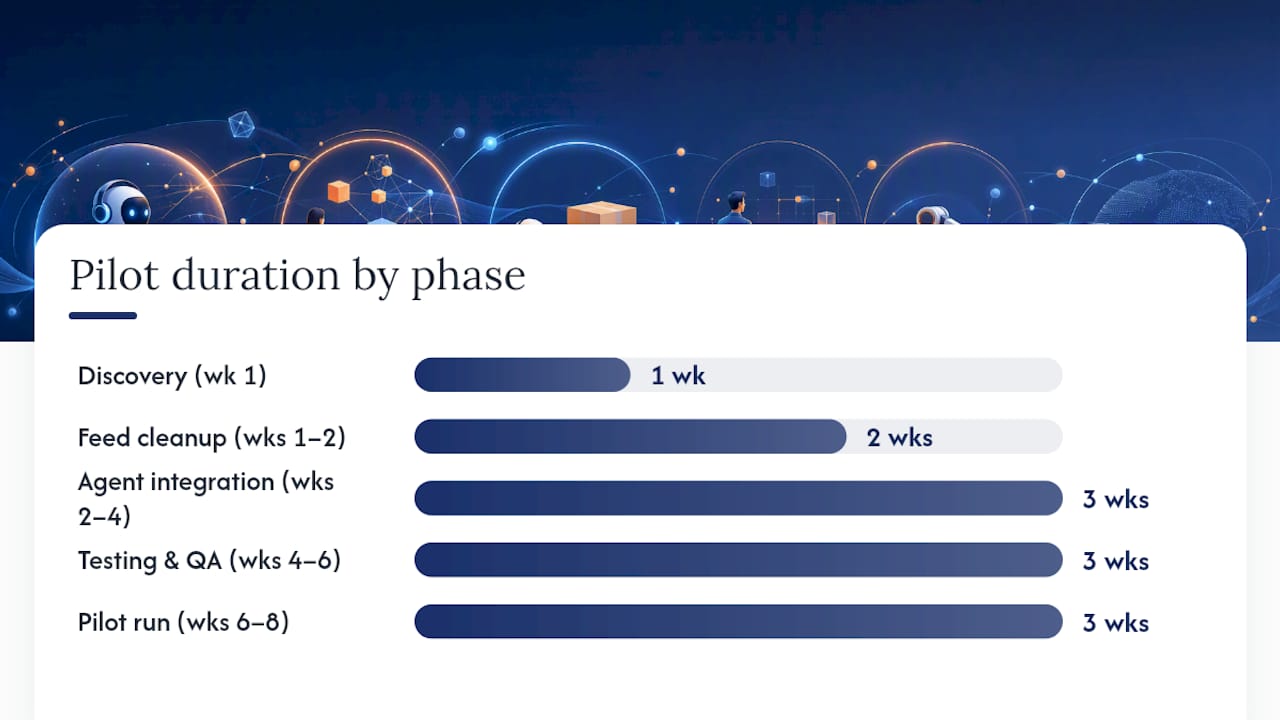
A minimal pilot follows a predictable arc, and most of the time isn’t spent building the agent. It’s spent cleaning up the data the agent needs to work with.
- Discovery and scoping (week 1). Define the single agentic surface you’re testing, whether that’s storefront checkout, support, or recommendations.
- Feed cleanup and data mapping (weeks 1 to 2). Audit your product feed for missing schema markup, incomplete specs, and stale inventory data. This step is usually the longest, not the coding.
- Agent integration (weeks 2 to 4). Connect UCP/MCP tooling or your chosen SaaS platform to your storefront and backend systems.
- Testing and QA (weeks 4 to 6). Run test transactions, check edge cases, verify human-in-the-loop handoffs work as designed.
- Pilot run (weeks 6 to 8). Launch to a limited audience or traffic segment, track KPIs against your baseline.
Once a pilot proves out, production scale adds monitoring infrastructure, formal SLAs with any third-party vendor, and redundancy so a single API outage doesn’t take down your checkout flow.
Budget across five buckets: internal engineering time for integration work, any third-party platform or SaaS subscription fees, agency or partner costs if you’re not building in-house, ongoing monitoring and hosting, and a code audit before anything touches production checkout. That last line item gets skipped more often than it should. The Shopify quickstart documentation shows a full agentic flow, from discovery to checkout to tracking, can be wired up in about five minutes in a development sandbox. That speed is real for prototyping, but production hardening, security review, and load testing is where the actual budget goes. Don’t mistake a fast demo for a finished project; if you’re planning that budget conversation, our guide to outsourcing software projects breaks down where costs typically land.
What Operational Risks Do AI Agents Introduce and How Do You Guard Against Them?
Every agent that touches checkout or customer data introduces failure modes that didn’t exist with a static storefront. Naming them plainly is the first step to managing them.
Hallucinations happen when an agent states something false, wrong pricing, incorrect stock status, a return policy that doesn’t exist. Order errors occur when cart-building logic misreads a variant or quantity. Inventory mismatches happen when your agent’s data lags behind your actual stock levels. Chargebacks and fraud risk rises if an agent completes checkout without adequate identity or payment verification. Brand-messaging drift creeps in when an agent’s tone diverges from how your team actually talks to customers. Privacy and data leaks are a real exposure any time customer data flows through a third-party model, and GDPR compliance becomes directly relevant if you serve customers in the EU, since customer conversation data and purchase history can qualify as personal data under that regulation.
Pro Tip: Reserve full autonomous checkout for low-risk, low-value transactions first. Route anything above a dollar threshold you define, or anything flagged as unusual, through a human confirmation step before it completes. This single guardrail catches the majority of costly agent mistakes before they become refunds.
Build a monitoring routine around four checkpoints: transaction logs reviewed on a regular cadence, order reconciliation against your OMS to catch mismatches early, webhook reliability checks so you know immediately when an integration silently breaks, and anomaly alerts for unusual order patterns. Practitioners generally agree that human-in-the-loop review isn’t optional friction, it’s how merchants keep agents handling repetitive volume while retaining final say on brand and strategic decisions.
How Does Bowtie Take an Agentic Pilot From Idea to Production?
We approach an agentic ecommerce build the same way we approach any production software project: data first, guardrails built in from day one, and no shortcuts around testing.
- Discovery. We map your current stack, Shopify setup, PIM, OMS, CRM, and identify which agentic surface offers the fastest path to measurable impact.
- Feed audit. We assess your product data for the schema markup, completeness, and structure agents need to find and transact against your catalog, closing the gaps that make products invisible to autonomous buyers.
- UCP/MCP integration. We connect your storefront to Shopify’s agent protocols, or build custom connectors where your stack doesn’t fit the standard pattern.
- Agent development. We build the conversational and transactional logic specific to your use case, whether that’s support, recommendations, or checkout.
- Human-in-the-loop design. We define exactly where a human needs to confirm before an agent acts, based on transaction value and risk.
- Testing. We run structured QA against edge cases, then apply the same code audit discipline we use on every AI-generated codebase before anything reaches production.
- Production rollout. We launch with monitoring in place from day one, not bolted on after something breaks.
That code audit step matters more than most vendors admit. AI-generated integration code, whether from an agent framework’s boilerplate or a rushed contractor build, frequently ships with security gaps or fragile error handling that only surfaces under real transaction volume. Catching that before launch is cheaper than catching it after a bad weekend of order errors.
Merchants who run a well-scoped pilot typically see measurable movement on two fronts: a drop in support ticket volume from routine questions the agent now handles, and a conversion lift on the agentic surface itself compared to their standard storefront baseline. The exact numbers depend heavily on your starting data quality and traffic mix, which is exactly why the pilot comes before the full rollout.
What Actually Determines Whether an Agentic Pilot Succeeds?
Most of the advice circulating about AI agents in ecommerce treats the agent as the hard part. It isn’t. The model layer is commoditizing fast, and the protocols connecting agents to storefronts are becoming standardized enough that any competent development team can wire them up. The actual bottleneck, in nearly every failed pilot I’ve seen discussed and documented, is data quality that was never fixed before launch.
Here’s what the conventional advice gets wrong: it frames agent adoption as a vendor selection problem. Which platform, which SaaS tool, which model. That’s the wrong first question. The right first question is whether your product feed can be read by a machine without a human filling in the gaps. An agent evaluating incomplete specs, missing dimensions, or stale inventory doesn’t fail loudly. It just quietly skips you and shows the shopper a competitor instead. You won’t get an error message. You’ll get a slow revenue leak you can’t easily trace back to its cause.
The second miscalculation is treating this as an all-or-nothing platform migration. It isn’t. The merchants making real progress are running narrow, bounded pilots, one agentic surface, one clear success metric, four to eight weeks, then deciding whether to expand based on actual results rather than vendor promises. That’s not caution for its own sake. It’s the only way to know if the investment is working before you’ve spent a production-scale budget finding out.
What should you prioritize first, if you take one thing from this guide? Audit your product data before you evaluate a single vendor. Everything else, the agent type, the integration approach, the buy-versus-build decision, is a much easier call once your data can actually support the answer.
Get Your Ecommerce Stack Ready for Agentic Commerce
Bowtie is the alternative to piecing together SaaS subscriptions and hoping they talk to each other. If you’ve read this far, you already know the real work isn’t picking an agent tool, it’s making your product data, your PIM, and your checkout flow actually work together under one coherent system. That’s the part generic SaaS agents don’t touch and most agencies don’t have the engineering depth to do right.
We build custom agentic workflows connected directly to your Shopify storefront, your inventory systems, and your CRM, with the code audit and human-in-the-loop guardrails baked into the build instead of added after something breaks. Whether you need a scoped pilot to test one agentic surface or a full production integration across UCP/MCP, our team handles the parts that generic tools can’t reach: custom connectors, data cleanup, and the ongoing support that keeps an agent working correctly six months after launch, not just on demo day.
If you’re ready to scope your pilot, start with a conversation about your AI integration needs or explore our full development services to see how we structure an engagement from discovery through production.
Sources
If you’re the technical lead responsible for implementation, start with Shopify’s developer documentation directly. If you’re the business owner scoping the decision, the help center pages and industry reporting will get you further, faster.
- Shopify Agentic Plan — Shopify Help Center
- Get started quickstart — Shopify developer docs
- AI traffic to U.S. retailers rose 393% in Q1 — TechCrunch (2026)
- Machine-readable product catalog: AI agents and retail — Tredence