The best move in 2026 isn’t picking one AI agent framework. It’s building a layered stack: an orchestration runtime for state and control flow, an agent harness for reasoning and tool use, and an observability layer for tracing what actually
happened. Pick each layer based on your cloud commitment and how close you are to production, not on which name trends hardest this quarter. The rest of this guide breaks down exactly which tool fits which layer.
TL;DR:
- Building a layered stack with orchestration, reasoning, and observability layers is essential for scalable AI agent deployment in 2026.
- LangGraph offers durability and checkpointing, making it ideal for agents that require restart resilience and human-in-the-loop pauses.
- Frameworks like LangChain and Microsoft Agent simplify tool integration and enterprise deployment, but success depends on adding robust persistence and tracing layers.
- Production-ready agents must demonstrate fault-tolerant persistence, scoped credentials, and comprehensive observability through quick, focused testing.
- Choosing frameworks should be based on the specific layer roles they fulfill, with layered thinking outperforming loyalty to a single vendor or tool.
Table of Contents
- What Are the Best AI Agent Frameworks Right Now?
- How Do the Leading Agent Frameworks Work?
- How Do You Know a Framework Is Production Ready?
- Where Should You Deploy an Agent Stack?
- How Do You Move From Prototype to Production?
- What Bowtie Sees When We Audit Agent Systems
- How Do Licensing and Community Support Compare?
- What Do Real Agent Deployments Look Like?
- What Breaks When Agent Systems Scale?
- Stack-Layer Thinking Beats Framework Loyalty
- Get Help Shipping Your Agent System
- Sources
- FAQ
What Are the Best AI Agent Frameworks Right Now?
Here’s the short version, because you probably don’t need ten deep dives to eliminate half the field. Match your candidate list to what layer of the stack you’re actually solving for, then go deep on two or three.
- LangGraph — best for teams that need durable, stateful orchestration with real checkpointing and human-in-the-loop pauses baked in.
- LangChain — best for the agent abstractions, tool integrations, and prebuilt components layered on top of an orchestration runtime.
- Microsoft Agent Framework — best for enterprise teams already committed to .NET or Azure, replacing the older AutoGen and Semantic Kernel projects.
- Google Agent Development Kit (ADK) — best for GCP-native teams that want a straight line from prototype to Cloud Run or GKE.
- OpenAI Agents SDK — best for teams building primarily on OpenAI models who want a lightweight, opinionated starting point.
- CrewAI — best for role-based multi-agent setups where you want agents to behave like a coordinated team with defined jobs.
- Mastra — best for JavaScript and TypeScript shops who want agent tooling that feels native to a Node.js stack.
- Pydantic AI — best for Python teams who want strict schema validation and type safety on every agent input and output.
- Deep Agents — best for long-horizon planning tasks that need subagent delegation and filesystem-style memory, built on top of LangGraph.
- LangSmith — best for tracing, evaluation, and debugging across any LangChain or LangGraph deployment.
Language support splits roughly along ecosystem lines: Python dominates LangGraph, LangChain, Google ADK, Pydantic AI, and CrewAI. Microsoft Agent Framework spans .NET, Python, and Go. Mastra sticks to JavaScript and TypeScript. If your team already has a strong opinion about its runtime, that opinion should drive your first cut more than any feature checklist.
The managed-versus-self-hosted decision usually comes down to how much operational overhead you want to own. A managed platform tied to Vertex AI or Azure AI Foundry hands you inference scaling and GPU management for free. Self-hosting buys you control over persistence backends, model routing, and data residency, at the cost of running that infrastructure yourself.
How Do the Leading Agent Frameworks Work?
Each framework earns its place by solving a different layer of the problem. Trying to make one tool do all three jobs, orchestration, reasoning harness, and observability, is how prototypes stall out before they ever reach production.

LangGraph: The Orchestration Layer
LangGraph is a low-level runtime built for durable execution. It models an agent as a graph of nodes and edges, checkpointing state at every “super-step” so a run can pause, resume, or replay from any point.
That checkpointing is the headline feature. LangGraph’s checkpointer implementations support SQLite for local development and Postgres for production, with pending-writes recovery so a crashed process picks back up instead of restarting from zero. Human-in-the-loop works through interrupts: the graph pauses at a defined node, waits for approval or edited input, then continues. That’s the difference between an agent that can be trusted with an irreversible action and one that can’t.
Best for: Any team building an agent that needs to survive restarts, wait on a human, or be debugged after the fact. Language/runtime: Python and JavaScript. Deployment: Self-hosted or through LangChain’s managed runtime options.
LangChain: The Abstraction and Integration Layer
LangChain sits above LangGraph in most production stacks, providing the agent abstractions, prompt templates, and hundreds of prebuilt tool integrations that keep you from writing boilerplate for every API call. On its own, LangChain doesn’t give you durable execution. Paired with LangGraph for the runtime and LangSmith for tracing, it becomes a genuine prototype-to-production path rather than a demo.
Best for: Teams that want a large library of existing integrations instead of writing every tool wrapper from scratch.
Microsoft Agent Framework: The Enterprise Play
Microsoft folded AutoGen and Semantic Kernel into a single Microsoft Agent Framework, and that consolidation is the story here. Instead of choosing between two competing Microsoft agent projects, you get one vendor-backed SDK with typed message routing, middleware support, and runtimes across .NET, Python, and Go.
For an enterprise already standardized on Azure, that consolidation matters more than any individual feature. It means one set of docs, one support channel, and native hooks into Azure AI Foundry for deployment.
Best for: Organizations with existing Azure or .NET investment that want a single, supported orchestration SDK instead of stitching together open source parts.
Google Agent Development Kit (ADK): The GCP-Native Option
ADK is Google’s answer to the same problem, and its strongest selling point is how directly it deploys. Google’s own tutorials show an agent going from local code to a live Cloud Run endpoint using a single gcloud run deploy --source . command, with sample agents like a weather and time bot provided as working starting points you can test with curl right after deploying.
ADK also leans on Vertex AI for inference, which means you’re not provisioning or managing GPU instances yourself. For a team already living in GCP, that’s a real reduction in operational surface area.
Best for: GCP-committed teams that want the shortest path from code to a running, callable agent.
OpenAI Agents SDK: The Lightweight Starting Point
The OpenAI Agents SDK gives you a minimal, opinionated way to define an agent, its tools, and handoffs to other agents, tightly coupled to OpenAI’s own models. It’s less of a full orchestration runtime and more of a harness for building quickly on top of OpenAI’s infrastructure.
Best for: Teams standardized on OpenAI models who want to skip the ceremony of a heavier framework for a first build.
CrewAI: Role-Based Multi-Agent Coordination
CrewAI structures multi-agent systems around defined roles, think a “researcher” agent handing off to a “writer” agent, with a “manager” coordinating the sequence. It’s popular because that mental model maps cleanly onto how teams already think about delegating work.
The trade-off is depth. CrewAI’s abstractions are easier to pick up than LangGraph’s graph model, but teams that need fine-grained control over state, retries, or checkpoint-level resume often outgrow it once they hit production traffic. If you’re evaluating CrewAI alternatives specifically because you’ve hit that ceiling, LangGraph paired with a lighter harness is the most common landing spot.
Best for: Prototyping role-based workflows quickly, especially when the team is newer to agent development.
Mastra: The JavaScript-Native Framework
Mastra fills a real gap: most serious agent tooling assumes Python. Mastra brings agent workflows, memory, and tool calling into a framework that feels native to a TypeScript or Node.js codebase, which matters if your team’s production stack is already JavaScript end to end.
Best for: Full-stack JavaScript teams who don’t want to introduce a second language just to build an agent.
Pydantic AI: Type Safety for Agent Outputs
Pydantic AI applies the same schema validation discipline that made Pydantic essential in FastAPI projects to agent inputs and outputs. Every response an agent produces gets validated against a defined structure before your application trusts it.
Best for: Python teams who’ve been burned by an agent returning malformed JSON in production and never want that bug again.
Deep Agents: The Planning Harness
Deep Agents is a harness, not a runtime. Built on top of LangGraph, it adds long-horizon planning, subagent delegation, and filesystem-style memory so an agent can break a large task into subtasks and track its own progress. It’s the clearest example of the layered-stack idea in practice: Deep Agents handles the reasoning pattern while LangGraph underneath handles persistence and resume.
Best for: Complex, multi-step tasks like research or code generation that need a planning layer above raw orchestration.
LangSmith: The Observability Layer
LangSmith is where you find out what your agent actually did. It traces every step, tool call, and model invocation, and it’s built to pair with LangGraph and LangChain deployments for evaluation and debugging.
Best for: Any team running LangGraph or LangChain in production that needs to answer “why did the agent do that” after the fact.
Pro Tip: Don’t evaluate frameworks in isolation. Build a throwaway agent that touches all three layers, orchestration, harness, and tracing, before you commit. A framework that looks great in a solo demo can fall apart once you need to see inside it.
How Do You Know a Framework Is Production Ready?
Most frameworks look production ready in a demo. Very few actually are. Analyst and framework documentation in 2026 converges on three capabilities that separate the two: fault-tolerant persistence, human-in-the-loop interrupt mechanisms, and rigorous observability. Everything else is secondary.
Run through this checklist before you commit engineering time to any single stack:
- Durability and resume. Kill the process mid-run. Does it pick back up from the last checkpoint, or does it restart from zero?
- Human-in-the-loop. Can the agent pause on a defined step, wait for a human decision, and continue with that input incorporated?
- Observability. Can you trace a single run, step by step, and see every tool call and model response after the fact?
- Security boundaries. Are credentials and tool permissions scoped per agent, or does everything share one god-mode API key?
- Idempotency. If a step retries after a timeout, does it duplicate the action, or does it safely no-op?
- CI/CD hooks. Can you run agent behavior tests in a pipeline before merging a prompt or tool change?
Each of these is testable in a focused 30 to 90 minute experiment. Write a three-node agent, force a crash between nodes, and see what happens. Force a tool call to fail twice and check whether it duplicates side effects. That’s a faster signal than reading a feature comparison page.
If a framework can’t survive a forced crash without losing state, it’s still prototype-grade, no matter how polished its demo looks. That single test eliminates more candidates than any spec sheet comparison.

Where Should You Deploy an Agent Stack?
Deployment choice usually follows whichever cloud you’re already committed to, and each path has real trade-offs worth knowing before you write infrastructure code.
- Google Cloud path: ADK deploys straight to Cloud Run or GKE, with Vertex AI handling model inference so you skip GPU provisioning entirely. The
gcloud run deploy --source .pattern means you can go from local code to a public endpoint in minutes. - Azure path: Microsoft Agent Framework pairs naturally with Azure AI Foundry, giving enterprise teams a single support relationship and native identity and access management integration.
- Self-hosted path: Containerize the agent, run it on Kubernetes, and pick a persistence backend, usually Postgres, for checkpoint storage. This route demands more of your own IAM and secrets management but gives you full control over data residency and model routing.
- Hybrid reality: Many teams run orchestration self-hosted for control while calling a managed model API for inference, splitting the operational burden instead of choosing one extreme.
Whichever path you pick, the deciding factor should be where your data already lives and which cloud your platform team can support on a Tuesday at 2 a.m., not which vendor has the flashiest launch demo.
How Do You Move From Prototype to Production?
The sequence is consistent across teams, even when the tools differ. Composing the stack layer by layer instead of picking one tool for everything is what actually gets an agent across the finish line.
- Prototype on a lightweight harness. Get the reasoning loop working with minimal ceremony, OpenAI Agents SDK or CrewAI territory.
- Swap in a durable orchestration runtime. Move the working logic into LangGraph or Microsoft Agent Framework once you need checkpointing and resume.
- Add tracing and persistence. Wire in LangSmith and a Postgres-backed checkpointer before real users touch it.
- Harden security and CI. Scope credentials per agent, add idempotency checks, and gate deploys behind automated behavior tests.
The most common pitfall is skipping straight from step one to launch. Teams that ship a CrewAI or OpenAI Agents SDK prototype directly to production without adding durable persistence usually find out about it during their first outage, not before.
What Bowtie Sees When We Audit Agent Systems
Every audit we run turns up the same handful of gaps: no idempotency checks on retried tool calls, API keys shared across every agent instead of scoped per role, and zero tracing, so nobody can explain why an agent did what it did last Tuesday. Cost controls are usually an afterthought too, until a runaway loop racks up a five figure model bill overnight.
Before any agent system goes live, we check for scoped credentials, retry safety, checkpoint-based resume, and a working observability setup. If those four things aren’t in place, the system isn’t ready, regardless of how good the demo looked.
How Do Licensing and Community Support Compare?
Licensing shapes how freely you can build on top of a framework, and it’s worth checking before you commit real engineering hours. LangGraph and LangChain ship under the MIT license, giving you broad freedom to modify and redistribute. CrewAI is also MIT licensed, with an active open source community driving fast iteration on new integrations. Pydantic AI follows the same permissive model, benefiting from the existing Pydantic ecosystem’s large user base.
Mastra is open source as well, though its community is smaller simply because it’s newer and JavaScript-focused agent tooling is a thinner market than Python’s.
Microsoft Agent Framework and Google ADK sit in a different category. Both are open source but backed directly by their respective vendors, which means documentation, long-term support commitments, and roadmap direction come from Microsoft and Google rather than a community-driven project. That’s an advantage for enterprise buyers who want a support contract behind their tooling, and a disadvantage for teams who want to fork and radically customize.
OpenAI Agents SDK is open source too, but its practical utility is tied to OpenAI’s own model APIs, so community contributions tend to focus on integrations rather than core architecture changes. LangSmith, notably, is not open source. It’s a commercial observability product, which matters if budget or self-hosting requirements rule out proprietary tooling.
What Do Real Agent Deployments Look Like?
Production agent deployments tend to cluster around a few recognizable patterns once teams get past the demo stage. Customer support triage is the most common: an agent classifies an incoming ticket, drafts a response, and hands off to a human for approval before anything ships, exactly the human-in-the-loop pattern LangGraph is built to support.
Research and document synthesis is the second cluster, where a Deep Agents style planner breaks a broad question into subtasks, delegates each to a subagent, and assembles the results. This is where the harness layer earns its keep. Without planning logic on top of raw orchestration, an agent given “research our top five competitors” either does a shallow single pass or gets lost in an unbounded loop.
Internal tooling is the third, quieter category: agents that watch a queue, take a defined action, and log every step for an audit trail. These rarely make headlines, but they’re where checkpointing and observability matter most, because a silent failure in an internal automation can go unnoticed for weeks. E-commerce operations increasingly fall into this bucket too, from inventory reconciliation agents to order support automation, where a single bad tool call can mean a wrong refund or a duplicated shipment.
The common thread across every successful deployment: none of them shipped as a single monolithic prompt. Each broke the problem into orchestration, reasoning, and observability, then let each layer do its job.
What Breaks When Agent Systems Scale?
Scaling an agent system exposes problems that never show up in a ten-request demo. The first is state bloat: a long-running conversation or planning session accumulates context until every model call gets slower and more expensive. Frameworks with proper checkpointing handle this by persisting state externally instead of keeping it all in memory, which is exactly why LangGraph’s Postgres-backed checkpointers matter more at scale than they do in a prototype.
The second failure mode is concurrent execution collisions. When ten instances of the same agent try to write to the same resource simultaneously, without idempotency guards, you get duplicated actions, double-sent emails, double-charged refunds. This is a design problem, not an infrastructure problem, and no amount of autoscaling fixes it.
Cost is the third and most underestimated challenge. An agent that loops on a failed tool call five extra times before giving up quietly multiplies your token spend by five. At scale, that’s not a rounding error, it’s a line item finance will ask about. The fix is boring but effective: hard iteration caps, circuit breakers on repeated tool failures, and budget alerts tied to per-agent spend.
Managed platforms help here by absorbing the infrastructure scaling question, Cloud Run and GKE both autoscale horizontally without extra configuration, but they don’t solve the logic-level problems. Idempotency, iteration limits, and cost guards are still your job to build, no matter which cloud runs the containers.
Stack-Layer Thinking Beats Framework Loyalty
The biggest mistake I see teams make isn’t picking the “wrong” framework. It’s treating framework choice as a single, irreversible decision instead of three separate ones. Conventional advice frames this as CrewAI vs AutoGen vs LangGraph, a bake-off with one winner. That framing is backwards. The real question is which tool handles orchestration, which handles the reasoning harness, and which handles observability, and those three answers rarely come from the same vendor.
Teams that get burned aren’t the ones who picked a “bad” framework. They’re the ones who picked a harness for its clean demo and never added a durable orchestration layer underneath it, then got surprised when a crash mid-run lost everything. If you take one thing from this guide, prioritize checkpointing and tracing before you prioritize which framework has the prettiest agent-building syntax. Syntax is a Tuesday afternoon problem. Losing state in production is a Saturday night problem.
— Chad
Get Help Shipping Your Agent System
If you’ve read this far, you’re probably past the “which framework sounds cool” stage and into the “our prototype needs to actually survive contact with real users” stage. It helps to pair AI-assisted engineering with senior human review, so the agent stack you ship has proper checkpointing, scoped credentials, and traceability instead of a demo held together with hope.
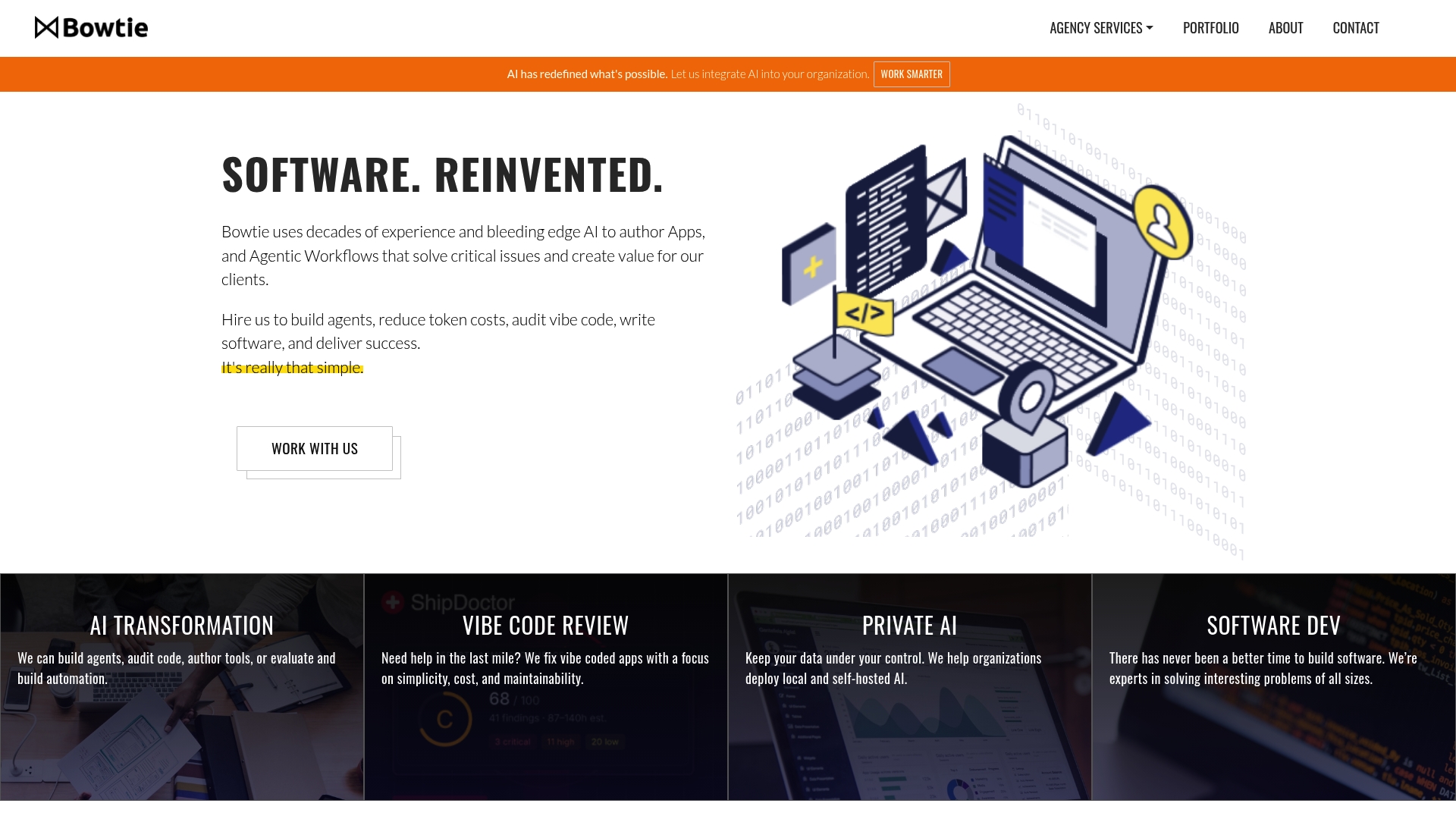
Bowtie’s AI Agent Creation & Workflow Automation work covers exactly the layered approach this guide describes: picking the right orchestration runtime, wiring in observability, and hardening the result for production traffic. If you’ve already got an agent running and just need a second set of eyes, a Senior Developer Review starting at $449 will surface the idempotency gaps and security holes before your users do. For teams weighing whether AI-assisted development is worth the investment at all, the productivity gains agencies report from applying AI to their workflows are a useful reference point.
Whether you’re building your first agent or migrating one out of prototype limbo, the next step is the same: get a second, senior set of eyes on the code before it touches production. Book a review with Bowtie and find out exactly what’s still prototype-grade in your stack.
Sources
- Build and deploy an AI agent to Cloud Run using the Agent Development Kit (ADK) | Google Cloud Documentation
- LangGraph overview
- Microsoft Agent Framework
- The best AI agent frameworks in 2026
FAQ
What Are the Top AI Agent Frameworks in 2026?
The frameworks developers reach for most are LangGraph, LangChain, Microsoft Agent Framework, Google ADK, OpenAI Agents SDK, CrewAI, Mastra, Pydantic AI, Deep Agents, and LangSmith. Each fills a different role: some handle orchestration, some handle reasoning, and LangSmith handles observability, which is why pairing several of them usually beats picking just one.
What Are the Five Types of AI Agents?
Definitions vary across sources, but a common breakdown includes simple reflex agents, model-based reflex agents, goal-based agents, utility-based agents, and learning agents. Most production frameworks discussed here, LangGraph, CrewAI, and similar tools, are built to support goal-based and learning agent patterns rather than the simpler reflex categories.
Is ChatGPT an Agent or an LLM?
ChatGPT is a product built around a large language model, not an agent framework on its own. It becomes agentic when paired with tool access, memory, and multi-step planning, which is exactly the gap frameworks like the OpenAI Agents SDK, LangGraph, and Deep Agents are built to fill.
What Are the Top Five AI Agents People Use Today?
Rather than five specific agent products, most production use falls into recognizable categories: customer support triage agents, research and document synthesis agents, internal workflow automation agents, coding assistants, and e-commerce operations agents. The framework underneath each of these, whether LangGraph, CrewAI, or Microsoft Agent Framework, matters more than any single branded agent product.
Should I Choose CrewAI or LangGraph for a New Project?
CrewAI is faster to prototype with because of its role-based mental model, while LangGraph gives you finer control over state, checkpointing, and resume behavior. Teams weighing CrewAI vs AutoGen or CrewAI vs LangGraph for anything beyond a demo usually find LangGraph’s durability wins out once real users and real failures enter the picture.