
Agentic workflows combine autonomous AI agents with orchestrated execution logic so software systems can take goal-directed action, not just generate text. The payoff is real: repetitive, judgment-heavy engineering work like triage, log analysis, and PR review can run with far
less manual effort. The catch is just as real. Without guardrails, cost caps, and observability, these systems become unpredictable fast, and “autonomous” turns into “unaccountable.”
TL;DR:
- Most agentic workflows should start as sequential processes to simplify debugging and gradually introduce concurrency once trust in individual agents is established.
- Implement strict guardrails such as identity propagation, sandboxing, and validation pipelines to ensure accountability and prevent unintentional system behavior.
- Cost management requires setting explicit inference budgets, monitoring token usage, and designing workflows to handle partial failures and retries reliably.
- Security measures include individual agent credentials, full audit trails, and validation of outputs to support compliance and traceability.
- Adopting agentic workflows for low-stakes, ambiguous tasks improves efficiency, but overapplication without proven judgment trust risks unnecessary complexity and safety issues.
Table of Contents
- What Are Agentic Workflows, and What Do They Look Like in Practice?
- What Are the Core Components of an Agentic Workflow?
- Which Orchestration Pattern Fits Your Agentic Workflow?
- What Security Guardrails Do Agentic Workflows Require?
- How Do You Run Agentic Workflows Reliably in Production?
- What Do Real Agentic Workflow Examples Look Like?
- How Should Teams Adopt Agentic Workflows?
- Bowtie’s Experience Building Agentic Workflows That Ship
- How Did Agentic Workflows Evolve?
- What Challenges Limit Agentic Workflows Today?
- What Are the Best Practices for Scalable Agentic Workflows?
- Where Are Agentic Workflow Technologies Headed?
- When Do Agentic Workflows Actually Make Sense?
- How Bowtie Helps Teams Build and Operate Agentic Workflows
- Selected Resources for Deeper Technical Detail
- Sources
- FAQ
What Are Agentic Workflows, and What Do They Look Like in Practice?
An agentic workflow is a sequence of steps where at least one AI agent decides how to act, not just what to generate. Instead of a script that runs the same three commands every time, an agent reads context, evaluates options, and picks a path toward a goal. The workflow around it constrains what that agent is allowed to touch.
You’ve probably already sketched something like this without naming it. A few examples that show up constantly in real engineering orgs:
- Issue triage and labeling: an agent reads a new GitHub issue, classifies severity, applies labels, and routes it to the right team channel.
- CI failure diagnosis: an agent parses failing test logs, isolates the likely cause, and drafts a suggested fix as a pull request comment.
- Documentation upkeep: an agent scans merged PRs for API changes and flags or drafts corresponding doc updates.
- Test coverage improvement: an agent identifies untested code paths and generates candidate test cases for review.
The line that separates this from ordinary automation matters. A cron job that restarts a failed pod is deterministic. It does one thing, every time, with no judgment involved. An agentic workflow, by contrast, reasons about ambiguous input, e.g., “is this log failure a flaky test or a real regression?”, and decides accordingly. That reasoning is the entire value proposition, and it’s also where the risk lives.
What Are the Core Components of an Agentic Workflow?
Every production agentic system, regardless of vendor or framework, breaks down into the same functional pieces. Understanding this breakdown is what separates teams that ship something durable from teams that ship a fragile demo.
- Agents. Each agent should own one narrow responsibility, e.g., “classify this ticket” rather than “handle all support.” Single-responsibility agents are easier to test, easier to audit, and less likely to hallucinate their way into scope creep. Manager agents sit above them, delegating subtasks and aggregating results.
- Model engines. The layer that actually calls the LLM. Keep credentials and provider logic here, isolated from the agent’s reasoning code, so swapping models doesn’t mean rewriting business logic.
- Tool adapters. Controlled interfaces agents use to act on the world, e.g., “create a PR,” “post a Slack message.” Adapters enforce the safe-outputs pattern: every write action gets validated before it executes, not after.
- Orchestrator / workflow engine. The layer that sequences steps, manages state handoffs, and enforces permissions.
- Durable state and memory. Long-running agent loops need externalized state, often via a model-context server, so a crash mid-run doesn’t erase progress.
- Workflow configuration. Frontmatter defining triggers, permission scopes, and inference caps, compiled into a hardened, reviewable workflow definition rather than freeform agent instructions.
Design best practices consistently point toward tool-first design and separating workflow logic from the model layer entirely, which is exactly what production-grade agentic AI guidance recommends for teams moving past the prototype stage.
Which Orchestration Pattern Fits Your Agentic Workflow?
Pattern choice determines your latency, your token bill, and how predictable your outputs are. Get this wrong and you either overpay for compute or ship something too rigid to be useful.
- Sequential: Agent A’s output feeds Agent B, feeds Agent C. Best for pipelines where order matters, like “extract requirements, then generate code, then run validation.” Predictable but slow, since nothing runs in parallel.
- Concurrent: Multiple agents work the same problem simultaneously, and results get aggregated. Good for parallel analysis, e.g., three agents independently reviewing a PR for security, performance, and style. Faster wall-clock time, but token spend can spike since you’re running N model calls instead of one.
- Handoff: One agent recognizes a task is outside its scope and passes control to a specialist agent. Useful when a triage agent needs to escalate to a debugging specialist.
- Manager / magnetic: A coordinating agent dynamically assigns subtasks to worker agents based on the situation, rather than following a fixed script. Fits complex, unpredictable workloads like incident response.
Vendor architecture guidance from Microsoft confirms this trade-off directly: concurrent patterns raise throughput but can spike inference consumption, while sequential patterns cap concurrency in exchange for predictability. Most production systems don’t pick one pattern and stop. They mix sequential steps for the parts that must happen in order with concurrent sub-tasks for the parts that don’t.
Pro Tip: Start every new agentic workflow sequentially, even if concurrency looks tempting. It’s far easier to spot which step is misbehaving when steps run one at a time. Add parallelism only once you trust the individual agents.
What Security Guardrails Do Agentic Workflows Require?
Autonomous action without accountability is a liability, not a feature. Every agent action needs to trace back to a defined identity with defined limits, the same way you’d never give a junior engineer root access “just in case.”
- Least-privilege identity propagation. Each agent runs under its own credential scope, not a shared service account, so every action is individually auditable. Agentic orchestration research points to identity propagation as a foundational control, not an afterthought.
- Sandboxed execution. Agents that run code or touch infrastructure should do it in isolated environments with no direct path to production credentials.
- Safe-outputs validation. Every write action, PR, deployment, ticket update, passes through a validation pipeline before it executes, catching malformed or dangerous output before it lands.
- Audit trails. Full traces of agent reasoning, tool calls, and decisions, stored durably enough to reconstruct what happened after the fact.
Orchestration platforms increasingly position themselves as the system of record for agent activity, persisting every decision and tool call so teams can replay and audit runs after something goes wrong. That auditability is often the difference between a workflow you can defend to a compliance team and one you can’t. For a deeper breakdown of identity scoping and sandbox design, see Bowtie’s agent security playbook.
How Do You Run Agentic Workflows Reliably in Production?
Reliability here doesn’t mean the agent is always right; integrating AI automation workflows that drive agency growth can help build more reliable production systems. It means the system fails predictably and recovers cleanly when the agent is wrong.
- Build correlated observability first. Every agent run should carry trace IDs, prompt versions, and model metadata so you can reconstruct exactly what happened, not just that something happened. Bowtie’s observability guidance covers the tracing setup teams tend to skip early and regret later.
- Design for failure, not just success. Durable checkpoints let a long-running agent loop resume after a crash instead of starting over. Idempotent tool calls mean a retry doesn’t duplicate a PR or double-post a ticket.
- Control concurrency and cost explicitly. Set hard inference budgets per workflow run, batch calls where possible, and monitor spend the way you’d monitor any other infrastructure cost.
- Test before you trust. Canary a new agent version against a small percentage of traffic. Run integration tests against known-bad inputs. Validate continuously, since model behavior drifts even when your code doesn’t.
Common enterprise concerns cluster around exactly these three areas: cost management, agent trace monitoring, and robust retry mechanisms for long-running or interrupted work.
Pro Tip: Track a single “agentic inference cost” metric per workflow, not just aggregate API spend. A workflow that quietly triples its token usage after a prompt tweak is nearly invisible in a general billing dashboard.
What Do Real Agentic Workflow Examples Look Like?
Three sketches map cleanly onto stacks most engineering teams already run.
- Repo triage pipeline. Trigger: new issue opened. An agent analyzes the description, checks for duplicates, applies labels, and drafts a suggested PR if the fix is trivial. Human review gates any merge. Integrations: your VCS and ticketing system.
- CI failure investigator. Trigger: build fails. An agent parses test logs, isolates the failing assertion, reruns a targeted subset of tests, and proposes a fix as a PR comment. Integrations: CI provider, VCS. Safety gate: no auto-merge, ever.
- Incident remediation orchestration. Trigger: monitoring alert fires. An agent diagnoses probable cause from metrics and logs, then either triggers an automated rollback within pre-approved bounds or escalates to an on-call engineer. Integrations: monitoring stack, deployment system, alerting. Safety gate: rollback scope is explicitly capped in advance.
Each example shares a spine: a narrow trigger, a bounded agent task, and a human or hard-coded checkpoint before anything irreversible happens.
How Should Teams Adopt Agentic Workflows?
- Pick one narrow pilot with a measurable success metric, e.g., “reduce triage time by a meaningful amount each week,” not “automate support.”
- Define guardrails up front: what counts as a safe output, and what always requires human sign-off.
- Set an inference budget and stand up a monitoring dashboard before the pilot goes live, not after.
- Assign clear owners: a workflow owner, a security reviewer, and an SRE responsible for operational health.
- Move through pilot, evaluation, hardening, then progressive rollout. Skipping the hardening step is how teams end up with a “temporary” agent running unmonitored in production for a year.
For teams weighing build versus integrate decisions at this stage, Bowtie’s AI workflow integration guide walks through the decision points in more detail.
Bowtie’s Experience Building Agentic Workflows That Ship
We’ve built agentic workflows for clients ranging from the NFL to early-stage startups, and the pattern holds regardless of scale: the pilot is easy, production is where teams get stuck. Bowtie’s engagements typically start with a code audit to understand what’s actually running, move into a scoped pilot with real guardrails, and end with a handoff that includes ongoing support, not a “good luck” email. Our AI workflow automation service covers that full arc: clean, secure, production-ready code with support that doesn’t disappear after launch.
How Did Agentic Workflows Evolve?
Agentic workflows didn’t appear fully formed. They’re the third act in a longer story about automating engineering judgment.
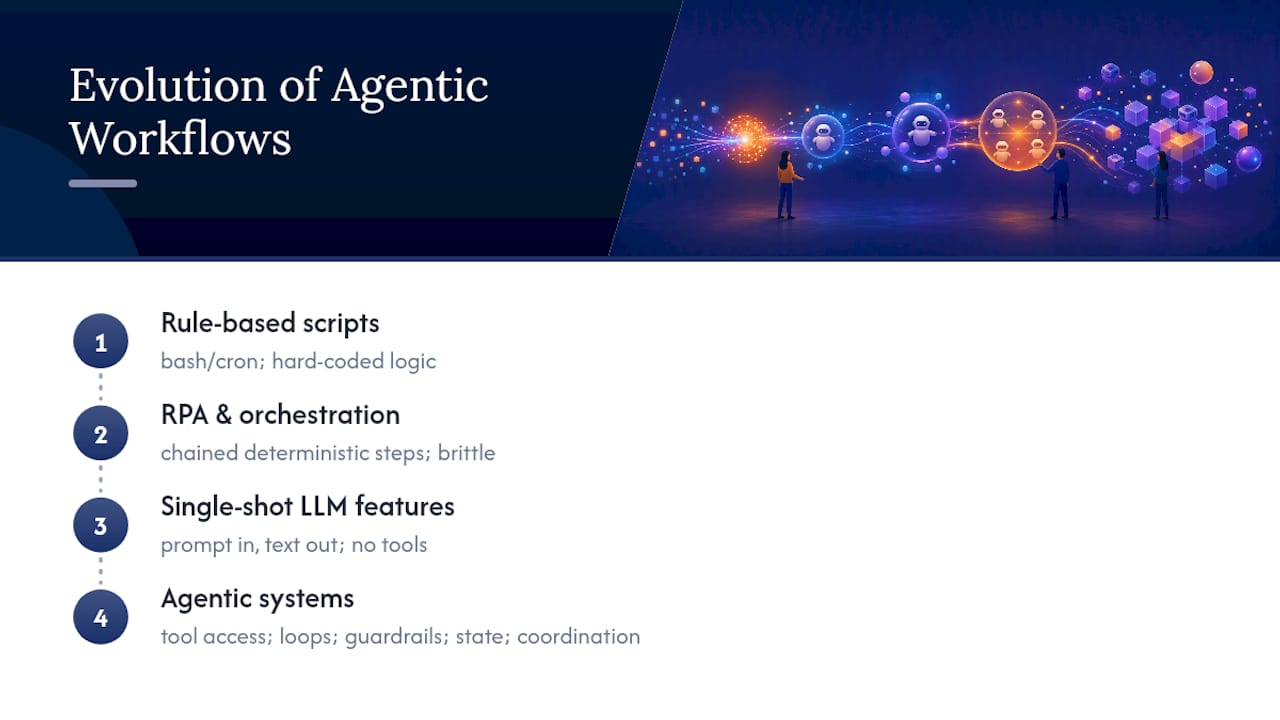
Rule-based scripts came first: bash jobs, cron tasks, deterministic CI steps. They worked because the logic was simple enough to hard-code. Then came robotic process automation and workflow orchestration tools that chained deterministic steps together, e.g., “if build fails, notify Slack.” Useful, but brittle the moment a task required interpretation rather than pattern-matching.
Large language models changed the calculus. Once a model could read unstructured context, e.g., a stack trace, a vague bug report, and produce a reasonable judgment, it became possible to hand that judgment to software instead of a human. Early implementations were single-shot: prompt in, text out, no memory, no tool access. That’s where a lot of “AI features” still live today.
The shift to genuinely agentic systems happened when models gained tool access and multi-step reasoning loops, letting an agent take an action, observe the result, and adjust, rather than producing one answer and stopping. Orchestration frameworks followed close behind, adding the guardrails, state management, and multi-agent coordination that turn a clever demo into something a team can actually run unattended. Camunda and similar platforms extending deterministic orchestration into agentic territory reflects how recent this maturation is. Most of the tooling engineers rely on today didn’t exist three years ago.
What Challenges Limit Agentic Workflows Today?
The honest failure modes matter more than the marketing promises. A few show up in nearly every team’s first serious attempt.
Hallucination compounds across steps. A single wrong inference in a five-step chain doesn’t stay contained. It propagates, and the final output can look confident while being built on a false premise from step two. Multi-agent patterns help by isolating reasoning into smaller, checkable units, but they don’t eliminate the risk entirely.
Cost is harder to predict than with traditional software. A workflow that costs pennies per run in testing can balloon once real-world inputs trigger longer reasoning chains or retries. Teams that skip explicit inference budgets tend to discover this the expensive way.
Debugging is fundamentally different. You can’t just read the code to know what happened; you need the full trace of prompts, tool calls, and intermediate reasoning. Teams without observability infrastructure end up debugging by guesswork.
Overreach is common. The temptation to let one agent handle “everything” instead of scoping it narrowly is a well-documented anti-pattern, and it’s usually paired with missing audit traces and write actions that skip pre-write validation, exactly the conditions that make a system brittle and risky.
Human trust takes time to earn. Engineers who’ve been burned by a confidently wrong agent output tend to over-correct into manual review of everything, which defeats the purpose. Calibrating the right amount of human-in-the-loop oversight is an ongoing tuning problem, not a one-time setup task.
What Are the Best Practices for Scalable Agentic Workflows?
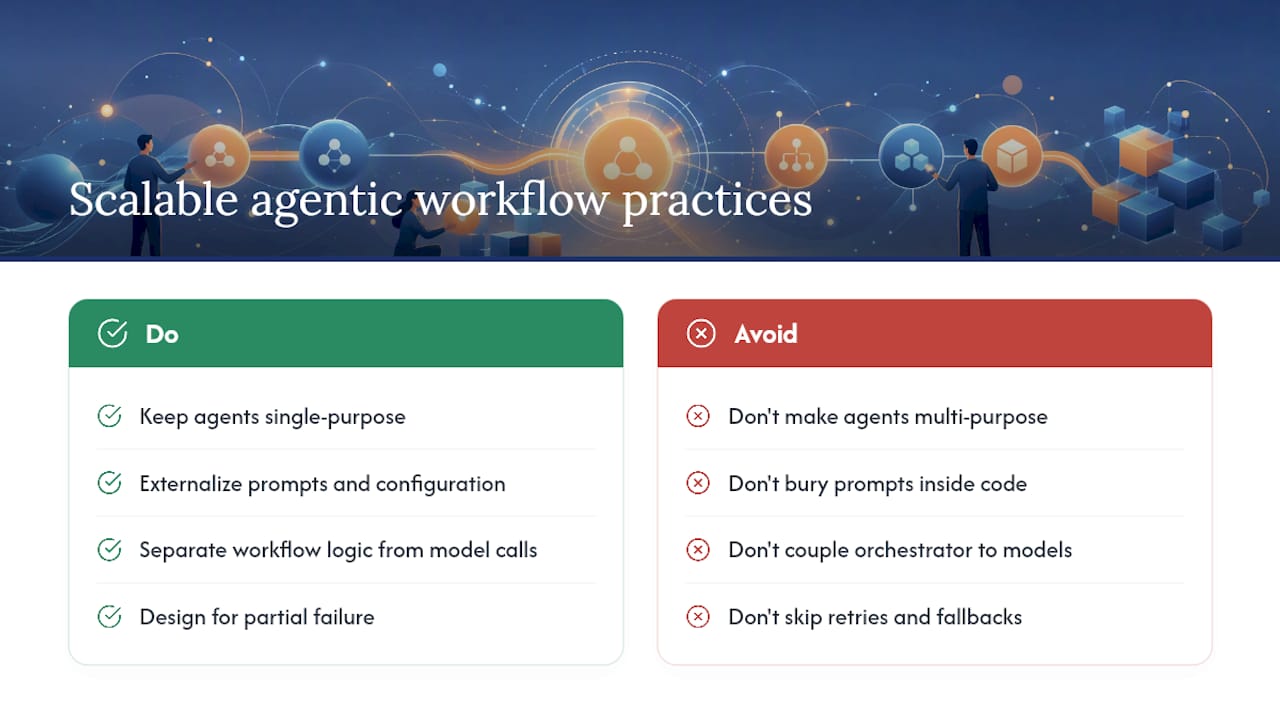
Scalability in agentic systems isn’t about handling more traffic. It’s about the system staying comprehensible as it grows, so a workflow with fifteen agents is still debuggable by the person who didn’t write it.
Keep agents single-purpose. An agent that does one thing well is testable in isolation. An agent that does five things is testable only as a black box, and black boxes are where production incidents hide.
Externalize prompts and configuration. Prompt text buried inside application code means every tweak requires a full deployment. Externalized prompt management lets you iterate on agent behavior without touching the codebase, which production guidance treats as a core design principle rather than a nice-to-have.
Separate workflow logic from model calls. The orchestrator should never need to know which model is answering a given step. That separation is what lets you swap providers or fall back to a cheaper model under load without rewriting your pipeline.
Design for partial failure. Assume any given agent call will occasionally fail, time out, or return garbage. Build retry logic and fallback paths as a default, not an exception handler bolted on after an incident.
Batch where reasoning allows it. Concurrent execution scales throughput, but only if you’ve built an aggregation strategy for combining parallel results. Skipping that step is how teams end up with three agents producing three conflicting answers and no tiebreaker.
Instrument before you scale, not after. Adding tracing to a five-agent system already running in production is far harder than building it in from agent one.
Teams that treat these as sequencing decisions, not just technical checkboxes, tend to move from pilot to durable production system without the painful mid-project rewrite.
Where Are Agentic Workflow Technologies Headed?
A few directions are already visible in how orchestration vendors and framework maintainers are building right now.
Orchestration is absorbing more governance responsibility. Platforms are increasingly built to function as the system of record for agent activity, not just a task scheduler. Expect audit and compliance features that once required bolted-on tooling to become native orchestration capabilities.
Standardized model-context protocols are maturing. Externalizing state and prompt scaffolding to dedicated context servers, rather than baking it into agent runtime code, is becoming the default architecture rather than an advanced pattern reserved for large teams.
Cost-aware orchestration is coming. Today, most teams manually cap inference budgets. Expect orchestrators to natively support dynamic model routing, e.g., routing a simple classification task to a cheap model and an ambiguous edge case to a stronger one, automatically.
Multi-agent coordination is standardizing. The handoff and manager patterns that currently require custom implementation are becoming built-in orchestration primitives, lowering the engineering lift required to run genuinely dynamic, delegation-based systems.
Verification layers are getting more sophisticated. Pre-write validation is currently mostly custom logic. Expect more standardized, pluggable safe-output verification, closer to how linters became a standard CI step rather than a custom script every team wrote from scratch.
None of this removes the need for the guardrails covered earlier. If anything, better tooling raises the bar for what “production-ready” means, not lowers it.
When Do Agentic Workflows Actually Make Sense?
Agentic workflows earn their complexity when the task involves genuine ambiguity, triage, diagnosis, judgment calls, not when it’s just repetitive. If a deterministic script can already do it reliably, adding an agent only adds risk and cost for no real gain.
The most common overreach I see is teams reaching for a fully autonomous, no-human-in-the-loop design before they’ve proven the agent’s judgment is trustworthy on narrow, low-stakes tasks first. Start narrow, keep a human checkpoint on anything irreversible, and expand scope only once the failure modes are boring and well understood. Boring failures are a good sign. Surprising ones mean you scaled too fast.
— Chad
How Bowtie Helps Teams Build and Operate Agentic Workflows
Bowtie is the alternative to hiring a full in-house AI platform team just to get one agentic workflow into production. Instead of months spent building orchestration infrastructure from scratch, you get an engineering partner who’s already solved the guardrails, observability, and cost-control problems this article just walked through.
Most engagements start the same way: a code audit to see what’s actually running today, followed by a scoped pilot built around one real bottleneck, whether that’s CI triage, ticket routing, or incident response. From there, Bowtie handles the hardening work, permissions, retry logic, monitoring, that separates a pilot from something safe to leave running unattended. Support doesn’t end at launch either; ongoing maintenance keeps workflows working as models and dependencies shift underneath them.
If you’re ready to move past the whiteboard stage, start with Bowtie’s AI integration services and scope a pilot around the workflow costing your team the most manual hours right now.
Selected Resources for Deeper Technical Detail
For engineers who want the underlying research: the practical guide to production-grade agentic AI covers engineering checklists in depth, Microsoft’s orchestration pattern guide breaks down pattern trade-offs, and Camunda’s agentic orchestration overview explains enterprise governance models. Each link goes directly to the source material.
Sources
- A Practical Guide for Designing, Developing, and Deploying Production-Grade Agentic AI Workflows
- AI Agent Orchestration Patterns - Azure Architecture Center | Microsoft Learn
- From Workflow Orchestration to Agentic Orchestration
- Agentic orchestration | Camunda
FAQ
What Is an Agentic Workflow?
An agentic workflow is a process where one or more AI agents make autonomous decisions and take actions toward a goal, operating inside an orchestration layer that enforces permissions, guardrails, and audit logging.
Is ChatGPT an Agentic AI?
Standard ChatGPT conversation is not agentic on its own since it just responds to prompts. It becomes part of an agentic workflow only when connected to tools, memory, and an orchestrator that lets it take actions and observe results across multiple steps.
What Is an Example of an Agentic Workflow?
A CI failure investigator is a common example: an agent parses failing test logs, reruns a targeted subset of tests, isolates the likely cause, and drafts a suggested fix for human review before anything merges.
What Is the Difference Between Agentic and Non-Agentic Workflows?
Non-agentic automation, like a cron job or a fixed CI script, executes the same deterministic steps every time with no judgment involved. Agentic workflows reason about ambiguous input and choose a path, which is what makes them useful for triage and diagnosis but also why they need tighter guardrails than a simple script.
How Do I Get Started With Agentic Workflows Without Overbuilding?
Pick one narrow, measurable pilot, define what counts as a safe output before you launch, and pair it with monitoring from day one. Bowtie’s AI workflow automation guide walks through the full pilot-to-production path if you want a structured starting point.